




Find the equation of the circle passing through $ \left( 0,0 \right) $ and making intercepts $ a $ and $ b $ on the coordinate axes.
Answer
 Verified
601.5k+ views
Hint: We denote the centre of the circle as $ C\left( h,k \right) $ and radius $ OA=r $ where O is the origin. We use given intercepts $ a,b $ and find the coordinates of $ A,B $ where $ x- $ and $ y- $ axis cut the circle excluding O. We put the coordinates of $ A,B,O $ in the equation of the circle in centre-radius to express $ h,k,{{r}^{2}} $ in terms of $ a,b $ . We put the expressions in $ a,b $ centre-radius equation of circle to get the required.
Complete step-by-step answer:
Let us denote the centre of the given circle in the question as $ C\left( h,k \right) $ and the radius as $ OA=r $ where O is the origin. Let $ x- $ axis cut circle excluding the origin at A and $ y- $ axis cut circle excluding the origin at B . So we have obtained the $ x- $ intercept OA and $ y- $ intercept OB. We are given i the question that $ a $ and $ b $ are length of the intercept. We assign
\[OA=a,OB=b\]
So the co-ordinates of A and B are given by $ A\left( a,0 \right),B\left( 0,b \right) $ . \[\]
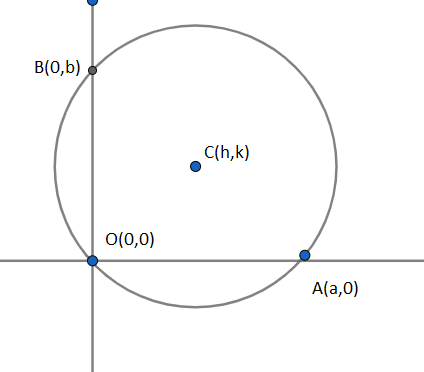
We write the equation of the circle in centre radius form as
\[{{\left( x-h \right)}^{2}}+{{\left( y-k \right)}^{2}}={{r}^{2}}......\left( 1 \right)\]
The circle (1) passes through origin $ O\left( 0,0 \right) $ and so $ O\left( 0,0 \right) $ will satisfy equation of circle (1). So we have,
\[\begin{align}
& {{\left( 0-h \right)}^{2}}+{{\left( 0-k \right)}^{2}}={{r}^{2}}. \\
& \Rightarrow {{h}^{2}}+{{k}^{2}}={{r}^{2}}......\left( 2 \right) \\
\end{align}\]
The circle (1) passes through origin $ A\left( a,0 \right) $ and so $ A\left( a,0 \right) $ will satisfy equation of circle (1). So we have,
\[\begin{align}
& {{\left( a-h \right)}^{2}}+{{\left( 0-k \right)}^{2}}={{r}^{2}}. \\
& \Rightarrow {{a}^{2}}-2ah+{{h}^{2}}+{{k}^{2}}={{r}^{2}} \\
& \Rightarrow {{a}^{2}}-2ah+{{r}^{2}}={{r}^{2}}\left( \because {{h}^{2}}+{{k}^{2}}={{r}^{2}} \right) \\
& \Rightarrow a\left( a-2h \right)=0 \\
\end{align}\]
So we have $ a=0 $ or $ h=\dfrac{a}{2} $ . If $ a=0 $ the point is on $ x- $ axis and we reject the value. So the $ x- $ coordinate of the centre is $ h=\dfrac{a}{2} $ .
The circle (1) passes through origin $ B\left( 0,b \right) $ and so $ A\left( 0,b \right) $ will satisfy equation of circle (1). So we have,
\[\begin{align}
& {{\left( 0-h \right)}^{2}}+{{\left( b-k \right)}^{2}}={{r}^{2}}. \\
& \Rightarrow {{h}^{2}}+{{b}^{2}}-2kb+{{k}^{2}}={{r}^{2}} \\
& \Rightarrow {{b}^{2}}-2kb+{{r}^{2}}={{r}^{2}}\left( \because {{h}^{2}}+{{k}^{2}}={{r}^{2}} \right) \\
& \Rightarrow b\left( b-2k \right)=0 \\
\end{align}\]
So we have $ b=0 $ or $ k=\dfrac{b}{2} $ . If $ b=0 $ the point is on $ y- $ axis and we reject the value. So the $ y- $ coordinate of the centre is $ k=\dfrac{b}{2} $ . Let us put the value of $ h=\dfrac{a}{2},k=\dfrac{b}{2} $ in the equation (2) and find $ {{r}^{2}} $ . We have
\[\begin{align}
& {{\left( \dfrac{a}{2} \right)}^{2}}+{{\left( \dfrac{b}{2} \right)}^{2}}={{r}^{2}} \\
& \Rightarrow {{r}^{2}}=\dfrac{{{a}^{2}}+{{b}^{2}}}{4} \\
\end{align}\]
We put the obtained values of $ h,k,{{r}^{2}} $ in equation(1) and have
\[\begin{align}
& {{\left( x-\dfrac{a}{2} \right)}^{2}}+{{\left( y-\dfrac{b}{2} \right)}^{2}}=\dfrac{{{a}^{2}}+{{b}^{2}}}{4} \\
& \Rightarrow {{x}^{2}}-ax+\dfrac{{{a}^{2}}}{4}+{{y}^{2}}-bx+\dfrac{{{b}^{2}}}{4}=\dfrac{{{a}^{2}}+{{b}^{2}}}{4} \\
& \Rightarrow {{x}^{2}}-ax+{{y}^{2}}-bx+\dfrac{{{a}^{2}}+{{b}^{2}}}{4}=\dfrac{{{a}^{2}}+{{b}^{2}}}{4} \\
& \Rightarrow {{x}^{2}}-ax+{{y}^{2}}-bx=0 \\
\end{align}\]
The above equation is the required equation of the circle. \[\]
Note: We can also proceed to find the equation of the circle with $ x- $ intercept as $ b $ and h $ y- $ intercept as $ a $ and get the equation as $ {{x}^{2}}-bx+{{y}^{2}}-ay=0 $ . The general equation of circle in two variables is given by $ {{x}^{2}}+{{y}^{2}}+2gx+2fy+c=0 $ for real numbers $ f,g,c $ which simultaneously cannot be zero and $ {{g}^{2}}+{{f}^{2}} > c $ .
Complete step-by-step answer:
Let us denote the centre of the given circle in the question as $ C\left( h,k \right) $ and the radius as $ OA=r $ where O is the origin. Let $ x- $ axis cut circle excluding the origin at A and $ y- $ axis cut circle excluding the origin at B . So we have obtained the $ x- $ intercept OA and $ y- $ intercept OB. We are given i the question that $ a $ and $ b $ are length of the intercept. We assign
\[OA=a,OB=b\]
So the co-ordinates of A and B are given by $ A\left( a,0 \right),B\left( 0,b \right) $ . \[\]
We write the equation of the circle in centre radius form as
\[{{\left( x-h \right)}^{2}}+{{\left( y-k \right)}^{2}}={{r}^{2}}......\left( 1 \right)\]
The circle (1) passes through origin $ O\left( 0,0 \right) $ and so $ O\left( 0,0 \right) $ will satisfy equation of circle (1). So we have,
\[\begin{align}
& {{\left( 0-h \right)}^{2}}+{{\left( 0-k \right)}^{2}}={{r}^{2}}. \\
& \Rightarrow {{h}^{2}}+{{k}^{2}}={{r}^{2}}......\left( 2 \right) \\
\end{align}\]
The circle (1) passes through origin $ A\left( a,0 \right) $ and so $ A\left( a,0 \right) $ will satisfy equation of circle (1). So we have,
\[\begin{align}
& {{\left( a-h \right)}^{2}}+{{\left( 0-k \right)}^{2}}={{r}^{2}}. \\
& \Rightarrow {{a}^{2}}-2ah+{{h}^{2}}+{{k}^{2}}={{r}^{2}} \\
& \Rightarrow {{a}^{2}}-2ah+{{r}^{2}}={{r}^{2}}\left( \because {{h}^{2}}+{{k}^{2}}={{r}^{2}} \right) \\
& \Rightarrow a\left( a-2h \right)=0 \\
\end{align}\]
So we have $ a=0 $ or $ h=\dfrac{a}{2} $ . If $ a=0 $ the point is on $ x- $ axis and we reject the value. So the $ x- $ coordinate of the centre is $ h=\dfrac{a}{2} $ .
The circle (1) passes through origin $ B\left( 0,b \right) $ and so $ A\left( 0,b \right) $ will satisfy equation of circle (1). So we have,
\[\begin{align}
& {{\left( 0-h \right)}^{2}}+{{\left( b-k \right)}^{2}}={{r}^{2}}. \\
& \Rightarrow {{h}^{2}}+{{b}^{2}}-2kb+{{k}^{2}}={{r}^{2}} \\
& \Rightarrow {{b}^{2}}-2kb+{{r}^{2}}={{r}^{2}}\left( \because {{h}^{2}}+{{k}^{2}}={{r}^{2}} \right) \\
& \Rightarrow b\left( b-2k \right)=0 \\
\end{align}\]
So we have $ b=0 $ or $ k=\dfrac{b}{2} $ . If $ b=0 $ the point is on $ y- $ axis and we reject the value. So the $ y- $ coordinate of the centre is $ k=\dfrac{b}{2} $ . Let us put the value of $ h=\dfrac{a}{2},k=\dfrac{b}{2} $ in the equation (2) and find $ {{r}^{2}} $ . We have
\[\begin{align}
& {{\left( \dfrac{a}{2} \right)}^{2}}+{{\left( \dfrac{b}{2} \right)}^{2}}={{r}^{2}} \\
& \Rightarrow {{r}^{2}}=\dfrac{{{a}^{2}}+{{b}^{2}}}{4} \\
\end{align}\]
We put the obtained values of $ h,k,{{r}^{2}} $ in equation(1) and have
\[\begin{align}
& {{\left( x-\dfrac{a}{2} \right)}^{2}}+{{\left( y-\dfrac{b}{2} \right)}^{2}}=\dfrac{{{a}^{2}}+{{b}^{2}}}{4} \\
& \Rightarrow {{x}^{2}}-ax+\dfrac{{{a}^{2}}}{4}+{{y}^{2}}-bx+\dfrac{{{b}^{2}}}{4}=\dfrac{{{a}^{2}}+{{b}^{2}}}{4} \\
& \Rightarrow {{x}^{2}}-ax+{{y}^{2}}-bx+\dfrac{{{a}^{2}}+{{b}^{2}}}{4}=\dfrac{{{a}^{2}}+{{b}^{2}}}{4} \\
& \Rightarrow {{x}^{2}}-ax+{{y}^{2}}-bx=0 \\
\end{align}\]
The above equation is the required equation of the circle. \[\]
Note: We can also proceed to find the equation of the circle with $ x- $ intercept as $ b $ and h $ y- $ intercept as $ a $ and get the equation as $ {{x}^{2}}-bx+{{y}^{2}}-ay=0 $ . The general equation of circle in two variables is given by $ {{x}^{2}}+{{y}^{2}}+2gx+2fy+c=0 $ for real numbers $ f,g,c $ which simultaneously cannot be zero and $ {{g}^{2}}+{{f}^{2}} > c $ .
Recently Updated Pages
Master Class 11 English: Engaging Questions & Answers for Success

Master Class 11 Maths: Engaging Questions & Answers for Success
Class 11 Question and Answer - Your Ultimate Solutions Guide
Master Class 11 Biology: Engaging Questions & Answers for Success
Master Class 11 Physics: Engaging Questions & Answers for Success
Master Class 11 Accountancy: Engaging Questions & Answers for Success
Trending doubts
There are 720 permutations of the digits 1 2 3 4 5 class 11 maths CBSE
In what year Guru Nanak Dev ji was born A15 April 1469 class 11 social science CBSE
1 Quintal is equal to a 110 kg b 10 kg c 100kg d 1000 class 11 physics CBSE
10 examples of friction in our daily life
Explain zero factorial class 11 maths CBSE
When guru nanak ji was born in 1469 AD according to class 11 social studies CBSE