




Find the equation of tangent and normal for the given curves at point P.
i) ${x^2} + {y^2} + xy = 3$ at P ( 1 , 1 )
ii) $\sqrt x - \sqrt y = 1$ at P ( 9 , 4 )
Answer
 Verified
582.3k+ views
Hint: Tangent and normal on the given point can be calculated using following steps:
i) Differentiate both sides with respect to x
ii) Substitute the given coordinates ( x , y ) in the equation obtained in i)
iii) Let $\dfrac{{dy}}{{dx}} = m$ which will give us the slope.
\[Slope{\text{ }}of{\text{ }}normal{\text{ }} = - \dfrac{1}{{Slope{\text{ }}of{\text{ tangent }}}}\] = $ - \dfrac{1}{m}$
Required equation of normal or tangent :
$\left( {y - {y_1}} \right) = m\left( {x - {x_1}} \right)$ where,
${x_1}$ and ${y_1}$ are the coordinates of the point and m is the slope.
Complete step-by-step answer:
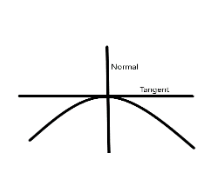
Equation of normal or tangent is given as:
$\left( {y - {y_1}} \right) = m\left( {x - {x_1}} \right)$ __________ (1)
i) Given equation is ${x^2} + {y^2} + xy = 3$
Differentiating both sides with respect to x :
$\Rightarrow 2x + 2y\dfrac{{dy}}{{dx}} + y(1) + x\dfrac{{dy}}{{dx}} = 0$
Let $\dfrac{{dy}}{{dx}} = m$ (Slope), the equation becomes:
$\Rightarrow$ 2x + 2ym + y + mx = 0
Now given point is P ( 1 , 1 )
comparing it with ( x , y ); x = 1 and y = 1
By substitution, we get:
$\Rightarrow$ 2.(1) + 2.(1).m + (1).(1) + m.(1) = 0
3m + 3 = 0
3m = -3
m = -1
From (1), we have:
$\left( {y - {y_1}} \right) = m\left( {x - {x_1}} \right)$
${y_1}$ = 1 [coordinates of P = (1 , 1) ]
${x_1}$ = 1
m = -1
Substituting, we get:
$\Rightarrow$ (y – 1) = -1 (x – 1)
y – 1 = -x + 1
x + y – 2 = 0 [rearranging]
Therefore, the equation of the tangent for the curve is x + y – 2 = 0
For normal, the slope is :
$ - \dfrac{1}{m}$ = $ - \dfrac{1}{{( - 1)}}$
m = 1 for same pair of coordinates, thus substituting the values, we get:
(y – 1) = 1 (x – 1)
y – 1 = x – 1
x – y = 0 [rearranging]
Therefore, the equation of the normal for the curve is x -y = 0
ii) Given equation is $\sqrt x - \sqrt y = 1$
It can be written as: ${(x)^{\dfrac{1}{2}}} + {(y)^{\dfrac{1}{2}}} = 1$
Differentiating both sides with respect to x :
$\Rightarrow \dfrac{1}{2}{(x)^{ - \dfrac{1}{2}}} + \dfrac{1}{2}{(y)^{ - \dfrac{1}{2}}}\dfrac{{dy}}{{dx}} = 0$
Let $\dfrac{{dy}}{{dx}} = m$ (Slope), the equation becomes:
$\Rightarrow \dfrac{1}{2}{(x)^{ - \dfrac{1}{2}}} + \dfrac{1}{2}{(y)^{ - \dfrac{1}{2}}}m = 0$
\[\dfrac{1}{2} \times \dfrac{1}{{{{(x)}^{\dfrac{1}{2}}}}} + \dfrac{1}{2} \times \dfrac{1}{{{{(y)}^{\dfrac{1}{2}}}}}m = 0\]
Now given point is P ( 9 , 4 )
comparing it with ( x , y ); x = 9 and y = 4
By substitution, we get:
\[\Rightarrow \dfrac{1}{2} \times \dfrac{1}{{{{(9)}^{\dfrac{1}{2}}}}} + \dfrac{1}{2} \times \dfrac{1}{{{{(4)}^{\dfrac{1}{2}}}}}m = 0\]
$\left[ \because {(9)^{\dfrac{1}{2}}} = {\left( {{3^2}} \right)^{\dfrac{1}{2}}} = 3 {(4)^{\dfrac{1}{2}}} = {\left( {{2^2}} \right)^{\dfrac{1}{2}}} = 2 \right]$
\[\Rightarrow \dfrac{1}{2} \times \dfrac{1}{3} + \dfrac{1}{2} \times \dfrac{1}{2}m = 0\]
\[
\dfrac{1}{2} \times \dfrac{1}{2}m = - \left( {\dfrac{1}{2} \times \dfrac{1}{3}} \right)
m = - \dfrac{2}{3}
\]
From (1), we have:
$\left( {y - {y_1}} \right) = m\left( {x - {x_1}} \right)$
${y_1}$ = 4 [coordinates of P = (9 , 4) ]
${x_1}$ = 9
\[m = - \dfrac{2}{3}\]
Substituting, we get:
$
\Rightarrow \left( {y - 4} \right) = - \dfrac{2}{3}\left( {x - 9} \right)
3\left( {y - 4} \right) = - 2\left( {x - 9} \right)
3y - 12 = - 2x + 18
2x + 3y - 30 = 0
$ [Rearranging]
Therefore, the equation of the tangent for the curve is 2x + 3y – 30 = 0
For normal, the slope is :
$
- \dfrac{1}{m} = - \dfrac{1}{{\left( { - \dfrac{2}{3}} \right)}}
$
$m = \dfrac{3}{2}$ for same pair of coordinates, thus substituting the values, we get:
$
\Rightarrow \left( {y - 4} \right) = \dfrac{3}{2}\left( {x - 9} \right)
2\left( {y - 4} \right) = 3\left( {x - 9} \right)
2y - 8 = 3x - 27
3x - 2y - 19 = 0
$ [Rearranging]
Therefore, the equation of the normal for the curve is 3x – 2y – 19 = 0
Note: Points to remember while differentiating:
$\dfrac{d}{{dx}}({x^n}) = n{x^{n - 1}}$
Differentiation of a constant = 0
When another quantity is differentiated with respect to the other and the same quantity is differentiated with respect to itself, the cases are:
i) Differentiation of y with respect to x = $\dfrac{{dy}}{{dx}}$
ii) Differentiation of x with respect to x = $\dfrac{{dx}}{{dx}} = 1$
i) Differentiate both sides with respect to x
ii) Substitute the given coordinates ( x , y ) in the equation obtained in i)
iii) Let $\dfrac{{dy}}{{dx}} = m$ which will give us the slope.
\[Slope{\text{ }}of{\text{ }}normal{\text{ }} = - \dfrac{1}{{Slope{\text{ }}of{\text{ tangent }}}}\] = $ - \dfrac{1}{m}$
Required equation of normal or tangent :
$\left( {y - {y_1}} \right) = m\left( {x - {x_1}} \right)$ where,
${x_1}$ and ${y_1}$ are the coordinates of the point and m is the slope.
Complete step-by-step answer:
Equation of normal or tangent is given as:
$\left( {y - {y_1}} \right) = m\left( {x - {x_1}} \right)$ __________ (1)
i) Given equation is ${x^2} + {y^2} + xy = 3$
Differentiating both sides with respect to x :
$\Rightarrow 2x + 2y\dfrac{{dy}}{{dx}} + y(1) + x\dfrac{{dy}}{{dx}} = 0$
Let $\dfrac{{dy}}{{dx}} = m$ (Slope), the equation becomes:
$\Rightarrow$ 2x + 2ym + y + mx = 0
Now given point is P ( 1 , 1 )
comparing it with ( x , y ); x = 1 and y = 1
By substitution, we get:
$\Rightarrow$ 2.(1) + 2.(1).m + (1).(1) + m.(1) = 0
3m + 3 = 0
3m = -3
m = -1
From (1), we have:
$\left( {y - {y_1}} \right) = m\left( {x - {x_1}} \right)$
${y_1}$ = 1 [coordinates of P = (1 , 1) ]
${x_1}$ = 1
m = -1
Substituting, we get:
$\Rightarrow$ (y – 1) = -1 (x – 1)
y – 1 = -x + 1
x + y – 2 = 0 [rearranging]
Therefore, the equation of the tangent for the curve is x + y – 2 = 0
For normal, the slope is :
$ - \dfrac{1}{m}$ = $ - \dfrac{1}{{( - 1)}}$
m = 1 for same pair of coordinates, thus substituting the values, we get:
(y – 1) = 1 (x – 1)
y – 1 = x – 1
x – y = 0 [rearranging]
Therefore, the equation of the normal for the curve is x -y = 0
ii) Given equation is $\sqrt x - \sqrt y = 1$
It can be written as: ${(x)^{\dfrac{1}{2}}} + {(y)^{\dfrac{1}{2}}} = 1$
Differentiating both sides with respect to x :
$\Rightarrow \dfrac{1}{2}{(x)^{ - \dfrac{1}{2}}} + \dfrac{1}{2}{(y)^{ - \dfrac{1}{2}}}\dfrac{{dy}}{{dx}} = 0$
Let $\dfrac{{dy}}{{dx}} = m$ (Slope), the equation becomes:
$\Rightarrow \dfrac{1}{2}{(x)^{ - \dfrac{1}{2}}} + \dfrac{1}{2}{(y)^{ - \dfrac{1}{2}}}m = 0$
\[\dfrac{1}{2} \times \dfrac{1}{{{{(x)}^{\dfrac{1}{2}}}}} + \dfrac{1}{2} \times \dfrac{1}{{{{(y)}^{\dfrac{1}{2}}}}}m = 0\]
Now given point is P ( 9 , 4 )
comparing it with ( x , y ); x = 9 and y = 4
By substitution, we get:
\[\Rightarrow \dfrac{1}{2} \times \dfrac{1}{{{{(9)}^{\dfrac{1}{2}}}}} + \dfrac{1}{2} \times \dfrac{1}{{{{(4)}^{\dfrac{1}{2}}}}}m = 0\]
$\left[ \because {(9)^{\dfrac{1}{2}}} = {\left( {{3^2}} \right)^{\dfrac{1}{2}}} = 3 {(4)^{\dfrac{1}{2}}} = {\left( {{2^2}} \right)^{\dfrac{1}{2}}} = 2 \right]$
\[\Rightarrow \dfrac{1}{2} \times \dfrac{1}{3} + \dfrac{1}{2} \times \dfrac{1}{2}m = 0\]
\[
\dfrac{1}{2} \times \dfrac{1}{2}m = - \left( {\dfrac{1}{2} \times \dfrac{1}{3}} \right)
m = - \dfrac{2}{3}
\]
From (1), we have:
$\left( {y - {y_1}} \right) = m\left( {x - {x_1}} \right)$
${y_1}$ = 4 [coordinates of P = (9 , 4) ]
${x_1}$ = 9
\[m = - \dfrac{2}{3}\]
Substituting, we get:
$
\Rightarrow \left( {y - 4} \right) = - \dfrac{2}{3}\left( {x - 9} \right)
3\left( {y - 4} \right) = - 2\left( {x - 9} \right)
3y - 12 = - 2x + 18
2x + 3y - 30 = 0
$ [Rearranging]
Therefore, the equation of the tangent for the curve is 2x + 3y – 30 = 0
For normal, the slope is :
$
- \dfrac{1}{m} = - \dfrac{1}{{\left( { - \dfrac{2}{3}} \right)}}
$
$m = \dfrac{3}{2}$ for same pair of coordinates, thus substituting the values, we get:
$
\Rightarrow \left( {y - 4} \right) = \dfrac{3}{2}\left( {x - 9} \right)
2\left( {y - 4} \right) = 3\left( {x - 9} \right)
2y - 8 = 3x - 27
3x - 2y - 19 = 0
$ [Rearranging]
Therefore, the equation of the normal for the curve is 3x – 2y – 19 = 0
Note: Points to remember while differentiating:
$\dfrac{d}{{dx}}({x^n}) = n{x^{n - 1}}$
Differentiation of a constant = 0
When another quantity is differentiated with respect to the other and the same quantity is differentiated with respect to itself, the cases are:
i) Differentiation of y with respect to x = $\dfrac{{dy}}{{dx}}$
ii) Differentiation of x with respect to x = $\dfrac{{dx}}{{dx}} = 1$
Recently Updated Pages
Master Class 12 Economics: Engaging Questions & Answers for Success

Master Class 12 Physics: Engaging Questions & Answers for Success
Master Class 12 English: Engaging Questions & Answers for Success
Master Class 12 Social Science: Engaging Questions & Answers for Success
Master Class 12 Maths: Engaging Questions & Answers for Success
Master Class 12 Business Studies: Engaging Questions & Answers for Success
Trending doubts
Which are the Top 10 Largest Countries of the World?
What are the major means of transport Explain each class 12 social science CBSE
Draw a labelled sketch of the human eye class 12 physics CBSE
Differentiate between insitu conservation and exsitu class 12 biology CBSE
Draw a neat and well labeled diagram of TS of ovary class 12 biology CBSE
Differentiate between homogeneous and heterogeneous class 12 chemistry CBSE