




Find the domain and range of the following real functions: $f\left( x \right)=\left| x \right|$.
Answer
 Verified
603k+ views
Hint: We first need to define the modulus function and explain how that function works. We draw the function on a graph and observe the domain and range of that function. We also expand the function in its simplest form. We also confirm the range and domain using mathematical expressions.
Complete step by step answer:
The given function $f\left( x \right)=\left| x \right|$ defines the modulus function which gives the positive value back as the result of any number that belongs in the real number domain.
$f\left( x \right)=\left| x \right|$ is a continuous function and we can take any number within real number range to apply the function.
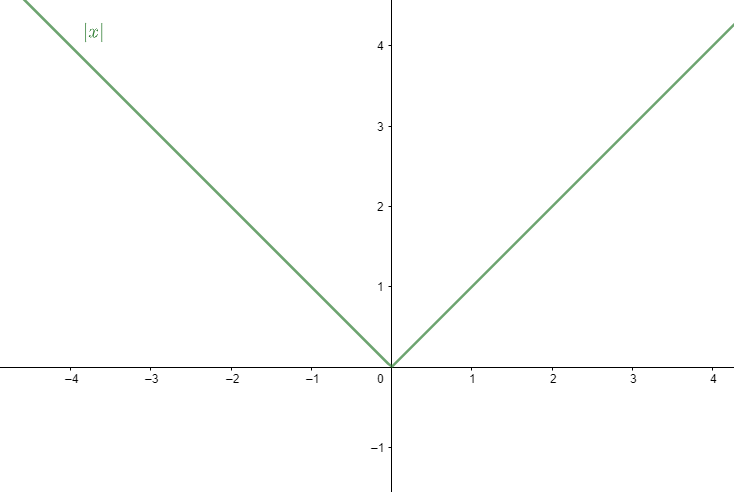
So, the domain of the function $f\left( x \right)=\left| x \right|$ is $\mathbb{R}$.
Now we expand the function in its simplest form.
$f\left( x \right)=\left| x \right|=\left\{ \begin{align}
& -x\left( x<0 \right) \\
& x\left( x\ge 0 \right) \\
\end{align} \right.$
So, for all value of $x<0$, $f\left( x \right)=\left| x \right|>0$ and for all value of $x\ge 0$, $f\left( x \right)=\left| x \right|\ge 0$.
The graph also shows that value of y is always $y=f\left( x \right)=\left| x \right|\ge 0$.
Therefore, $\forall x\in \mathbb{R}$, the range of $f\left( x \right)=\left| x \right|\ge 0$ which means $f\left( x \right)=\left| x \right|\in \left[ 0,\infty \right)$.
Let’s take an example to get a clear idea about $f\left( x \right)=\left| x \right|$.
We take values of x as $x=-1,-34,0,5,10$. For the values of x, we find
$f\left( -1 \right)=\left| -1 \right|=1$, $f\left( -34 \right)=\left| -34 \right|=34$, $f\left( 0 \right)=\left| 0 \right|=0$, $f\left( 5 \right)=\left| 5 \right|=5$, $f\left( 10 \right)=\left| 10 \right|=10$.
For all given values we took the number without any sign. For negative values, we eliminated the negative sign and for positive values, we took the number itself.
Note:
Although the graph is continuous at all points in $\mathbb{R}$, it’s not differentiable at all points. At point $x=0$, function $f\left( x \right)=\left| x \right|$ is not differentiable. The modulus function brings out the positive part of any value. So, $f\left( x \right)=\left| x \right|$ can never be negative.
Complete step by step answer:
The given function $f\left( x \right)=\left| x \right|$ defines the modulus function which gives the positive value back as the result of any number that belongs in the real number domain.
$f\left( x \right)=\left| x \right|$ is a continuous function and we can take any number within real number range to apply the function.
So, the domain of the function $f\left( x \right)=\left| x \right|$ is $\mathbb{R}$.
Now we expand the function in its simplest form.
$f\left( x \right)=\left| x \right|=\left\{ \begin{align}
& -x\left( x<0 \right) \\
& x\left( x\ge 0 \right) \\
\end{align} \right.$
So, for all value of $x<0$, $f\left( x \right)=\left| x \right|>0$ and for all value of $x\ge 0$, $f\left( x \right)=\left| x \right|\ge 0$.
The graph also shows that value of y is always $y=f\left( x \right)=\left| x \right|\ge 0$.
Therefore, $\forall x\in \mathbb{R}$, the range of $f\left( x \right)=\left| x \right|\ge 0$ which means $f\left( x \right)=\left| x \right|\in \left[ 0,\infty \right)$.
Let’s take an example to get a clear idea about $f\left( x \right)=\left| x \right|$.
We take values of x as $x=-1,-34,0,5,10$. For the values of x, we find
$f\left( -1 \right)=\left| -1 \right|=1$, $f\left( -34 \right)=\left| -34 \right|=34$, $f\left( 0 \right)=\left| 0 \right|=0$, $f\left( 5 \right)=\left| 5 \right|=5$, $f\left( 10 \right)=\left| 10 \right|=10$.
For all given values we took the number without any sign. For negative values, we eliminated the negative sign and for positive values, we took the number itself.
Note:
Although the graph is continuous at all points in $\mathbb{R}$, it’s not differentiable at all points. At point $x=0$, function $f\left( x \right)=\left| x \right|$ is not differentiable. The modulus function brings out the positive part of any value. So, $f\left( x \right)=\left| x \right|$ can never be negative.
Recently Updated Pages
Master Class 12 Economics: Engaging Questions & Answers for Success

Master Class 12 English: Engaging Questions & Answers for Success
Master Class 12 Social Science: Engaging Questions & Answers for Success
Master Class 12 Maths: Engaging Questions & Answers for Success
Master Class 12 Physics: Engaging Questions & Answers for Success
Master Class 9 General Knowledge: Engaging Questions & Answers for Success
Trending doubts
Explain the Treaty of Vienna of 1815 class 10 social science CBSE
Why is it 530 pm in india when it is 1200 afternoon class 10 social science CBSE
What is the full form of POSCO class 10 social science CBSE
Define Potential, Developed, Stock and Reserved resources
Which Country Has the Largest Border with India?
Complete the sentence with the most appropriate word class 10 english CBSE