




Find the domain and range of the following function:
$\begin{align}
& \left( i \right)f\left( x \right)={{x}^{2}} \\
& \left( ii \right)f\left( x \right)=\sqrt{\left( x-1 \right)\left( 3-x \right)} \\
\end{align}$
Answer
 Verified
672k+ views
Hint: To solve this question given above, we will first find out what the domain and range of a function is. Then, to find the domain of (i) and (ii), we will find out all the values of x for which $f\left( x \right)$ will exist. To find the range of (i), we will simply draw the graph of $y={{x}^{2}}$ and find all the values of y for which the graph exists. To find the range of (ii), we will differentiate the function given in (i) with respect to x. After that, we will analyze its derivative and on the basis of this, we will find its range.
Complete step-by-step answer:
Before we start solving this question, we will first find out what is the domain and range of a function. The domain of a function is defined as the set of all the values that the independent variable can take. The range of a function is the set of all the values the dependent variable can take. Now we will find the domain and range of (i) and (ii).
$\left( i \right)f\left( x \right)={{x}^{2}}$
We can see here that x can take any value and for any value of x, $f\left( x \right)$ is defined. Thus, the domain of $f\left( x \right)$ is $\left( -\infty ,\infty \right)$.
To find the range, we will draw the graph of $y={{x}^{2}}$.
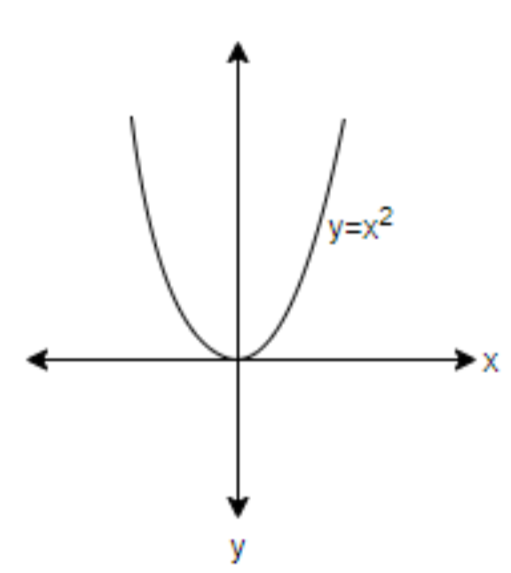
Here, the value of y is positive and zero only. So, the range will be $f\left( x \right)\in [0,\infty )$.
$\left( ii \right)f\left( x \right)=\sqrt{\left( x-1 \right)\left( 3-x \right)}$
Now, we can see that x cannot take nay value. It can take those values only where $\left( x-1 \right)\left( 3-x \right)$ is greater than or equal to zero. Thus :
$\begin{align}
& \left( x-1 \right)\left( 3-x \right)\ge 0 \\
& \left( x-1 \right)\left( x-3 \right)\le 0 \\
\end{align}$
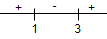
So, it implies $x\in \left[ 1,3 \right]$. Thus, the domain will be $x\in \left[ 1,3 \right]$.
Now, to find the range, we will find the derivative of $f\left( x \right)$. Thus, we have,
$\dfrac{df\left( x \right)}{dx}=\dfrac{d}{dx}\left[ \sqrt{\left( x-1 \right)\left( 3-x \right)} \right]$
Now, we know that according to the product rule, $\dfrac{d}{dx}\left( a.b \right)=b.\dfrac{da}{dx}+a.\dfrac{db}{dx}$. Thus, we have,
$f'\left( x \right)=\sqrt{3-x}\dfrac{d\left( \sqrt{x-1} \right)}{dx}+\sqrt{x-1}\dfrac{d\left( \sqrt{3-x} \right)}{dx}$
And we know that, $\dfrac{d\sqrt{ax+b}}{dx}=\dfrac{a}{2\sqrt{ax+b}}$. So, using this formula, we will get,
$\begin{align}
& f'\left( x \right)=\dfrac{\sqrt{3-x}}{2\sqrt{x-1}}-\dfrac{\sqrt{x-1}}{2\sqrt{3-x}} \\
& \Rightarrow f'\left( x \right)=\dfrac{\left( 3-x \right)-\left( x-1 \right)}{4\sqrt{\left( x-1 \right)\left( 3-x \right)}} \\
& \Rightarrow f'\left( x \right)=\dfrac{4-2x}{4\sqrt{\left( 3-x \right)\left( x-1 \right)}} \\
& \Rightarrow f'\left( x \right)=\dfrac{2-x}{2\sqrt{\left( 3-x \right)\left( x-1 \right)}} \\
\end{align}$
Now, let’s plot the graph for this derivative:
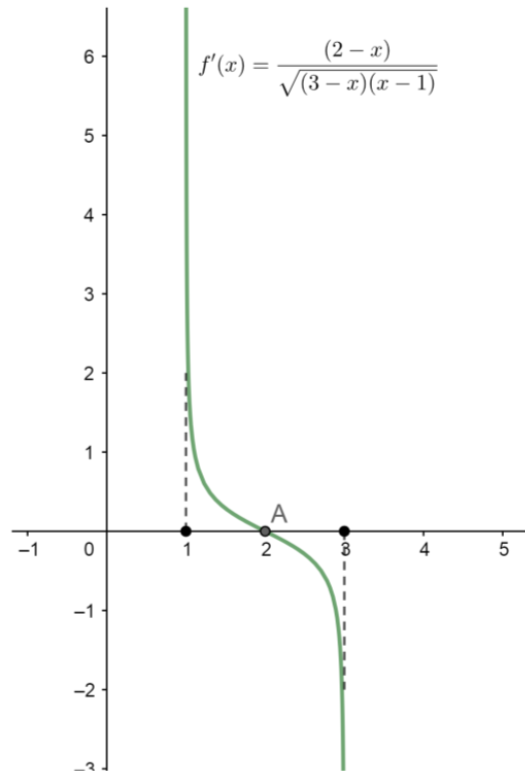
Here, we can see that $f'\left( x \right)>0$ in $\left( 1,2 \right)$ and $f'\left( x \right)<0$ in $\left( 2,3 \right)$. Thus, x = 2 will be the maxima. Thus the minimum of $f\left( x \right)$ will be when x =3 and x = 1 and it will be maximum when x = 2. Thus,
$\begin{align}
& f\left( 3 \right)=f\left( 1 \right)=0 \\
& f\left( 2 \right)=1 \\
\end{align}$
Thus, the range of $f\left( x \right)$ is $f\left( x \right)\in \left[ 0,1 \right]$.
Note: We can also find the range of $f\left( x \right)={{x}^{2}}$ by the following method. We know that when the derivative of a function is zero, the value of x at which it is zero will be either maxima or minima. Thus, the derivative of $f\left( x \right)$ is,
$\dfrac{df\left( x \right)}{dx}=\dfrac{d}{dx}\left( {{x}^{2}} \right)=2x$
Now, $\dfrac{df\left( x \right)}{dx}=0$, so we have, $2x=0\Rightarrow x=0$. Now, x = 0 can’t be maxima as the maximum value of $f\left( x \right)={{x}^{2}}$ is infinity, but when we put x = 0 in $f\left( x \right)$, we will get $f\left( 0 \right)=0$. Thus, the range of $f\left( x \right)={{x}^{2}}$ is $f\left( x \right)\in [0,\infty )$.
Complete step-by-step answer:
Before we start solving this question, we will first find out what is the domain and range of a function. The domain of a function is defined as the set of all the values that the independent variable can take. The range of a function is the set of all the values the dependent variable can take. Now we will find the domain and range of (i) and (ii).
$\left( i \right)f\left( x \right)={{x}^{2}}$
We can see here that x can take any value and for any value of x, $f\left( x \right)$ is defined. Thus, the domain of $f\left( x \right)$ is $\left( -\infty ,\infty \right)$.
To find the range, we will draw the graph of $y={{x}^{2}}$.
Here, the value of y is positive and zero only. So, the range will be $f\left( x \right)\in [0,\infty )$.
$\left( ii \right)f\left( x \right)=\sqrt{\left( x-1 \right)\left( 3-x \right)}$
Now, we can see that x cannot take nay value. It can take those values only where $\left( x-1 \right)\left( 3-x \right)$ is greater than or equal to zero. Thus :
$\begin{align}
& \left( x-1 \right)\left( 3-x \right)\ge 0 \\
& \left( x-1 \right)\left( x-3 \right)\le 0 \\
\end{align}$
So, it implies $x\in \left[ 1,3 \right]$. Thus, the domain will be $x\in \left[ 1,3 \right]$.
Now, to find the range, we will find the derivative of $f\left( x \right)$. Thus, we have,
$\dfrac{df\left( x \right)}{dx}=\dfrac{d}{dx}\left[ \sqrt{\left( x-1 \right)\left( 3-x \right)} \right]$
Now, we know that according to the product rule, $\dfrac{d}{dx}\left( a.b \right)=b.\dfrac{da}{dx}+a.\dfrac{db}{dx}$. Thus, we have,
$f'\left( x \right)=\sqrt{3-x}\dfrac{d\left( \sqrt{x-1} \right)}{dx}+\sqrt{x-1}\dfrac{d\left( \sqrt{3-x} \right)}{dx}$
And we know that, $\dfrac{d\sqrt{ax+b}}{dx}=\dfrac{a}{2\sqrt{ax+b}}$. So, using this formula, we will get,
$\begin{align}
& f'\left( x \right)=\dfrac{\sqrt{3-x}}{2\sqrt{x-1}}-\dfrac{\sqrt{x-1}}{2\sqrt{3-x}} \\
& \Rightarrow f'\left( x \right)=\dfrac{\left( 3-x \right)-\left( x-1 \right)}{4\sqrt{\left( x-1 \right)\left( 3-x \right)}} \\
& \Rightarrow f'\left( x \right)=\dfrac{4-2x}{4\sqrt{\left( 3-x \right)\left( x-1 \right)}} \\
& \Rightarrow f'\left( x \right)=\dfrac{2-x}{2\sqrt{\left( 3-x \right)\left( x-1 \right)}} \\
\end{align}$
Now, let’s plot the graph for this derivative:
Here, we can see that $f'\left( x \right)>0$ in $\left( 1,2 \right)$ and $f'\left( x \right)<0$ in $\left( 2,3 \right)$. Thus, x = 2 will be the maxima. Thus the minimum of $f\left( x \right)$ will be when x =3 and x = 1 and it will be maximum when x = 2. Thus,
$\begin{align}
& f\left( 3 \right)=f\left( 1 \right)=0 \\
& f\left( 2 \right)=1 \\
\end{align}$
Thus, the range of $f\left( x \right)$ is $f\left( x \right)\in \left[ 0,1 \right]$.
Note: We can also find the range of $f\left( x \right)={{x}^{2}}$ by the following method. We know that when the derivative of a function is zero, the value of x at which it is zero will be either maxima or minima. Thus, the derivative of $f\left( x \right)$ is,
$\dfrac{df\left( x \right)}{dx}=\dfrac{d}{dx}\left( {{x}^{2}} \right)=2x$
Now, $\dfrac{df\left( x \right)}{dx}=0$, so we have, $2x=0\Rightarrow x=0$. Now, x = 0 can’t be maxima as the maximum value of $f\left( x \right)={{x}^{2}}$ is infinity, but when we put x = 0 in $f\left( x \right)$, we will get $f\left( 0 \right)=0$. Thus, the range of $f\left( x \right)={{x}^{2}}$ is $f\left( x \right)\in [0,\infty )$.
Recently Updated Pages
Write the number of covalent bonds in the molecule class 11 chemistry CBSE

Master Class 11 Social Science: Engaging Questions & Answers for Success
Master Class 11 English: Engaging Questions & Answers for Success
Master Class 11 Maths: Engaging Questions & Answers for Success
Master Class 11 Chemistry: Engaging Questions & Answers for Success
Class 11 Question and Answer - Your Ultimate Solutions Guide
Trending doubts
One Metric ton is equal to kg A 10000 B 1000 C 100 class 11 physics CBSE
Find the value of the expression given below sin 30circ class 11 maths CBSE
Which of the following viruses contains both DNA and class 11 biology CBSE
10 examples of friction in our daily life
Difference between physical and chemical change class 11 chemistry CBSE
Bond order ofO2 O2+ O2 and O22 is in order A O2 langle class 11 chemistry CBSE