




Find the domain and range of $f\left( g\left( x \right) \right)$ where
$f\left( x \right)=\left\{ \begin{matrix}
x+1 & \text{if }x\le 1 \\
2x+1 & \text{if }1 < x \le 2 \\
\end{matrix} \right.,g\left( x \right)=\left\{ \begin{matrix}
{{x}^{2}} & \text{if }-1 < x \le 2 \\
x+2 & \text{if 2}\le x\le 3 \\
\end{matrix} \right.$ \[\]
Answer
 Verified
571.2k+ views
Hint: We take the intersection of domains of $f\left( x \right)$ and $g\left( x \right)$ to find the domain of $f\left( g\left( x \right) \right)$. We put $g\left( x \right)$ in place of $x$ in the given definition of function $f\left( x \right)$ and considering obtained domain, using the domain of $f\left( x \right)$ and the definition $g\left( x \right)$ under the limits to define $f\left( g\left( x \right) \right)$. We find the range of $f\left( g\left( x \right) \right)$ checking the value of $f\left( g\left( x \right) \right)$ at the limits of interval. \[\]
Complete step-by-step answer:
We know that if $f\left( x \right):A\to B,g\left( x \right):B\to C$ are two functions then the composite function $fog\left( x \right)$ is defined as $f\left( g\left( x \right) \right)=B\to A$.
We are given two piecewise defined functions $f\left( x \right)$ and $g\left( x \right)$ as defined below.
\[\begin{align}
& f\left( x \right)=\left\{ \begin{matrix}
x+1 & \text{if }x\le 1 \\
2x+1 & \text{if }1 < x \le 2 \\
\end{matrix} \right. \\
& g\left( x \right)=\left\{ \begin{matrix}
{{x}^{2}} & \text{if }-1 < x \le 2 \\
x+2 & \text{if } 2 < x\le 3 \\
\end{matrix} \right. \\
\end{align}\]
We see that piecewise function $f\left( x \right)$ is defined for $x \le 1$ and $1 < x \le 2$ which means it has the domain
\[x\in \left( -\infty ,1 \right]\bigcup \left( 1,2 \right]=\left( -\infty ,2 \right]....\left( 1 \right)\]
Similarly the piecewise defined function $g\left( x \right)$ is defined for $-1 < x \le 2$ and $2 < x\le 3$,which means it has the domain
\[x\in \left[ -1,2 \right)\bigcup \left[ 2,3 \right]=\left[ -1,3 \right].....\left( 2 \right)\]
We are asked to find the domain and range of their composite function $f\left( g\left( x \right) \right)$. The definition of $g\left( x \right)$ is limited by its domain$\left[ -1,2 \right]$ and the definition of $f\left( x \right)$is limited by its domain$\left( -\infty ,2 \right]$. So the domain of $f\left( g\left( x \right) \right)$ will be the intersection of domains of $f\left( x \right)$ and $g\left( x \right)$ which is
\[ x \in \left[ -1,3 \right]\bigcap \left( -\infty ,2 \right]=\left[ -1,2 \right]\]
Let us put $g\left( x \right)$ in place of $x$ in the definition of $f\left( x \right)$ to get the definition of$f\left( g\left( x \right) \right)$.So we have;
\[f\left( g\left( x \right) \right)=\left\{ \begin{matrix}
g\left( x \right)+1 & \text{if }x\le 1 \\
2g\left( x \right)+1 & \text{if }1 < x\le 2 \\
\end{matrix} \right...........\left( 3 \right)\]
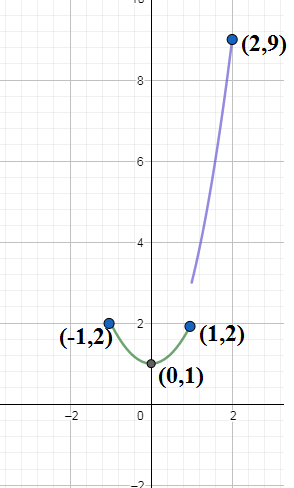
We see that the function $f\left( g\left( x \right) \right)$ will have different two sub-functions before and after $x=1$ because $f\left( x \right)$ has two sub-functions before and after$x=1$. So we put $g\left( x \right)={{x}^{2}}$ in (3) for $-1\le x\le 1$ and $1 < x\le 2$ in (1) since $g\left( x \right)={{x}^{2}}$ for all $-1\le x\le 2$ and define $f\left( g\left( x \right) \right)$ as
\[f\left( g\left( x \right) \right)=\left\{ \begin{matrix}
{{x}^{2}}+1 & \text{if }-1 < x\le 1 \\
2{{x}^{2}}+1 & \text{if }1 < x \le 2 \\
\end{matrix} \right.\]
We see that when $-1\le x\le 1$ then we have
\[\begin{align}
& 0\le {{x}^{2}}\le 1 \\
& \Rightarrow 1\le {{x}^{2}}+1\le 2 \\
& \Rightarrow 1\le f\left( g\left( x \right) \right)\le 2 \\
& \Rightarrow f\left( g\left( x \right) \right)\in \left[ 1,2 \right].......\left( 4 \right) \\
\end{align}\]
We also observe that when $1\le x\le 2$ then we have
\[\begin{align}
& 1 < {{x}^{2}}\le 4 \\
& \Rightarrow 2\cdot 1+1<2{{x}^{2}}+1\le 2\cdot 4+1 \\
& \Rightarrow 3 < f\left( g\left( x \right) \right)\le 9 \\
& \Rightarrow f\left( g\left( x \right) \right)\in \left( 3,9 \right].....\left( 5 \right) \\
\end{align}\]
We take union of the intervals in (4) and (5) and find the required range as
\[f\left( g\left( x \right) \right)\in \left[ 1,2 \right]\bigcup \left( 3,9 \right]\]
Note: We note that a piecewise has different functions in different intervals and each function is called a sub function. We also note that the sub-function $g\left( x \right)=2$ could not be used since $f\left( g\left( x \right) \right)$ is not denied for $x>2$. We must be careful of the less than and less than equal to sign as well as greater than or greater than equal to sign while solving this problem.
Complete step-by-step answer:
We know that if $f\left( x \right):A\to B,g\left( x \right):B\to C$ are two functions then the composite function $fog\left( x \right)$ is defined as $f\left( g\left( x \right) \right)=B\to A$.
We are given two piecewise defined functions $f\left( x \right)$ and $g\left( x \right)$ as defined below.
\[\begin{align}
& f\left( x \right)=\left\{ \begin{matrix}
x+1 & \text{if }x\le 1 \\
2x+1 & \text{if }1 < x \le 2 \\
\end{matrix} \right. \\
& g\left( x \right)=\left\{ \begin{matrix}
{{x}^{2}} & \text{if }-1 < x \le 2 \\
x+2 & \text{if } 2 < x\le 3 \\
\end{matrix} \right. \\
\end{align}\]
We see that piecewise function $f\left( x \right)$ is defined for $x \le 1$ and $1 < x \le 2$ which means it has the domain
\[x\in \left( -\infty ,1 \right]\bigcup \left( 1,2 \right]=\left( -\infty ,2 \right]....\left( 1 \right)\]
Similarly the piecewise defined function $g\left( x \right)$ is defined for $-1 < x \le 2$ and $2 < x\le 3$,which means it has the domain
\[x\in \left[ -1,2 \right)\bigcup \left[ 2,3 \right]=\left[ -1,3 \right].....\left( 2 \right)\]
We are asked to find the domain and range of their composite function $f\left( g\left( x \right) \right)$. The definition of $g\left( x \right)$ is limited by its domain$\left[ -1,2 \right]$ and the definition of $f\left( x \right)$is limited by its domain$\left( -\infty ,2 \right]$. So the domain of $f\left( g\left( x \right) \right)$ will be the intersection of domains of $f\left( x \right)$ and $g\left( x \right)$ which is
\[ x \in \left[ -1,3 \right]\bigcap \left( -\infty ,2 \right]=\left[ -1,2 \right]\]
Let us put $g\left( x \right)$ in place of $x$ in the definition of $f\left( x \right)$ to get the definition of$f\left( g\left( x \right) \right)$.So we have;
\[f\left( g\left( x \right) \right)=\left\{ \begin{matrix}
g\left( x \right)+1 & \text{if }x\le 1 \\
2g\left( x \right)+1 & \text{if }1 < x\le 2 \\
\end{matrix} \right...........\left( 3 \right)\]
We see that the function $f\left( g\left( x \right) \right)$ will have different two sub-functions before and after $x=1$ because $f\left( x \right)$ has two sub-functions before and after$x=1$. So we put $g\left( x \right)={{x}^{2}}$ in (3) for $-1\le x\le 1$ and $1 < x\le 2$ in (1) since $g\left( x \right)={{x}^{2}}$ for all $-1\le x\le 2$ and define $f\left( g\left( x \right) \right)$ as
\[f\left( g\left( x \right) \right)=\left\{ \begin{matrix}
{{x}^{2}}+1 & \text{if }-1 < x\le 1 \\
2{{x}^{2}}+1 & \text{if }1 < x \le 2 \\
\end{matrix} \right.\]
We see that when $-1\le x\le 1$ then we have
\[\begin{align}
& 0\le {{x}^{2}}\le 1 \\
& \Rightarrow 1\le {{x}^{2}}+1\le 2 \\
& \Rightarrow 1\le f\left( g\left( x \right) \right)\le 2 \\
& \Rightarrow f\left( g\left( x \right) \right)\in \left[ 1,2 \right].......\left( 4 \right) \\
\end{align}\]
We also observe that when $1\le x\le 2$ then we have
\[\begin{align}
& 1 < {{x}^{2}}\le 4 \\
& \Rightarrow 2\cdot 1+1<2{{x}^{2}}+1\le 2\cdot 4+1 \\
& \Rightarrow 3 < f\left( g\left( x \right) \right)\le 9 \\
& \Rightarrow f\left( g\left( x \right) \right)\in \left( 3,9 \right].....\left( 5 \right) \\
\end{align}\]
We take union of the intervals in (4) and (5) and find the required range as
\[f\left( g\left( x \right) \right)\in \left[ 1,2 \right]\bigcup \left( 3,9 \right]\]
Note: We note that a piecewise has different functions in different intervals and each function is called a sub function. We also note that the sub-function $g\left( x \right)=2$ could not be used since $f\left( g\left( x \right) \right)$ is not denied for $x>2$. We must be careful of the less than and less than equal to sign as well as greater than or greater than equal to sign while solving this problem.
Recently Updated Pages
Master Class 11 Computer Science: Engaging Questions & Answers for Success

Master Class 11 Business Studies: Engaging Questions & Answers for Success
Master Class 11 Economics: Engaging Questions & Answers for Success
Master Class 11 English: Engaging Questions & Answers for Success
Master Class 11 Maths: Engaging Questions & Answers for Success
Master Class 11 Biology: Engaging Questions & Answers for Success
Trending doubts
One Metric ton is equal to kg A 10000 B 1000 C 100 class 11 physics CBSE
There are 720 permutations of the digits 1 2 3 4 5 class 11 maths CBSE
Discuss the various forms of bacteria class 11 biology CBSE
Draw a diagram of a plant cell and label at least eight class 11 biology CBSE
State the laws of reflection of light
Explain zero factorial class 11 maths CBSE