




Find the distance of a chord 8cm from the center of the circle of radius 5 cm .
A. 2 cm
B. 3 cm
C. 4 cm
D. 6 cm
Answer
 Verified
640.8k+ views
Hint: In this problem, we are given a circle having center O with a chord AB. Length of the chord AB is 8 cm and the radius of circle i.e. OA is 5 cm. By visualizing the diagram, we can easily solve our problem and find the distance of OP.
Complete step-by-step answer:
Consider a circle having center O with a chord. Let OA be the radius of the circle and AB be the chord. As given in the question, the radius of the circle is 5 cm and length of chord is 8 cm. Let the distance between the center of the circle and chord be OP. So, this can be shown diagrammatically as:
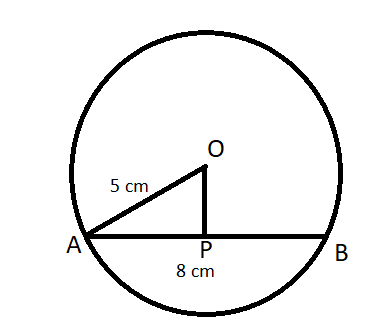
It is clear from the diagram that OP is perpendicular to AB. As OP is perpendicular to AB and passes through the center O, it will bisect the chord AB at P. Now the length of AP will be,
$\begin{align}
& AP=\dfrac{1}{2}\times AB \\
& AP=\dfrac{1}{2}\times 8 \\
& AP=4cm \\
\end{align}$
Since, triangle OPA is a right-angle triangle, we can easily apply the Pythagoras theorem which can be stated as ${{b}^{2}}+{{p}^{2}}={{h}^{2}}$ where b, p and h are base, perpendicular and hypotenuse of the respective triangle.
$\begin{align}
& \text{In }\Delta OPA, \\
& A{{P}^{2}}+O{{P}^{2}}=A{{O}^{2}} \\
& O{{P}^{2}}=A{{O}^{2}}-A{{P}^{2}} \\
& O{{P}^{2}}={{5}^{2}}-{{4}^{2}} \\
& OP=\sqrt{25-16} \\
& OP=\sqrt{9}=3cm \\
\end{align}$
Therefore, the distance of the chord AB from the center is 3 cm.
Hence, option (b) is correct.
Note: The key step for solving this problem is transforming the statement into a diagram. Once the diagram is known, then we can easily evaluate the required thing. Students must be careful in drawing the diagram and labelling it.
Complete step-by-step answer:
Consider a circle having center O with a chord. Let OA be the radius of the circle and AB be the chord. As given in the question, the radius of the circle is 5 cm and length of chord is 8 cm. Let the distance between the center of the circle and chord be OP. So, this can be shown diagrammatically as:
It is clear from the diagram that OP is perpendicular to AB. As OP is perpendicular to AB and passes through the center O, it will bisect the chord AB at P. Now the length of AP will be,
$\begin{align}
& AP=\dfrac{1}{2}\times AB \\
& AP=\dfrac{1}{2}\times 8 \\
& AP=4cm \\
\end{align}$
Since, triangle OPA is a right-angle triangle, we can easily apply the Pythagoras theorem which can be stated as ${{b}^{2}}+{{p}^{2}}={{h}^{2}}$ where b, p and h are base, perpendicular and hypotenuse of the respective triangle.
$\begin{align}
& \text{In }\Delta OPA, \\
& A{{P}^{2}}+O{{P}^{2}}=A{{O}^{2}} \\
& O{{P}^{2}}=A{{O}^{2}}-A{{P}^{2}} \\
& O{{P}^{2}}={{5}^{2}}-{{4}^{2}} \\
& OP=\sqrt{25-16} \\
& OP=\sqrt{9}=3cm \\
\end{align}$
Therefore, the distance of the chord AB from the center is 3 cm.
Hence, option (b) is correct.
Note: The key step for solving this problem is transforming the statement into a diagram. Once the diagram is known, then we can easily evaluate the required thing. Students must be careful in drawing the diagram and labelling it.
Recently Updated Pages
Master Class 11 English: Engaging Questions & Answers for Success

Master Class 11 Maths: Engaging Questions & Answers for Success
Class 11 Question and Answer - Your Ultimate Solutions Guide
Master Class 11 Biology: Engaging Questions & Answers for Success
Master Class 11 Physics: Engaging Questions & Answers for Success
Master Class 11 Accountancy: Engaging Questions & Answers for Success
Trending doubts
Differentiate between an exothermic and an endothermic class 11 chemistry CBSE
One Metric ton is equal to kg A 10000 B 1000 C 100 class 11 physics CBSE
Difference Between Prokaryotic Cells and Eukaryotic Cells
There are 720 permutations of the digits 1 2 3 4 5 class 11 maths CBSE
Draw a diagram of a plant cell and label at least eight class 11 biology CBSE
1 Quintal is equal to a 110 kg b 10 kg c 100kg d 1000 class 11 physics CBSE