




Find the distance between the points $P\left( -6,7 \right)$ and $Q\left( -1,-5 \right)$ .
Answer
 Verified
585k+ views
Hint: we need to find the distance between the points P(-6,7) and Q(-1,-5). These two points both lie in the XY-plane. For finding out the distance between the two points lying in the XY-plane, we use the formula $\sqrt{{{\left( {{x}_{2}}-{{x}_{1}} \right)}^{2}}+{{\left( {{y}_{2}}-{{y}_{1}} \right)}^{2}}}$ where $\left( {{x}_{1}},{{y}_{1}} \right)$ and $\left( {{x}_{2}},{{y}_{2}} \right)$ are the coordinates of the points between whose distance we want to find out. Using this formula, we will get our answer.
Complete step by step answer:
Here, we have been given the points P(-6,7) and Q(-1,-5).
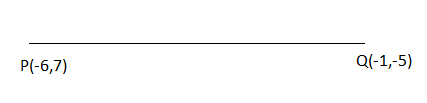
Let the point P be $\left( {{x}_{1}},{{y}_{1}} \right)$ and let the point Q be $\left( {{x}_{2}},{{y}_{2}} \right)$ .
Thus, we get the values of ${{x}_{1}},{{x}_{2}},{{y}_{1}}$ and ${{y}_{2}}$ as:
$\begin{align}
& {{x}_{1}}=-6 \\
& {{x}_{2}}=-1 \\
& {{y}_{1}}=7 \\
& {{y}_{2}}=-5 \\
\end{align}$
Now, we know that the distance between the two points $\left( {{x}_{1}},{{y}_{1}} \right)$ and $\left( {{x}_{2}},{{y}_{2}} \right)$ is given by the formula $\sqrt{{{\left( {{x}_{2}}-{{x}_{1}} \right)}^{2}}+{{\left( {{y}_{2}}-{{y}_{1}} \right)}^{2}}}$ .
Putting the values of ${{x}_{1}},{{x}_{2}},{{y}_{1}}$ and ${{y}_{2}}$ in this formula, we get the distance PQ as:
$\begin{align}
& PQ=\sqrt{{{\left( -1-\left( -6 \right) \right)}^{2}}+{{\left( -5-\left( 7 \right) \right)}^{2}}} \\
& \Rightarrow PQ=\sqrt{{{\left( 5 \right)}^{2}}+{{\left( -12 \right)}^{2}}} \\
\end{align}$
\[\Rightarrow PQ=\sqrt{25+144}\]
$\begin{align}
& \Rightarrow PQ=\sqrt{169} \\
& \Rightarrow PQ=13 \\
\end{align}$
Therefore, the distance between the points P(-6,7) and Q(-1,-5) is $PQ=13units$
Note: This formula is applicable for all the coordinates belonging to the XY-plane. But remember, this formula is only applicable for coordinates of the XY-plane. If we have been given a 3-dimensional coordinates, then we will have to use the formula $\sqrt{{{\left( {{x}_{2}}-{{x}_{1}} \right)}^{2}}+{{\left( {{y}_{2}}-{{y}_{1}} \right)}^{2}}+{{\left( {{z}_{2}}-{{z}_{1}} \right)}^{2}}}$ where $\left( {{x}_{1}},{{y}_{1}},{{z}_{1}} \right)$ and $\left( {{x}_{2}},{{y}_{2}},{{z}_{2}} \right)$ are the 3-dimensional coordinates. This formula is similar to the formula we used here, only an extra ${{\left( {{z}_{2}}-{{z}_{1}} \right)}^{2}}$ is added inside the under root. Thus it can be remembered in the same way as we remember the formula used above.
Complete step by step answer:
Here, we have been given the points P(-6,7) and Q(-1,-5).
Let the point P be $\left( {{x}_{1}},{{y}_{1}} \right)$ and let the point Q be $\left( {{x}_{2}},{{y}_{2}} \right)$ .
Thus, we get the values of ${{x}_{1}},{{x}_{2}},{{y}_{1}}$ and ${{y}_{2}}$ as:
$\begin{align}
& {{x}_{1}}=-6 \\
& {{x}_{2}}=-1 \\
& {{y}_{1}}=7 \\
& {{y}_{2}}=-5 \\
\end{align}$
Now, we know that the distance between the two points $\left( {{x}_{1}},{{y}_{1}} \right)$ and $\left( {{x}_{2}},{{y}_{2}} \right)$ is given by the formula $\sqrt{{{\left( {{x}_{2}}-{{x}_{1}} \right)}^{2}}+{{\left( {{y}_{2}}-{{y}_{1}} \right)}^{2}}}$ .
Putting the values of ${{x}_{1}},{{x}_{2}},{{y}_{1}}$ and ${{y}_{2}}$ in this formula, we get the distance PQ as:
$\begin{align}
& PQ=\sqrt{{{\left( -1-\left( -6 \right) \right)}^{2}}+{{\left( -5-\left( 7 \right) \right)}^{2}}} \\
& \Rightarrow PQ=\sqrt{{{\left( 5 \right)}^{2}}+{{\left( -12 \right)}^{2}}} \\
\end{align}$
\[\Rightarrow PQ=\sqrt{25+144}\]
$\begin{align}
& \Rightarrow PQ=\sqrt{169} \\
& \Rightarrow PQ=13 \\
\end{align}$
Therefore, the distance between the points P(-6,7) and Q(-1,-5) is $PQ=13units$
Note: This formula is applicable for all the coordinates belonging to the XY-plane. But remember, this formula is only applicable for coordinates of the XY-plane. If we have been given a 3-dimensional coordinates, then we will have to use the formula $\sqrt{{{\left( {{x}_{2}}-{{x}_{1}} \right)}^{2}}+{{\left( {{y}_{2}}-{{y}_{1}} \right)}^{2}}+{{\left( {{z}_{2}}-{{z}_{1}} \right)}^{2}}}$ where $\left( {{x}_{1}},{{y}_{1}},{{z}_{1}} \right)$ and $\left( {{x}_{2}},{{y}_{2}},{{z}_{2}} \right)$ are the 3-dimensional coordinates. This formula is similar to the formula we used here, only an extra ${{\left( {{z}_{2}}-{{z}_{1}} \right)}^{2}}$ is added inside the under root. Thus it can be remembered in the same way as we remember the formula used above.
Recently Updated Pages
Master Class 11 English: Engaging Questions & Answers for Success

Master Class 11 Maths: Engaging Questions & Answers for Success
Master Class 11 Biology: Engaging Questions & Answers for Success
Master Class 11 Social Science: Engaging Questions & Answers for Success
Master Class 11 Physics: Engaging Questions & Answers for Success
Master Class 11 Accountancy: Engaging Questions & Answers for Success
Trending doubts
One Metric ton is equal to kg A 10000 B 1000 C 100 class 11 physics CBSE
There are 720 permutations of the digits 1 2 3 4 5 class 11 maths CBSE
Discuss the various forms of bacteria class 11 biology CBSE
Draw a diagram of a plant cell and label at least eight class 11 biology CBSE
State the laws of reflection of light
Explain zero factorial class 11 maths CBSE