




Find the distance between \[P\left( {{x}_{1}},{{y}_{1}} \right)\] and \[Q\left( {{x}_{2}},{{y}_{2}} \right)\] when
(i) PQ is parallel to the y – axis and
(ii) PQ is parallel to the x – axis.
Answer
 Verified
628.5k+ views
Hint: Consider part (i) of the given question and draw a diagram in which PQ is shown parallel to y – axis. Find the relation between \[{{x}_{1}}\] and \[{{x}_{2}}\] and then apply the distance formula given as \[PQ=\sqrt{{{\left( {{x}_{2}}-{{x}_{1}} \right)}^{2}}+{{\left( {{y}_{2}}-{{y}_{1}} \right)}^{2}}}\] to get the answer. Similarly, consider part (ii) of the question and draw a diagram in which PQ is shown parallel to x – axis. Find the relation between \[{{y}_{1}}\] and \[{{y}_{2}}\] in this case and apply the same distance formula to get the answer.
Complete step by step answer:
Here we have been provided with two points P and Q having the coordinates \[\left( {{x}_{1}},{{y}_{1}} \right)\] and \[\left( {{x}_{2}},{{y}_{2}} \right)\] respectively. Two cases are provided to us and we have to determine the distance between P and Q in both the cases. So, let us check these cases one by one.
(i) When PQ is parallel to y-axis
In this case, one of the possible diagrams can be shown as
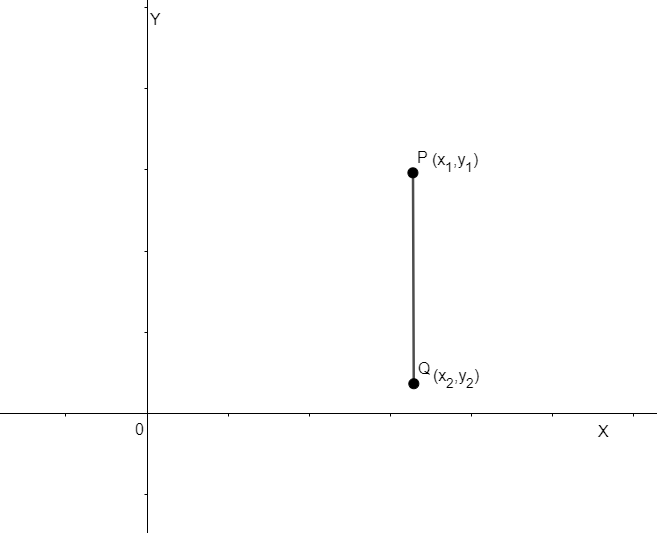
Now, we know that the equation of a line parallel to the y – axis is given as x = constant. So, we can say that the x – coordinate of points P and Q will be the same because the x – coordinate of any two points on the line PQ will remain constant. So, we have,
\[\Rightarrow {{x}_{1}}={{x}_{2}}.....\left( i \right)\]
Now, applying the distance formula given as \[PQ=\sqrt{{{\left( {{x}_{2}}-{{x}_{1}} \right)}^{2}}+{{\left( {{y}_{2}}-{{y}_{1}} \right)}^{2}}}\] we get,
\[\Rightarrow PQ=\sqrt{{{\left( 0 \right)}^{2}}+{{\left( {{y}_{2}}-{{y}_{1}} \right)}^{2}}}\left[ \text{using relation (i)} \right]\]
\[\Rightarrow PQ=\sqrt{{{\left( {{y}_{2}}-{{y}_{1}} \right)}^{2}}}\]
\[\Rightarrow PQ=\left| {{y}_{2}}-{{y}_{1}} \right|\]
Here, the modulus sign is considered to keep the value of the distance positive.
(ii) When PQ is parallel to x-axis
In this case, one of the possible diagrams can be shown as
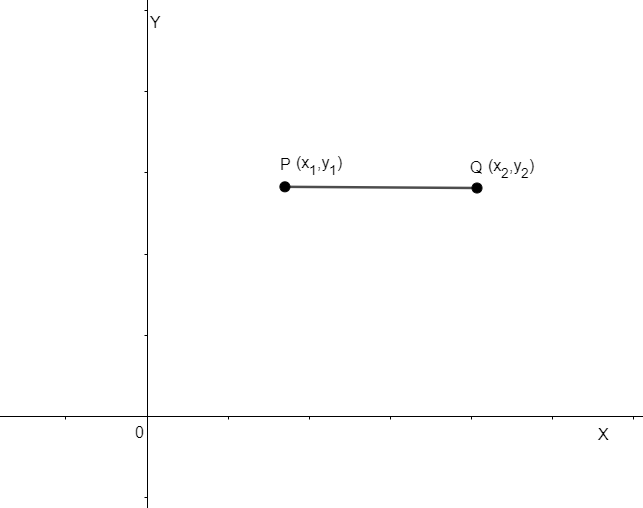
Now, we know that the equation of the line parallel to x – axis is given as y = constant. So, we can say that the y – coordinate of points P and Q will be the same because the y – coordinate of any two points on the line PQ will remain constant. So, we have,
\[\Rightarrow {{y}_{1}}={{y}_{2}}......\left( ii \right)\]
Now, applying the same distance formula, we get,
\[\Rightarrow PQ=\sqrt{{{\left( {{x}_{2}}-{{x}_{1}} \right)}^{2}}+{{0}^{2}}}\left[ \text{using equation (ii)} \right]\]
\[\Rightarrow PQ=\sqrt{{{\left( {{x}_{2}}-{{x}_{1}} \right)}^{2}}}\]
\[\Rightarrow PQ=\left| {{x}_{2}}-{{x}_{1}} \right|\]
Here also the modulus sign is considered to keep the value of the distance positive.
Note:
One must note that the significance of the modulus sign in the above answers. Actually, we have shown the line PQ in the first quadrant which is one of the possible conditions. P and Q may lie in other quadrants also. So, x and y – coordinates can be positive or negative depending on the situation. So, the difference \[\left( {{x}_{2}}-{{x}_{1}} \right)\] or \[\left( {{y}_{2}}-{{y}_{1}} \right)\] can be negative also but we know that the distance is a scalar quantity and cannot be negative. So, to keep the distance positive, a modulus sign is applied.
Complete step by step answer:
Here we have been provided with two points P and Q having the coordinates \[\left( {{x}_{1}},{{y}_{1}} \right)\] and \[\left( {{x}_{2}},{{y}_{2}} \right)\] respectively. Two cases are provided to us and we have to determine the distance between P and Q in both the cases. So, let us check these cases one by one.
(i) When PQ is parallel to y-axis
In this case, one of the possible diagrams can be shown as
Now, we know that the equation of a line parallel to the y – axis is given as x = constant. So, we can say that the x – coordinate of points P and Q will be the same because the x – coordinate of any two points on the line PQ will remain constant. So, we have,
\[\Rightarrow {{x}_{1}}={{x}_{2}}.....\left( i \right)\]
Now, applying the distance formula given as \[PQ=\sqrt{{{\left( {{x}_{2}}-{{x}_{1}} \right)}^{2}}+{{\left( {{y}_{2}}-{{y}_{1}} \right)}^{2}}}\] we get,
\[\Rightarrow PQ=\sqrt{{{\left( 0 \right)}^{2}}+{{\left( {{y}_{2}}-{{y}_{1}} \right)}^{2}}}\left[ \text{using relation (i)} \right]\]
\[\Rightarrow PQ=\sqrt{{{\left( {{y}_{2}}-{{y}_{1}} \right)}^{2}}}\]
\[\Rightarrow PQ=\left| {{y}_{2}}-{{y}_{1}} \right|\]
Here, the modulus sign is considered to keep the value of the distance positive.
(ii) When PQ is parallel to x-axis
In this case, one of the possible diagrams can be shown as
Now, we know that the equation of the line parallel to x – axis is given as y = constant. So, we can say that the y – coordinate of points P and Q will be the same because the y – coordinate of any two points on the line PQ will remain constant. So, we have,
\[\Rightarrow {{y}_{1}}={{y}_{2}}......\left( ii \right)\]
Now, applying the same distance formula, we get,
\[\Rightarrow PQ=\sqrt{{{\left( {{x}_{2}}-{{x}_{1}} \right)}^{2}}+{{0}^{2}}}\left[ \text{using equation (ii)} \right]\]
\[\Rightarrow PQ=\sqrt{{{\left( {{x}_{2}}-{{x}_{1}} \right)}^{2}}}\]
\[\Rightarrow PQ=\left| {{x}_{2}}-{{x}_{1}} \right|\]
Here also the modulus sign is considered to keep the value of the distance positive.
Note:
One must note that the significance of the modulus sign in the above answers. Actually, we have shown the line PQ in the first quadrant which is one of the possible conditions. P and Q may lie in other quadrants also. So, x and y – coordinates can be positive or negative depending on the situation. So, the difference \[\left( {{x}_{2}}-{{x}_{1}} \right)\] or \[\left( {{y}_{2}}-{{y}_{1}} \right)\] can be negative also but we know that the distance is a scalar quantity and cannot be negative. So, to keep the distance positive, a modulus sign is applied.
Recently Updated Pages
Class 10 Question and Answer - Your Ultimate Solutions Guide

Master Class 10 Computer Science: Engaging Questions & Answers for Success
Master Class 10 General Knowledge: Engaging Questions & Answers for Success
Master Class 12 Economics: Engaging Questions & Answers for Success
Master Class 12 Social Science: Engaging Questions & Answers for Success
Master Class 12 English: Engaging Questions & Answers for Success
Trending doubts
Explain the Treaty of Vienna of 1815 class 10 social science CBSE
The slogan Jai Hind was given by A Lal Bahadur Shastri class 10 social science CBSE
10 examples of evaporation in daily life with explanations
What is the full form of POSCO class 10 social science CBSE
Identify the feminine form of noun nephew a shenephew class 10 english CBSE
CSIR full form?