




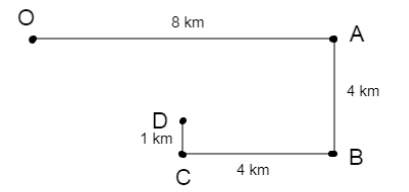
Find the displacement $OD$ in the following figure
Answer
 Verified
510.6k+ views
Hint: In this question, we have to calculate the displacement of a point i.e. the difference between the initial point and the final point. Here, we make use of properties of the rectangle, distance and displacement concept and Pythagoras theorem.
Complete step by step answer:
Let us consider an object is displacing from point $D$to point $O$via points $A,B,C$.
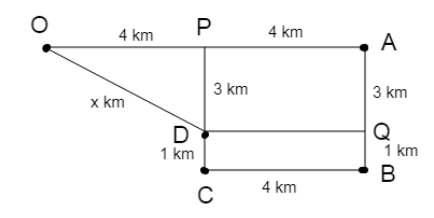
Extending the point $D$ to touch seg $OA$ at $P$. Also extend point $D$to touch seg $AB$ at $Q$.Join the points $OD$. We have to find this displacement $OD$. From the figure, Using the properties of rectangle that opposite sides are equal and all angles are right angled triangle, we have
$BC = QD = AP = 4$ km
$\Rightarrow AQ = 3$ km and $QB = 1$ km
So, we get,
$OP = 4$ km and $PD = 3$ km -------------$(1)$
Now, consider the triangle $\Delta OPD$, It is a right angled triangle at $\angle P$
So, by using Pythagoras theorem,
$O{D^2} = O{P^2} + P{D^2}$
Substituting the values from eq$(1)$ , we get
$O{D^2} = {4^2} + {3^2}$
$\Rightarrow O{D^2} = 16 + 9 = 25$
Taking square root, we get
$\therefore OD = 5$ km
Hence, the displacement $OD = 5$ km.
Note:Displacement and distance are different terms having different meanings.Displacement is the difference between the initial and final position of the object and distance is the length of path covered by the object in a given time interval. Also, displacement is a vector quantity and distance is a scalar quantity.
Complete step by step answer:
Let us consider an object is displacing from point $D$to point $O$via points $A,B,C$.
Extending the point $D$ to touch seg $OA$ at $P$. Also extend point $D$to touch seg $AB$ at $Q$.Join the points $OD$. We have to find this displacement $OD$. From the figure, Using the properties of rectangle that opposite sides are equal and all angles are right angled triangle, we have
$BC = QD = AP = 4$ km
$\Rightarrow AQ = 3$ km and $QB = 1$ km
So, we get,
$OP = 4$ km and $PD = 3$ km -------------$(1)$
Now, consider the triangle $\Delta OPD$, It is a right angled triangle at $\angle P$
So, by using Pythagoras theorem,
$O{D^2} = O{P^2} + P{D^2}$
Substituting the values from eq$(1)$ , we get
$O{D^2} = {4^2} + {3^2}$
$\Rightarrow O{D^2} = 16 + 9 = 25$
Taking square root, we get
$\therefore OD = 5$ km
Hence, the displacement $OD = 5$ km.
Note:Displacement and distance are different terms having different meanings.Displacement is the difference between the initial and final position of the object and distance is the length of path covered by the object in a given time interval. Also, displacement is a vector quantity and distance is a scalar quantity.
Recently Updated Pages
Master Class 11 English: Engaging Questions & Answers for Success

Master Class 11 Maths: Engaging Questions & Answers for Success
Master Class 11 Biology: Engaging Questions & Answers for Success
Master Class 11 Social Science: Engaging Questions & Answers for Success
Master Class 11 Physics: Engaging Questions & Answers for Success
Master Class 11 Accountancy: Engaging Questions & Answers for Success
Trending doubts
One Metric ton is equal to kg A 10000 B 1000 C 100 class 11 physics CBSE
There are 720 permutations of the digits 1 2 3 4 5 class 11 maths CBSE
Discuss the various forms of bacteria class 11 biology CBSE
Draw a diagram of a plant cell and label at least eight class 11 biology CBSE
State the laws of reflection of light
Explain zero factorial class 11 maths CBSE