




How do you find the dimensions of a rectangle whose area is \[100\] square meters and whose perimeter is minimum?
Answer
 Verified
546k+ views
Hint: for the question we are asked to find the dimensions of a rectangle whose area is \[100{{m}^{2}}\] and the given condition is perimeter is minimum. So, for solving this question we will use the perimeter formula of a rectangle and differentiate it and equate it to zero to find the dimensions of the rectangle.
Complete step by step solution:
Firstly, let us assume that the base and height of a rectangle are x and y respectively.
Here in the question we are given that the area of the rectangle is \[100{{m}^{2}}\]. So, by using the area of a rectangle \[area=x\times y\] and substitute the given area value in this formula.
After doing it we get,
\[\Rightarrow x\times y=100\]
Here we will send \[x\] to the other side of the equation. We get the equation reduced as follows.
\[\Rightarrow y=\dfrac{100}{x}\]
Let us assume the perimeter of the rectangle as P. So, the perimeter formula for the rectangle is \[P=2\left( x+y \right)\].
Here we will substitute the value of \[y\] which we got earlier in the perimeter formula.
\[\Rightarrow P=2\left( x+y \right)\]
\[\Rightarrow P=2\left( x+\dfrac{100}{x} \right)\]
For the question it is given that the perimeter is minimum. So, we want to minimize P on \[\left( 0,\infty \right)\] as the perimeter is always positive.
We will minimize by taking the derivative. So, after doing the derivative the equation will be reduced as below.
\[\Rightarrow P=2\left( x+\dfrac{100}{x} \right)\]
We use the formula of differentiation which is \[\dfrac{dy}{dx}\left( \dfrac{1}{x} \right)=-\dfrac{1}{{{x}^{2}}}\]
\[\Rightarrow \dfrac{dP}{dx}=2\left( 1-\dfrac{100}{{{x}^{2}}} \right)\]
Now, for the minimization we will equate the derivative to zero. After doing it the equation will be reduced as follows.
\[\Rightarrow 2\left( 1-\dfrac{100}{{{x}^{2}}} \right)=0\]
\[\Rightarrow \left( \dfrac{100}{{{x}^{2}}} \right)=1\]
Now, we will send the denominator on the left hand side to the numerator of the right hand side of the equation.
\[\Rightarrow {{x}^{2}}=100\]
\[\Rightarrow x=\pm 10\]
Here \[x\] is the base of the rectangle so it can’t be negative. So, the value of it will be positive.
Therefore the value of \[x\]is \[10\].
We know that from the question area of the rectangle is \[100\]. So, we will find the height by substituting the base which we got in the area formula.
\[\Rightarrow area=100{{m}^{2}}\]
\[\Rightarrow \left( xy \right)=100\]
\[\Rightarrow 10y=100\]
\[\Rightarrow y=10\]
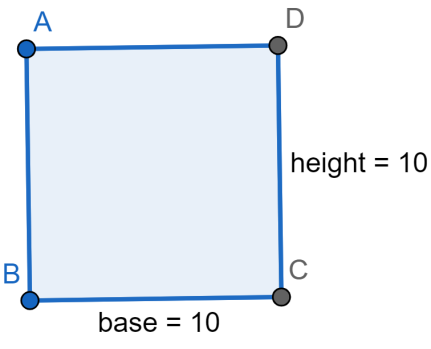
Therefore the dimensions are \[base=10\] and \[height=10\].
The figure for the question with least dimensions is given below.
Note:
Students must be very careful in doing the calculations and they must know the formula of perimeter and area of the rectangle very clearly. We can check the values by some sample values,
\[\Rightarrow \dfrac{dP}{dx}\left( 1 \right)<0\Rightarrow p\left( x \right)\] is decreasing on \[(0,10]\].
\[\Rightarrow \dfrac{dP}{dx}\left( 11 \right)>0\Rightarrow p\left( x \right)\] is increasing on \[(10,\infty ]\].
Therefore, \[P\left( 10 \right)\] is the minimum.
Hence dimensions are \[10\times 10\].
Complete step by step solution:
Firstly, let us assume that the base and height of a rectangle are x and y respectively.
Here in the question we are given that the area of the rectangle is \[100{{m}^{2}}\]. So, by using the area of a rectangle \[area=x\times y\] and substitute the given area value in this formula.
After doing it we get,
\[\Rightarrow x\times y=100\]
Here we will send \[x\] to the other side of the equation. We get the equation reduced as follows.
\[\Rightarrow y=\dfrac{100}{x}\]
Let us assume the perimeter of the rectangle as P. So, the perimeter formula for the rectangle is \[P=2\left( x+y \right)\].
Here we will substitute the value of \[y\] which we got earlier in the perimeter formula.
\[\Rightarrow P=2\left( x+y \right)\]
\[\Rightarrow P=2\left( x+\dfrac{100}{x} \right)\]
For the question it is given that the perimeter is minimum. So, we want to minimize P on \[\left( 0,\infty \right)\] as the perimeter is always positive.
We will minimize by taking the derivative. So, after doing the derivative the equation will be reduced as below.
\[\Rightarrow P=2\left( x+\dfrac{100}{x} \right)\]
We use the formula of differentiation which is \[\dfrac{dy}{dx}\left( \dfrac{1}{x} \right)=-\dfrac{1}{{{x}^{2}}}\]
\[\Rightarrow \dfrac{dP}{dx}=2\left( 1-\dfrac{100}{{{x}^{2}}} \right)\]
Now, for the minimization we will equate the derivative to zero. After doing it the equation will be reduced as follows.
\[\Rightarrow 2\left( 1-\dfrac{100}{{{x}^{2}}} \right)=0\]
\[\Rightarrow \left( \dfrac{100}{{{x}^{2}}} \right)=1\]
Now, we will send the denominator on the left hand side to the numerator of the right hand side of the equation.
\[\Rightarrow {{x}^{2}}=100\]
\[\Rightarrow x=\pm 10\]
Here \[x\] is the base of the rectangle so it can’t be negative. So, the value of it will be positive.
Therefore the value of \[x\]is \[10\].
We know that from the question area of the rectangle is \[100\]. So, we will find the height by substituting the base which we got in the area formula.
\[\Rightarrow area=100{{m}^{2}}\]
\[\Rightarrow \left( xy \right)=100\]
\[\Rightarrow 10y=100\]
\[\Rightarrow y=10\]
Therefore the dimensions are \[base=10\] and \[height=10\].
The figure for the question with least dimensions is given below.
Note:
Students must be very careful in doing the calculations and they must know the formula of perimeter and area of the rectangle very clearly. We can check the values by some sample values,
\[\Rightarrow \dfrac{dP}{dx}\left( 1 \right)<0\Rightarrow p\left( x \right)\] is decreasing on \[(0,10]\].
\[\Rightarrow \dfrac{dP}{dx}\left( 11 \right)>0\Rightarrow p\left( x \right)\] is increasing on \[(10,\infty ]\].
Therefore, \[P\left( 10 \right)\] is the minimum.
Hence dimensions are \[10\times 10\].
Recently Updated Pages
Master Class 10 Computer Science: Engaging Questions & Answers for Success

Master Class 10 General Knowledge: Engaging Questions & Answers for Success
Master Class 10 English: Engaging Questions & Answers for Success
Master Class 10 Social Science: Engaging Questions & Answers for Success
Master Class 10 Maths: Engaging Questions & Answers for Success
Master Class 10 Science: Engaging Questions & Answers for Success
Trending doubts
What is the median of the first 10 natural numbers class 10 maths CBSE
Which women's tennis player has 24 Grand Slam singles titles?
Who is the Brand Ambassador of Incredible India?
Why is there a time difference of about 5 hours between class 10 social science CBSE
Write a letter to the principal requesting him to grant class 10 english CBSE
A moving boat is observed from the top of a 150 m high class 10 maths CBSE