




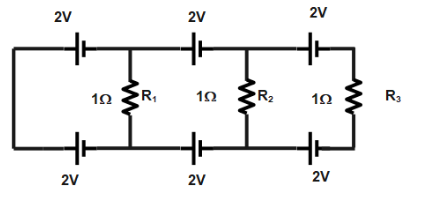
Find the current in the three resistors in figure.
Answer
 Verified
543k+ views
Hint:To solve circuit-based questions we have to know the concepts and applications of KVL and KCL. Name the ends of the circuits as ABCDEFGH. Let us consider a current $i$ coming out from the lower left most cell of the circuit AB and then dividing into ${i_1}$ and$i - {i_1}$ at point G. Now let ${i_1}$ be again divided into part ${i_1}$ and ${i_1} - {i_2}$ at the point F.
Complete step by step answer:
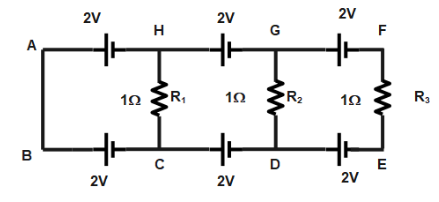
Considering loop AHGBA:
$ 2 + (i - {i_1}) - 2 = 0 \\
\Rightarrow i - {i_1} = 0. \\
\Rightarrow 2 + (i - {i_1}) - 2 = 0 \\
\Rightarrow i - {i_1} = 0$
Thus $i = {i_1}$ . $ - - - - (1)$
Considering loop BGFCB:
$2 - (i - {i_1}) - 2 + {i_1} - {i_2} = 0$
$\Rightarrow (i - {i_1}) + {i_1} - {i_2} = 0 $
But we know that $i = {i_1}$ , hence the first term gets cancelled.
Thus, ${i_1} = {i_2}$ $ - - - - (2)$
Considering loop CFEDC, we get
$2 + {i_2} - ({i_1} - {i_2}) - 2 = 0 \\$
$\Rightarrow 2{i_2} - {i_1} = 0$ $ - - - - (3)$
Now compare equation 2 and equation 3, we see that the value is only possible when both ${i_1},{i_2}$ are zero. Thus we can also confirm that $i{\text{ = 0}}$.Now lets see the current through resistors:
For $R_1$: current is $i - {i_1}$ , but from (1) we see the value is zero. Hence current through $R_1$ is zero.
For $R_2$: current is ${i_1} - {i_2} = 0$, but from (2) we see the value is zero. Hence current through $R_2$ is zero. Similarly, for $R_3$ we see that the value of current through the resistance is zero.
Hence no current passes through these three resistances.
Additional information:KVL: The law which deals with the conservation of energy for a closed circuit path. The law states that for a closed loop path the algebraic sum of all the emf around any closed loop in a circuit is equal to zero.
Note: From these types of questions it is to be kept in mind that if equal and opposite emf are applied in a circuit, then no current flows through the circuit. Thus we can now apply this concept to other questions where there may be any number of resistances and emf.
Complete step by step answer:
Considering loop AHGBA:
$ 2 + (i - {i_1}) - 2 = 0 \\
\Rightarrow i - {i_1} = 0. \\
\Rightarrow 2 + (i - {i_1}) - 2 = 0 \\
\Rightarrow i - {i_1} = 0$
Thus $i = {i_1}$ . $ - - - - (1)$
Considering loop BGFCB:
$2 - (i - {i_1}) - 2 + {i_1} - {i_2} = 0$
$\Rightarrow (i - {i_1}) + {i_1} - {i_2} = 0 $
But we know that $i = {i_1}$ , hence the first term gets cancelled.
Thus, ${i_1} = {i_2}$ $ - - - - (2)$
Considering loop CFEDC, we get
$2 + {i_2} - ({i_1} - {i_2}) - 2 = 0 \\$
$\Rightarrow 2{i_2} - {i_1} = 0$ $ - - - - (3)$
Now compare equation 2 and equation 3, we see that the value is only possible when both ${i_1},{i_2}$ are zero. Thus we can also confirm that $i{\text{ = 0}}$.Now lets see the current through resistors:
For $R_1$: current is $i - {i_1}$ , but from (1) we see the value is zero. Hence current through $R_1$ is zero.
For $R_2$: current is ${i_1} - {i_2} = 0$, but from (2) we see the value is zero. Hence current through $R_2$ is zero. Similarly, for $R_3$ we see that the value of current through the resistance is zero.
Hence no current passes through these three resistances.
Additional information:KVL: The law which deals with the conservation of energy for a closed circuit path. The law states that for a closed loop path the algebraic sum of all the emf around any closed loop in a circuit is equal to zero.
Note: From these types of questions it is to be kept in mind that if equal and opposite emf are applied in a circuit, then no current flows through the circuit. Thus we can now apply this concept to other questions where there may be any number of resistances and emf.
Recently Updated Pages
Master Class 12 Business Studies: Engaging Questions & Answers for Success

Master Class 12 Chemistry: Engaging Questions & Answers for Success
Master Class 12 Biology: Engaging Questions & Answers for Success
Class 12 Question and Answer - Your Ultimate Solutions Guide
Master Class 11 English: Engaging Questions & Answers for Success
Master Class 11 Social Science: Engaging Questions & Answers for Success
Trending doubts
Which are the Top 10 Largest Countries of the World?
Draw a labelled sketch of the human eye class 12 physics CBSE
Differentiate between homogeneous and heterogeneous class 12 chemistry CBSE
Differentiate between Pyramid of energy and pyramid class 12 biology CBSE
Why is the cell called the structural and functional class 12 biology CBSE
Draw the diagram of the pyramid of energy Explain In class 12 biology CBSE