




How can you find the critical angle of water? Explain your steps briefly.
Answer
 Verified
652.8k+ views
Hint: The critical angle of water is the angle of incidence of a light ray traveling from the denser medium to rarer medium such that the angle of refraction of the light ray is equal to 90\[^\circ \]. Using Snell’s law of refraction, we can find the critical angle for water.
Formula used:
Snell’s law of refraction defines the refractive index of a medium in the following way:
$\mu = \dfrac{{\sin i}}{{\sin r}}$
Here $\mu $ is used to represent the refractive index of a medium, ‘i’ represents the angle of incidence while r represents the angle of refraction.
Complete step-by-step solution:
The critical angle of a medium can be defined as the angle of incidence of a light ray in the denser medium which is such that the angle of refraction obtained is equal to 90$^\circ $. This can be represented as shown in the figure.
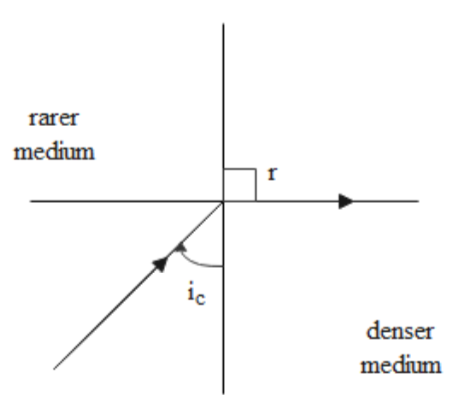
We can find the critical angle of water by using Snell's law. For the critical angle, the angle of refraction is equal to 90$^\circ $. The refractive index of water with respect to air is given as
$\mu = \dfrac{3}{4}$
Using this in Snell law and substituting i by ${i_C}$, we get
$ \mu = \dfrac{{\sin i}}{{\sin r}} \\
\dfrac{3}{4} = \dfrac{{\sin {i_C}}}{{\sin 90^\circ }} = \dfrac{{\sin {i_C}}}{1} \\
\Rightarrow \sin {i_C} = \dfrac{3}{4} = 0.7518 \\
{i_C} = {\sin ^{ - 1}}\left( {0.7518} \right) \\
{i_C} = 48.7^\circ $
This is the required value of the critical angle of water.
Note: If the angle of incidence of the light ray in the denser medium is equal to the critical angle of that medium then the light rays travel along the surface of the interface between two media. But if the angle is greater than the critical angle then total internal reflection takes place while if it’s less than the critical angle the normal refraction of light takes place.
Formula used:
Snell’s law of refraction defines the refractive index of a medium in the following way:
$\mu = \dfrac{{\sin i}}{{\sin r}}$
Here $\mu $ is used to represent the refractive index of a medium, ‘i’ represents the angle of incidence while r represents the angle of refraction.
Complete step-by-step solution:
The critical angle of a medium can be defined as the angle of incidence of a light ray in the denser medium which is such that the angle of refraction obtained is equal to 90$^\circ $. This can be represented as shown in the figure.
We can find the critical angle of water by using Snell's law. For the critical angle, the angle of refraction is equal to 90$^\circ $. The refractive index of water with respect to air is given as
$\mu = \dfrac{3}{4}$
Using this in Snell law and substituting i by ${i_C}$, we get
$ \mu = \dfrac{{\sin i}}{{\sin r}} \\
\dfrac{3}{4} = \dfrac{{\sin {i_C}}}{{\sin 90^\circ }} = \dfrac{{\sin {i_C}}}{1} \\
\Rightarrow \sin {i_C} = \dfrac{3}{4} = 0.7518 \\
{i_C} = {\sin ^{ - 1}}\left( {0.7518} \right) \\
{i_C} = 48.7^\circ $
This is the required value of the critical angle of water.
Note: If the angle of incidence of the light ray in the denser medium is equal to the critical angle of that medium then the light rays travel along the surface of the interface between two media. But if the angle is greater than the critical angle then total internal reflection takes place while if it’s less than the critical angle the normal refraction of light takes place.
Recently Updated Pages
Class 10 Question and Answer - Your Ultimate Solutions Guide

Master Class 10 Computer Science: Engaging Questions & Answers for Success
Master Class 10 General Knowledge: Engaging Questions & Answers for Success
Master Class 12 Economics: Engaging Questions & Answers for Success
Master Class 12 Social Science: Engaging Questions & Answers for Success
Master Class 12 English: Engaging Questions & Answers for Success
Trending doubts
Explain the Treaty of Vienna of 1815 class 10 social science CBSE
The slogan Jai Hind was given by A Lal Bahadur Shastri class 10 social science CBSE
10 examples of evaporation in daily life with explanations
What is the full form of POSCO class 10 social science CBSE
Identify the feminine form of noun nephew a shenephew class 10 english CBSE
CSIR full form?