




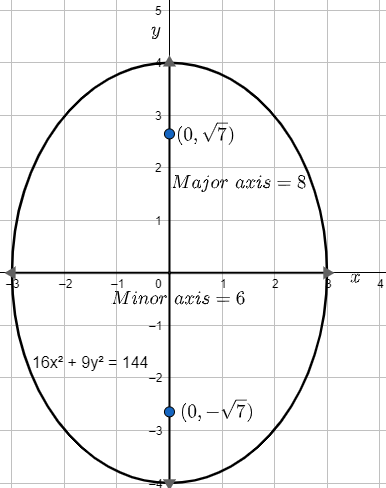
How do you find the coordinates of the centre, foci, the length of the major and minor axis given $16{{x}^{2}}+9{{y}^{2}}=144$ ?
Answer
 Verified
548.1k+ views
Hint: We are given equation as $16{{x}^{2}}+9{{y}^{2}}=144$, we are asked to find centre, foci, length of major and minor axis, to find all this we will learn what type of equation in this, then we reduce it to standard form, we will reduce it to $\dfrac{{{x}^{2}}}{{{a}^{2}}}+\dfrac{{{y}^{2}}}{{{b}^{2}}}=1$ then we will compare our equation with $\dfrac{{{\left( x-h \right)}^{2}}}{{{a}^{2}}}+\dfrac{{{\left( y-k \right)}^{2}}}{{{b}^{2}}}=1$ to find the value of $\left( h,k \right)$ centre also we find value of ‘a’ and ‘b’, using ‘a’ and ‘b’ we find length of major and minor axis, and we use $c=\pm \sqrt{{{b}^{2}}-{{a}^{2}}}$ , to find foci.
Complete step-by-step answer:
We are given a equation as $16{{x}^{2}}+9{{y}^{2}}=144$ , we are asked to find various things, to do so we will work on given equation, we have $16{{x}^{2}}+9{{y}^{2}}=144$ , here we can see that ${{x}^{2}}$ and ${{y}^{2}}$ are both being added and their coefficient are not same. So it is not a circle also coefficient of both are positive so it is not hyperbola.
So, we get our equation is ellipse.
Now we know that equation of ellipse is given as $\dfrac{{{\left( x-h \right)}^{2}}}{{{a}^{2}}}+\dfrac{{{\left( y-k \right)}^{2}}}{{{b}^{2}}}=1$ .
Where $\left( h,k \right)$ denote the centre of the ellipse, and ‘a’, ‘b’ represent half of the major/minor axis as in our problem, we have $16{{x}^{2}}+9{{y}^{2}}=144$.
We divide both sides by 144, to reduce it to standard form.
$\dfrac{16{{x}^{2}}}{144}+\dfrac{9{{y}^{2}}}{144}=\dfrac{144}{144}$ .
By simplifying, we get –
$\dfrac{{{x}^{2}}}{9}+\dfrac{{{y}^{2}}}{16}=1$ .
Now as $9={{3}^{2}}$ and $16={{4}^{2}}$ .
So, we can also re write it as –
$\dfrac{{{x}^{2}}}{{{3}^{2}}}+\dfrac{{{y}^{2}}}{{{4}^{2}}}=1$ .
As our standard form is $\dfrac{{{\left( x-h \right)}^{2}}}{{{a}^{2}}}+\dfrac{{{\left( y-k \right)}^{2}}}{{{b}^{2}}}=1$ , so we can also write it as $\dfrac{{{\left( x-0 \right)}^{2}}}{{{3}^{2}}}+\dfrac{{{\left( y-0 \right)}^{2}}}{{{4}^{2}}}=1$ .
So, comparing this with our standard equation, we get –
$h=0,k=0$
And value of $a=3,b=4$ .
As $h=0,k=0$ so coordinate of centre is $\left( h,k \right)=\left( 0,0 \right)$ .
So, coordinate of centre $=\left( 0,0 \right)$ .
Now, here $aAs ‘a’ is having length of minor axis so length of minor axis $=2a$
As $a=3$ so, length of minor axis $=2\times 3=6$ .
Similarly, b-denotes giving the length of major axis
So, length of major axis $=2b$
$\begin{align}
& =2\times 4 \\
& =8 \\
\end{align}$ (as $b=4$ )
Now foci of the ellipse is given as $c=\pm \sqrt{{{b}^{2}}-{{a}^{2}}}$ (major – minor).
As $b=4$ and $a=3$ so,
Using these we get –
$\begin{align}
& c=\pm \sqrt{{{4}^{2}}-{{3}^{2}}} \\
& =\pm \sqrt{16-9} \\
& c=\pm \sqrt{7} \\
\end{align}$ .
So, foci is $\pm \sqrt{7}$ .
As major axis is ‘y’.
So, coordinate of foci is $\left( 0,+\sqrt{7} \right)$ and $\left( 0,-\sqrt{7} \right)$ .
Note: Remember that here for foci, we subtract the square of major axis from square of minor axis so if ‘x’ is major and ‘y’ is minor then we get foci $=\pm \sqrt{{{a}^{2}}-{{b}^{2}}}$ , also we always careful that we consider both options ‘+’ and ‘-‘ for foci as in ellipse we have two focus.
Complete step-by-step answer:
We are given a equation as $16{{x}^{2}}+9{{y}^{2}}=144$ , we are asked to find various things, to do so we will work on given equation, we have $16{{x}^{2}}+9{{y}^{2}}=144$ , here we can see that ${{x}^{2}}$ and ${{y}^{2}}$ are both being added and their coefficient are not same. So it is not a circle also coefficient of both are positive so it is not hyperbola.
So, we get our equation is ellipse.
Now we know that equation of ellipse is given as $\dfrac{{{\left( x-h \right)}^{2}}}{{{a}^{2}}}+\dfrac{{{\left( y-k \right)}^{2}}}{{{b}^{2}}}=1$ .
Where $\left( h,k \right)$ denote the centre of the ellipse, and ‘a’, ‘b’ represent half of the major/minor axis as in our problem, we have $16{{x}^{2}}+9{{y}^{2}}=144$.
We divide both sides by 144, to reduce it to standard form.
$\dfrac{16{{x}^{2}}}{144}+\dfrac{9{{y}^{2}}}{144}=\dfrac{144}{144}$ .
By simplifying, we get –
$\dfrac{{{x}^{2}}}{9}+\dfrac{{{y}^{2}}}{16}=1$ .
Now as $9={{3}^{2}}$ and $16={{4}^{2}}$ .
So, we can also re write it as –
$\dfrac{{{x}^{2}}}{{{3}^{2}}}+\dfrac{{{y}^{2}}}{{{4}^{2}}}=1$ .
As our standard form is $\dfrac{{{\left( x-h \right)}^{2}}}{{{a}^{2}}}+\dfrac{{{\left( y-k \right)}^{2}}}{{{b}^{2}}}=1$ , so we can also write it as $\dfrac{{{\left( x-0 \right)}^{2}}}{{{3}^{2}}}+\dfrac{{{\left( y-0 \right)}^{2}}}{{{4}^{2}}}=1$ .
So, comparing this with our standard equation, we get –
$h=0,k=0$
And value of $a=3,b=4$ .
As $h=0,k=0$ so coordinate of centre is $\left( h,k \right)=\left( 0,0 \right)$ .
So, coordinate of centre $=\left( 0,0 \right)$ .
Now, here $a
As $a=3$ so, length of minor axis $=2\times 3=6$ .
Similarly, b-denotes giving the length of major axis
So, length of major axis $=2b$
$\begin{align}
& =2\times 4 \\
& =8 \\
\end{align}$ (as $b=4$ )
Now foci of the ellipse is given as $c=\pm \sqrt{{{b}^{2}}-{{a}^{2}}}$ (major – minor).
As $b=4$ and $a=3$ so,
Using these we get –
$\begin{align}
& c=\pm \sqrt{{{4}^{2}}-{{3}^{2}}} \\
& =\pm \sqrt{16-9} \\
& c=\pm \sqrt{7} \\
\end{align}$ .
So, foci is $\pm \sqrt{7}$ .
As major axis is ‘y’.
So, coordinate of foci is $\left( 0,+\sqrt{7} \right)$ and $\left( 0,-\sqrt{7} \right)$ .
Note: Remember that here for foci, we subtract the square of major axis from square of minor axis so if ‘x’ is major and ‘y’ is minor then we get foci $=\pm \sqrt{{{a}^{2}}-{{b}^{2}}}$ , also we always careful that we consider both options ‘+’ and ‘-‘ for foci as in ellipse we have two focus.
Recently Updated Pages
Master Class 11 Computer Science: Engaging Questions & Answers for Success

Master Class 11 Business Studies: Engaging Questions & Answers for Success
Master Class 11 Economics: Engaging Questions & Answers for Success
Master Class 11 English: Engaging Questions & Answers for Success
Master Class 11 Maths: Engaging Questions & Answers for Success
Master Class 11 Biology: Engaging Questions & Answers for Success
Trending doubts
One Metric ton is equal to kg A 10000 B 1000 C 100 class 11 physics CBSE
There are 720 permutations of the digits 1 2 3 4 5 class 11 maths CBSE
Discuss the various forms of bacteria class 11 biology CBSE
Draw a diagram of a plant cell and label at least eight class 11 biology CBSE
State the laws of reflection of light
10 examples of friction in our daily life