




Find the coordinate of the foot of the perpendicular drawn from the point (1, 2, 3) to the plane $2x + y - z - 7 = 0$. Also find the image of that point.
Answer
 Verified
592.2k+ views
Hint: According to the question given in the question we have to determine the coordinate of foot perpendicular drawn from the point (1, 2, 3) to the plane $2x + y - z - 7 = 0$ and also find the image of that point. So, first of all we have to determine the direction ratios for the plane as the points given with the help of the diagram given below:
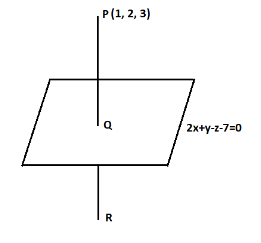
Now, from the diagram above we can see that we have point A(1, 2, 3) and we have to determine the coordinates of foot Q to the plane $2x + y - z - 7 = 0$. Now from the diagram above we can see that direction ratio and $\overrightarrow n $are parallel to each other so we can determine the foot with the help of the formula to determine foot as mentioned below:
$ \Rightarrow \dfrac{{{x_1} - x}}{a} = \dfrac{{{y_1} - y}}{b} = \dfrac{{{z_1} - z}}{c} = \lambda .................(A)$
Where, a, b, and c can be obtained from the plane and x, y, and x are the points of A. Therefore after solving the obtained expression we can obtain a coordinate of foot perpendicular drawn from the point (1, 2, 3) to the plane $2x + y - z - 7 = 0$.
Now, to determine the image of point P which is R below the plane as mentioned in the image below:
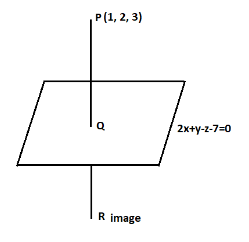
We have to use the formula to obtain the coordinate of image as mentioned below:
$ \Rightarrow \dfrac{{x - {x_1}}}{a} = \dfrac{{y - {y_1}}}{b} = \dfrac{{z - {z_1}}}{c} = \dfrac{{ - 2(a{x_1} + b{y_1} + c{z_1} + d)}}{{({a^2} + {b^2} + {c^2})}}...............(B)$
Where $({x_1},{y_1},{z_1})$are the points P(1, 2, 3) and $a{x_1} + b{y_1} + c{z_1} + d = 0$is the given plane $2x + y - z - 7 = 0$
Complete step-by-step answer:
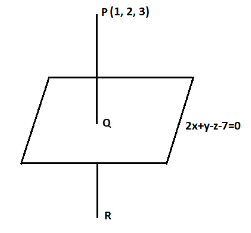
Step 1: First of all we have to determine the direction ratios which are ${x_1} - 1,{y_1} - 2$ and ${z_1} - 3$ as mentioned in the solution hint which are obtained with the help of the given point P(1, 2, 3) we can also understand it with the help of the diagram given below:
Step 2: Now, we can obtain the direction ratios $\overrightarrow n $which are (2, 1, -1)
Step 3: Now, as we know that obtained direction ratios and $\overrightarrow n $are parallel to each other hence on applying the formula (A) as mentioned in the solution hint. On substituting all the values in formula (a),
$ \Rightarrow \dfrac{{{x_1} - 1}}{2} = \dfrac{{{y_1} - 2}}{1} = \dfrac{{{z_1} - 3}}{{ - 1}} = \lambda $……………………..(1)
Step 4: Now, to obtain the values of $({x_1},{y_1},{z_1})$we have to apply the cross-multiplication. Hence,
$ \Rightarrow {x_1} = 2\lambda + 1,$
$ \Rightarrow {y_1} = \lambda + 2,$
$ \Rightarrow {z_1} = - \lambda + 3$
Step 5: Now, as we know that points $({x_1},{y_1},{z_1})$ lies on the plane $2x + y - z - 7 = 0$hence, on substituting all the points in the plane given,
$ \Rightarrow 2(2\lambda + 1) + (\lambda + 2) - ( - \lambda + 3) - 7 = 0$………………..(2)
Step 6: On solving the expression (2) obtained in the step 5 we can determine the value of $\lambda $ hence,
$
\Rightarrow 4\lambda + 2 + \lambda + 2 + \lambda - 3 - 7 = 0 \\
\Rightarrow 6\lambda = 6 \\
\Rightarrow \lambda = \dfrac{6}{6} \\
\Rightarrow \lambda = 1
$
Step 7: on substituting the value of $\lambda $ the points $({x_1},{y_1},{z_1})$ as obtained in step 4. Hence,
$
\Rightarrow {x_1} = 2 \times 1 + 1 \\
\Rightarrow {x_1} = 3 \\
$
$
\Rightarrow {y_1} = 1 + 2 \\
\Rightarrow {y_1} = 3
$
And,
$
\Rightarrow {z_1} = - 1 + 3 \\
\Rightarrow {z_1} = 2
$
Hence, points of foot are $Q(3,3,2)$
Step 8: Now, with the help of the formula (B) as mentioned in the solution hint we can obtain the coordinate of the image. Hence, on substituting all the values of point A (1, 2, 3) and plane $2x + y - z - 7 = 0$ in the formula (B),
$ \Rightarrow \dfrac{{x - 1}}{2} = \dfrac{{y - 2}}{1} = \dfrac{{z - 3}}{{ - 1}} = \dfrac{{ - 2(2 \times 1 + 1 \times 2 + ( - 1) \times 3 - 7)}}{{{2^2} + {1^2} + ( - {1^2})}}$
On solving the expression obtained just above,
$
\Rightarrow \dfrac{{x - 1}}{2} = \dfrac{{y - 2}}{1} = \dfrac{{z - 3}}{{ - 1}} = \dfrac{{ - 2(2 \times 1 + 1 \times 2 + ( - 1) \times 3 - 7)}}{{{2^2} + {1^2} + ( - {1^2})}} \\
\Rightarrow \dfrac{{x - 1}}{2} = \dfrac{{y - 2}}{1} = \dfrac{{z - 3}}{{ - 1}} = \dfrac{{ - 2(2 + 2 - 3 - 7)}}{{4 + 1 + 1}} \\
\Rightarrow \dfrac{{x - 1}}{2} = \dfrac{{y - 2}}{1} = \dfrac{{z - 3}}{{ - 1}} = \dfrac{{ - 2 \times - 6}}{6} \\
\Rightarrow \dfrac{{x - 1}}{2} = \dfrac{{y - 2}}{1} = \dfrac{{z - 3}}{{ - 1}} = - 2...................(3)
$
Step 9: Now, on solving the expression as obtained in the solution step 8 by applying cross-multiplication,
$
\Rightarrow x - 1 = - 2 \times 2 \\
\Rightarrow x = - 4 + 1 \\
\Rightarrow x = - 3
$
Same as,
$
\Rightarrow y - 2 = - 2 \times 1 \\
\Rightarrow y = - 2 + 2 \\
\Rightarrow y = 0
$
And,
$
\Rightarrow z - 3 = - 2 \times - 1 \\
\Rightarrow z = 3 + 3 \\
\Rightarrow z = 6
$
Hence, with the help of formula (A) and (B) the coordinate of foot of perpendicular drawn from the point (1, 2, 3) to the plane $2x + y - z - 7 = 0$ is $Q(3,3,2)$ and the image of that point \[\left( { - 3,0,6} \right)\]
Note: If a perpendicular line is drawn from any point on the plane to this straight line then the point of intersection of the given straight line and its perpendicular is called the foot of corresponding perpendicular.
If any point is perpendicular to the given plane and it is asked to determine the points or coordinate of the image of that point then the image of coordinate will be below the plane and will be perpendicular to that plane.
Now, from the diagram above we can see that we have point A(1, 2, 3) and we have to determine the coordinates of foot Q to the plane $2x + y - z - 7 = 0$. Now from the diagram above we can see that direction ratio and $\overrightarrow n $are parallel to each other so we can determine the foot with the help of the formula to determine foot as mentioned below:
$ \Rightarrow \dfrac{{{x_1} - x}}{a} = \dfrac{{{y_1} - y}}{b} = \dfrac{{{z_1} - z}}{c} = \lambda .................(A)$
Where, a, b, and c can be obtained from the plane and x, y, and x are the points of A. Therefore after solving the obtained expression we can obtain a coordinate of foot perpendicular drawn from the point (1, 2, 3) to the plane $2x + y - z - 7 = 0$.
Now, to determine the image of point P which is R below the plane as mentioned in the image below:
We have to use the formula to obtain the coordinate of image as mentioned below:
$ \Rightarrow \dfrac{{x - {x_1}}}{a} = \dfrac{{y - {y_1}}}{b} = \dfrac{{z - {z_1}}}{c} = \dfrac{{ - 2(a{x_1} + b{y_1} + c{z_1} + d)}}{{({a^2} + {b^2} + {c^2})}}...............(B)$
Where $({x_1},{y_1},{z_1})$are the points P(1, 2, 3) and $a{x_1} + b{y_1} + c{z_1} + d = 0$is the given plane $2x + y - z - 7 = 0$
Complete step-by-step answer:
Step 1: First of all we have to determine the direction ratios which are ${x_1} - 1,{y_1} - 2$ and ${z_1} - 3$ as mentioned in the solution hint which are obtained with the help of the given point P(1, 2, 3) we can also understand it with the help of the diagram given below:
Step 2: Now, we can obtain the direction ratios $\overrightarrow n $which are (2, 1, -1)
Step 3: Now, as we know that obtained direction ratios and $\overrightarrow n $are parallel to each other hence on applying the formula (A) as mentioned in the solution hint. On substituting all the values in formula (a),
$ \Rightarrow \dfrac{{{x_1} - 1}}{2} = \dfrac{{{y_1} - 2}}{1} = \dfrac{{{z_1} - 3}}{{ - 1}} = \lambda $……………………..(1)
Step 4: Now, to obtain the values of $({x_1},{y_1},{z_1})$we have to apply the cross-multiplication. Hence,
$ \Rightarrow {x_1} = 2\lambda + 1,$
$ \Rightarrow {y_1} = \lambda + 2,$
$ \Rightarrow {z_1} = - \lambda + 3$
Step 5: Now, as we know that points $({x_1},{y_1},{z_1})$ lies on the plane $2x + y - z - 7 = 0$hence, on substituting all the points in the plane given,
$ \Rightarrow 2(2\lambda + 1) + (\lambda + 2) - ( - \lambda + 3) - 7 = 0$………………..(2)
Step 6: On solving the expression (2) obtained in the step 5 we can determine the value of $\lambda $ hence,
$
\Rightarrow 4\lambda + 2 + \lambda + 2 + \lambda - 3 - 7 = 0 \\
\Rightarrow 6\lambda = 6 \\
\Rightarrow \lambda = \dfrac{6}{6} \\
\Rightarrow \lambda = 1
$
Step 7: on substituting the value of $\lambda $ the points $({x_1},{y_1},{z_1})$ as obtained in step 4. Hence,
$
\Rightarrow {x_1} = 2 \times 1 + 1 \\
\Rightarrow {x_1} = 3 \\
$
$
\Rightarrow {y_1} = 1 + 2 \\
\Rightarrow {y_1} = 3
$
And,
$
\Rightarrow {z_1} = - 1 + 3 \\
\Rightarrow {z_1} = 2
$
Hence, points of foot are $Q(3,3,2)$
Step 8: Now, with the help of the formula (B) as mentioned in the solution hint we can obtain the coordinate of the image. Hence, on substituting all the values of point A (1, 2, 3) and plane $2x + y - z - 7 = 0$ in the formula (B),
$ \Rightarrow \dfrac{{x - 1}}{2} = \dfrac{{y - 2}}{1} = \dfrac{{z - 3}}{{ - 1}} = \dfrac{{ - 2(2 \times 1 + 1 \times 2 + ( - 1) \times 3 - 7)}}{{{2^2} + {1^2} + ( - {1^2})}}$
On solving the expression obtained just above,
$
\Rightarrow \dfrac{{x - 1}}{2} = \dfrac{{y - 2}}{1} = \dfrac{{z - 3}}{{ - 1}} = \dfrac{{ - 2(2 \times 1 + 1 \times 2 + ( - 1) \times 3 - 7)}}{{{2^2} + {1^2} + ( - {1^2})}} \\
\Rightarrow \dfrac{{x - 1}}{2} = \dfrac{{y - 2}}{1} = \dfrac{{z - 3}}{{ - 1}} = \dfrac{{ - 2(2 + 2 - 3 - 7)}}{{4 + 1 + 1}} \\
\Rightarrow \dfrac{{x - 1}}{2} = \dfrac{{y - 2}}{1} = \dfrac{{z - 3}}{{ - 1}} = \dfrac{{ - 2 \times - 6}}{6} \\
\Rightarrow \dfrac{{x - 1}}{2} = \dfrac{{y - 2}}{1} = \dfrac{{z - 3}}{{ - 1}} = - 2...................(3)
$
Step 9: Now, on solving the expression as obtained in the solution step 8 by applying cross-multiplication,
$
\Rightarrow x - 1 = - 2 \times 2 \\
\Rightarrow x = - 4 + 1 \\
\Rightarrow x = - 3
$
Same as,
$
\Rightarrow y - 2 = - 2 \times 1 \\
\Rightarrow y = - 2 + 2 \\
\Rightarrow y = 0
$
And,
$
\Rightarrow z - 3 = - 2 \times - 1 \\
\Rightarrow z = 3 + 3 \\
\Rightarrow z = 6
$
Hence, with the help of formula (A) and (B) the coordinate of foot of perpendicular drawn from the point (1, 2, 3) to the plane $2x + y - z - 7 = 0$ is $Q(3,3,2)$ and the image of that point \[\left( { - 3,0,6} \right)\]
Note: If a perpendicular line is drawn from any point on the plane to this straight line then the point of intersection of the given straight line and its perpendicular is called the foot of corresponding perpendicular.
If any point is perpendicular to the given plane and it is asked to determine the points or coordinate of the image of that point then the image of coordinate will be below the plane and will be perpendicular to that plane.
Recently Updated Pages
Master Class 12 Social Science: Engaging Questions & Answers for Success

Master Class 12 Physics: Engaging Questions & Answers for Success
Master Class 12 Maths: Engaging Questions & Answers for Success
Master Class 12 Economics: Engaging Questions & Answers for Success
Master Class 12 Chemistry: Engaging Questions & Answers for Success
Master Class 12 Business Studies: Engaging Questions & Answers for Success
Trending doubts
Which are the Top 10 Largest Countries of the World?
Draw a labelled sketch of the human eye class 12 physics CBSE
Explain the structure of megasporangium class 12 biology CBSE
What are the major means of transport Explain each class 12 social science CBSE
How many chromosomes are found in human ovum a 46 b class 12 biology CBSE
The diagram of the section of a maize grain is given class 12 biology CBSE