




Find the condition for the line $x\cos \alpha + y\sin \alpha = p$ to be a tangent to the ellipse \[\dfrac{{{x^2}}}{{{a^2}}} + \dfrac{{{y^2}}}{{{b^2}}} = 1\]
Answer
 Verified
630.9k+ views
Hint: - Equation of tangent in parametric form to the given ellipse is written as
$\dfrac{x}{a}\cos \theta + \dfrac{y}{b}\sin \theta = 1$
Complete step-by-step answer:
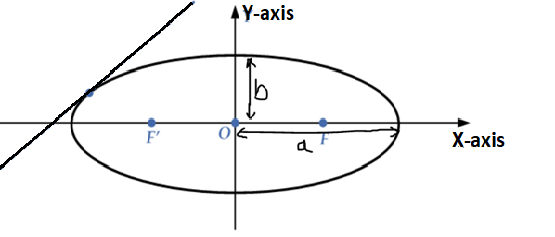
Here we need to find the condition for the given line to be a tangent to the given ellipse ie.
So, we can proceed as we know that the equation of tangent in parametric form to the given ellipse is written as $\dfrac{x}{a}\cos \theta + \dfrac{y}{b}\sin \theta = 1$.
Now as the next step compare the above parametric equation with \[x\cos \alpha + y\sin \alpha = p\]
This implies \[\dfrac{x}{p}\cos \alpha = \dfrac{x}{a}\cos \theta \] and \[\dfrac{y}{p}\sin \alpha = \dfrac{y}{b}\sin \theta ,\] if we rearrange these expressions, we get
\[\dfrac{{\cos \theta }}{{a\cos \alpha }} = \dfrac{{\sin \theta }}{{b\sin \alpha }} = \dfrac{1}{p}\]or \[ \Rightarrow \cos \theta = \dfrac{{a\cos \alpha }}{p}\]and \[{\text{sin}}\theta {\text{ = }}\dfrac{{b\sin \alpha }}{p}\]
We have obtained the value of \[\cos \theta \] and \[\sin \theta \]. Square and adding both sides we get
\[{\text{1 = }}\dfrac{{{a^2}{{\cos }^2}\alpha }}{{{p^2}}} + \dfrac{{{b^2}{{\sin }^2}\alpha }}{{{p^2}}}\]
\[ \Rightarrow {a^2}{\cos ^2}\alpha + {b^2}{\sin ^2}\alpha = {p^2}\]
Which is the required Condition for the given line to be a tangent on the given ellipse.
Note- Whenever this type of question appears always first note down the given details given in the question as it provides a better understanding to approach the question. Once \[\cos \theta \] and \[\sin \theta \] obtain square and add both sides respectively to obtain the required condition for the given line to be tangent on the given ellipse.
$\dfrac{x}{a}\cos \theta + \dfrac{y}{b}\sin \theta = 1$
Complete step-by-step answer:
Here we need to find the condition for the given line to be a tangent to the given ellipse ie.
So, we can proceed as we know that the equation of tangent in parametric form to the given ellipse is written as $\dfrac{x}{a}\cos \theta + \dfrac{y}{b}\sin \theta = 1$.
Now as the next step compare the above parametric equation with \[x\cos \alpha + y\sin \alpha = p\]
This implies \[\dfrac{x}{p}\cos \alpha = \dfrac{x}{a}\cos \theta \] and \[\dfrac{y}{p}\sin \alpha = \dfrac{y}{b}\sin \theta ,\] if we rearrange these expressions, we get
\[\dfrac{{\cos \theta }}{{a\cos \alpha }} = \dfrac{{\sin \theta }}{{b\sin \alpha }} = \dfrac{1}{p}\]or \[ \Rightarrow \cos \theta = \dfrac{{a\cos \alpha }}{p}\]and \[{\text{sin}}\theta {\text{ = }}\dfrac{{b\sin \alpha }}{p}\]
We have obtained the value of \[\cos \theta \] and \[\sin \theta \]. Square and adding both sides we get
\[{\text{1 = }}\dfrac{{{a^2}{{\cos }^2}\alpha }}{{{p^2}}} + \dfrac{{{b^2}{{\sin }^2}\alpha }}{{{p^2}}}\]
\[ \Rightarrow {a^2}{\cos ^2}\alpha + {b^2}{\sin ^2}\alpha = {p^2}\]
Which is the required Condition for the given line to be a tangent on the given ellipse.
Note- Whenever this type of question appears always first note down the given details given in the question as it provides a better understanding to approach the question. Once \[\cos \theta \] and \[\sin \theta \] obtain square and add both sides respectively to obtain the required condition for the given line to be tangent on the given ellipse.
Recently Updated Pages
Basicity of sulphurous acid and sulphuric acid are

Master Class 11 Business Studies: Engaging Questions & Answers for Success
Master Class 11 Computer Science: Engaging Questions & Answers for Success
Master Class 11 Economics: Engaging Questions & Answers for Success
Master Class 11 Social Science: Engaging Questions & Answers for Success
Master Class 11 English: Engaging Questions & Answers for Success
Trending doubts
One Metric ton is equal to kg A 10000 B 1000 C 100 class 11 physics CBSE
What are the examples of C3 and C4 plants class 11 biology CBSE
State and prove Bernoullis theorem class 11 physics CBSE
Draw a diagram of a plant cell and label at least eight class 11 biology CBSE
10 examples of friction in our daily life
A body is said to be in dynamic equilibrium if A When class 11 physics CBSE