




Find the coefficient of ${{x}^{4}}$ in the expansion of
${{(2-4x+3{{x}^{2}})}^{-2}}$.
Answer
 Verified
664.8k+ views
- Hint: Assume that the roots of the quadratic expression $3{{x}^{2}}-4x+2=0$ are a and b. Hence write $\dfrac{1}{{{\left( 3{{x}^{2}}-4x+2 \right)}^{2}}}$ as $\dfrac{1}{9}{{\left( \dfrac{1}{\left( x-a \right)\left( x-b \right)} \right)}^{2}}$. Decompose $\dfrac{1}{\left( x-a \right)\left( x-b \right)}$ into partial fractions by multiplying and dividing numerator by $b-a$ and writing b-a as (x-a)-(x-b). Use the identity ${{\left( a-b \right)}^{2}}={{a}^{2}}-2ab+{{b}^{2}}$ and binomial theorem for non-integral powers and hence find the coefficient of ${{x}^{4}}$ in the expansion of the term.
Complete step-by-step solution -
Let the roots of the quadratic expression $3{{x}^{2}}-4x+2=0$ be a and b.
Hence, we have
$3{{x}^{2}}-4x+2=3\left( x-a \right)\left( x-b \right)$
Hence, the given expression(E say) becomes
$E=\dfrac{1}{9}{{\left( \dfrac{1}{\left( x-a \right)\left( x-b \right)} \right)}^{2}}$
Inside the square term multiplying numerator and denominator by a-b, we get
$E=\dfrac{1}{9{{\left( a-b \right)}^{2}}}{{\left( \dfrac{a-b}{\left( x-a \right)\left( x-b \right)} \right)}^{2}}$
Writing a-b as (x-b)-(x-a) in the numerator, we get
$E=\dfrac{1}{9{{\left( a-b \right)}^{2}}}{{\left( \dfrac{x-b-\left( x-a \right)}{\left( x-a \right)\left( x-b \right)} \right)}^{2}}$
Using $\dfrac{a+b}{c}=\dfrac{a}{c}+\dfrac{b}{c}$, we get
$E=\dfrac{1}{9{{\left( a-b \right)}^{2}}}{{\left( \dfrac{1}{x-a}-\dfrac{1}{x-b} \right)}^{2}}$
Using the identity ${{\left( a-b \right)}^{2}}={{a}^{2}}-2ab+{{b}^{2}}$, we get
$E=\dfrac{1}{9{{\left( a-b \right)}^{2}}}\left( \dfrac{1}{{{\left( x-a \right)}^{2}}}+\dfrac{1}{{{\left( x-b \right)}^{2}}}+\dfrac{2}{\left( x-a \right)\left( x-b \right)} \right)$
From the above procedure, we know that $\dfrac{1}{\left( x-a \right)\left( x-b \right)}=\dfrac{1}{a-b}\left( \dfrac{1}{x-a}-\dfrac{1}{x-b} \right)$
Hence, we have
$E=\dfrac{1}{9{{\left( a-b \right)}^{2}}}\left( \dfrac{1}{{{\left( x-a \right)}^{2}}}+\dfrac{1}{{{\left( x-b \right)}^{2}}}+\dfrac{2}{a-b}\left( \dfrac{1}{x-a}-\dfrac{1}{x-b} \right) \right)$
Consider the term $\dfrac{1}{{{\left( x-a \right)}^{2}}}$
We know from binomial theorem for real exponents
${{\left( 1+x \right)}^{n}}=1+nx+\dfrac{n\left( n-1 \right)}{2!}{{x}^{2}}+\cdots $
Hence, we have
${{\left( x-a \right)}^{-2}}={{a}^{-2}}{{\left( 1-\dfrac{x}{a} \right)}^{-2}}=\dfrac{1}{{{a}^{2}}}\left( 1+\dfrac{2x}{a}+\dfrac{3!}{2!}{{\left( \dfrac{x}{a} \right)}^{2}}+\dfrac{4!}{3!}{{\left( \dfrac{x}{a} \right)}^{3}}+\dfrac{5!}{4!}{{\left( \dfrac{x}{a} \right)}^{4}}+O\left( {{x}^{5}} \right) \right)$
Hence the coefficient of ${{x}^{4}}$ in the expansion of $\dfrac{1}{{{\left( x-a \right)}^{2}}}$ is $\dfrac{5}{{{a}^{6}}}$
Similarly, the coefficient of ${{x}^{4}}$ in the expansion of $\dfrac{1}{{{\left( x-b \right)}^{2}}}$ is $\dfrac{5}{{{b}^{6}}}$
Consider the term $\dfrac{1}{x-a}$
We know from binomial theorem for real exponents
${{\left( 1+x \right)}^{n}}=1+nx+\dfrac{n\left( n-1 \right)}{2!}{{x}^{2}}+\cdots $
Hence, we have
${{\left( x-a \right)}^{-1}}=-{{a}^{-1}}{{\left( 1-\dfrac{x}{a} \right)}^{-1}}=-\dfrac{1}{a}\left( 1+\dfrac{x}{a}+{{\left( \dfrac{x}{a} \right)}^{2}}+{{\left( \dfrac{x}{a} \right)}^{3}}+{{\left( \dfrac{x}{a} \right)}^{4}}+O\left( {{x}^{5}} \right) \right)$
Hence the coefficient of ${{x}^{4}}$ in the expansion of $\dfrac{1}{\left( x-a \right)}$ is $-\dfrac{1}{{{a}^{5}}}$
Similarly, the coefficient of ${{x}^{4}}$ in the expansion of $\dfrac{1}{x-b}$ is $-\dfrac{1}{{{b}^{5}}}$
Hence, the coefficient of ${{x}^{4}}$ in the expansion of E is $\dfrac{1}{9{{\left( a-b \right)}^{2}}}\left( \dfrac{5}{{{a}^{6}}}+\dfrac{5}{{{b}^{6}}}-\dfrac{2}{a-b}\left( -\dfrac{1}{{{a}^{5}}}+\dfrac{1}{{{b}^{5}}} \right) \right)=\dfrac{1}{9{{\left( a-b \right)}^{2}}}\left( \dfrac{5}{{{\left( ab \right)}^{6}}}\left( {{a}^{6}}+{{b}^{6}} \right)-\dfrac{2\left( {{a}^{5}}-{{b}^{5}} \right)}{\left( a-b \right){{\left( ab \right)}^{5}}} \right)$
Dividing ${{a}^{5}}-{{b}^{5}}$ by a-b
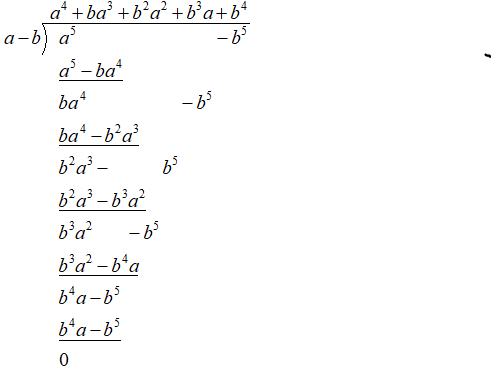
Hence, we have $\dfrac{{{a}^{5}}-{{b}^{5}}}{a-b}=\left( {{a}^{4}}+{{b}^{4}}+ab\left( {{a}^{2}}+{{b}^{2}} \right)+{{a}^{2}}{{b}^{2}} \right)$
Hence, the coefficient of ${{x}^{4}}$ in the expansion of E is
$\dfrac{1}{9{{\left( a-b \right)}^{2}}}\left( \dfrac{5}{{{\left( ab \right)}^{6}}}\left( {{a}^{6}}+{{b}^{6}} \right)-\dfrac{2\left( {{a}^{4}}+{{b}^{4}}+ab\left( {{a}^{2}}+{{b}^{2}} \right)+{{a}^{2}}{{b}^{2}} \right)}{{{\left( ab \right)}^{5}}} \right)$
Now, we have $a+b=\dfrac{4}{3},ab=\dfrac{2}{3}$
Hence, we have
${{\left( a-b \right)}^{2}}={{\left( a+b \right)}^{2}}-4ab=\dfrac{16}{9}-\dfrac{8}{3}=\dfrac{-8}{9}$
Also, we have
$\begin{align}
& {{a}^{2}}+{{b}^{2}}={{\left( a+b \right)}^{2}}-2ab=\dfrac{16}{9}-\dfrac{4}{3}=\dfrac{4}{9} \\
& {{a}^{4}}+{{b}^{4}}={{\left( {{a}^{2}}+{{b}^{2}} \right)}^{2}}-2{{\left( ab \right)}^{2}}=\dfrac{16}{81}-2\times \dfrac{4}{9}=\dfrac{16}{81}-\dfrac{8}{9}=\dfrac{-56}{81} \\
& {{a}^{6}}+{{b}^{6}}=\left( {{a}^{2}}+{{b}^{2}} \right)\left( {{a}^{4}}+{{b}^{4}}-{{\left( ab \right)}^{2}} \right)=\dfrac{4}{9}\left( \dfrac{-56}{81}-\dfrac{4}{9} \right)=\dfrac{-368}{729} \\
\end{align}$
Hence, we have
The coefficient of ${{x}^{4}}$ in the expansion of E is
$\dfrac{1}{9\left( \dfrac{-8}{9} \right)}\left( \dfrac{5}{{{\left( \dfrac{2}{3} \right)}^{6}}}\left( \dfrac{-368}{729} \right)+\dfrac{2}{{{\left( \dfrac{2}{3} \right)}^{5}}}\left( \dfrac{-56}{81}+\dfrac{2}{3}\left( \dfrac{4}{9} \right)+{{\left( \dfrac{2}{3} \right)}^{2}} \right) \right)=\dfrac{59}{16}$
Hence the coefficient of ${{x}^{4}}$ in the expansion of ${{(2-4x+3{{x}^{2}})}^{-2}}$ is $\dfrac{59}{16}$
Note: These types of questions usually involve long and cumbersome calculations, and hence a student is likely to make calculation mistakes. So we should try to minimise calculations as much as possible. In the above question, we minimise our calculation by converting to partial fractions and finding the coefficients of individual terms in summation rather than in product which made the calculations relatively easy.
Complete step-by-step solution -
Let the roots of the quadratic expression $3{{x}^{2}}-4x+2=0$ be a and b.
Hence, we have
$3{{x}^{2}}-4x+2=3\left( x-a \right)\left( x-b \right)$
Hence, the given expression(E say) becomes
$E=\dfrac{1}{9}{{\left( \dfrac{1}{\left( x-a \right)\left( x-b \right)} \right)}^{2}}$
Inside the square term multiplying numerator and denominator by a-b, we get
$E=\dfrac{1}{9{{\left( a-b \right)}^{2}}}{{\left( \dfrac{a-b}{\left( x-a \right)\left( x-b \right)} \right)}^{2}}$
Writing a-b as (x-b)-(x-a) in the numerator, we get
$E=\dfrac{1}{9{{\left( a-b \right)}^{2}}}{{\left( \dfrac{x-b-\left( x-a \right)}{\left( x-a \right)\left( x-b \right)} \right)}^{2}}$
Using $\dfrac{a+b}{c}=\dfrac{a}{c}+\dfrac{b}{c}$, we get
$E=\dfrac{1}{9{{\left( a-b \right)}^{2}}}{{\left( \dfrac{1}{x-a}-\dfrac{1}{x-b} \right)}^{2}}$
Using the identity ${{\left( a-b \right)}^{2}}={{a}^{2}}-2ab+{{b}^{2}}$, we get
$E=\dfrac{1}{9{{\left( a-b \right)}^{2}}}\left( \dfrac{1}{{{\left( x-a \right)}^{2}}}+\dfrac{1}{{{\left( x-b \right)}^{2}}}+\dfrac{2}{\left( x-a \right)\left( x-b \right)} \right)$
From the above procedure, we know that $\dfrac{1}{\left( x-a \right)\left( x-b \right)}=\dfrac{1}{a-b}\left( \dfrac{1}{x-a}-\dfrac{1}{x-b} \right)$
Hence, we have
$E=\dfrac{1}{9{{\left( a-b \right)}^{2}}}\left( \dfrac{1}{{{\left( x-a \right)}^{2}}}+\dfrac{1}{{{\left( x-b \right)}^{2}}}+\dfrac{2}{a-b}\left( \dfrac{1}{x-a}-\dfrac{1}{x-b} \right) \right)$
Consider the term $\dfrac{1}{{{\left( x-a \right)}^{2}}}$
We know from binomial theorem for real exponents
${{\left( 1+x \right)}^{n}}=1+nx+\dfrac{n\left( n-1 \right)}{2!}{{x}^{2}}+\cdots $
Hence, we have
${{\left( x-a \right)}^{-2}}={{a}^{-2}}{{\left( 1-\dfrac{x}{a} \right)}^{-2}}=\dfrac{1}{{{a}^{2}}}\left( 1+\dfrac{2x}{a}+\dfrac{3!}{2!}{{\left( \dfrac{x}{a} \right)}^{2}}+\dfrac{4!}{3!}{{\left( \dfrac{x}{a} \right)}^{3}}+\dfrac{5!}{4!}{{\left( \dfrac{x}{a} \right)}^{4}}+O\left( {{x}^{5}} \right) \right)$
Hence the coefficient of ${{x}^{4}}$ in the expansion of $\dfrac{1}{{{\left( x-a \right)}^{2}}}$ is $\dfrac{5}{{{a}^{6}}}$
Similarly, the coefficient of ${{x}^{4}}$ in the expansion of $\dfrac{1}{{{\left( x-b \right)}^{2}}}$ is $\dfrac{5}{{{b}^{6}}}$
Consider the term $\dfrac{1}{x-a}$
We know from binomial theorem for real exponents
${{\left( 1+x \right)}^{n}}=1+nx+\dfrac{n\left( n-1 \right)}{2!}{{x}^{2}}+\cdots $
Hence, we have
${{\left( x-a \right)}^{-1}}=-{{a}^{-1}}{{\left( 1-\dfrac{x}{a} \right)}^{-1}}=-\dfrac{1}{a}\left( 1+\dfrac{x}{a}+{{\left( \dfrac{x}{a} \right)}^{2}}+{{\left( \dfrac{x}{a} \right)}^{3}}+{{\left( \dfrac{x}{a} \right)}^{4}}+O\left( {{x}^{5}} \right) \right)$
Hence the coefficient of ${{x}^{4}}$ in the expansion of $\dfrac{1}{\left( x-a \right)}$ is $-\dfrac{1}{{{a}^{5}}}$
Similarly, the coefficient of ${{x}^{4}}$ in the expansion of $\dfrac{1}{x-b}$ is $-\dfrac{1}{{{b}^{5}}}$
Hence, the coefficient of ${{x}^{4}}$ in the expansion of E is $\dfrac{1}{9{{\left( a-b \right)}^{2}}}\left( \dfrac{5}{{{a}^{6}}}+\dfrac{5}{{{b}^{6}}}-\dfrac{2}{a-b}\left( -\dfrac{1}{{{a}^{5}}}+\dfrac{1}{{{b}^{5}}} \right) \right)=\dfrac{1}{9{{\left( a-b \right)}^{2}}}\left( \dfrac{5}{{{\left( ab \right)}^{6}}}\left( {{a}^{6}}+{{b}^{6}} \right)-\dfrac{2\left( {{a}^{5}}-{{b}^{5}} \right)}{\left( a-b \right){{\left( ab \right)}^{5}}} \right)$
Dividing ${{a}^{5}}-{{b}^{5}}$ by a-b
Hence, we have $\dfrac{{{a}^{5}}-{{b}^{5}}}{a-b}=\left( {{a}^{4}}+{{b}^{4}}+ab\left( {{a}^{2}}+{{b}^{2}} \right)+{{a}^{2}}{{b}^{2}} \right)$
Hence, the coefficient of ${{x}^{4}}$ in the expansion of E is
$\dfrac{1}{9{{\left( a-b \right)}^{2}}}\left( \dfrac{5}{{{\left( ab \right)}^{6}}}\left( {{a}^{6}}+{{b}^{6}} \right)-\dfrac{2\left( {{a}^{4}}+{{b}^{4}}+ab\left( {{a}^{2}}+{{b}^{2}} \right)+{{a}^{2}}{{b}^{2}} \right)}{{{\left( ab \right)}^{5}}} \right)$
Now, we have $a+b=\dfrac{4}{3},ab=\dfrac{2}{3}$
Hence, we have
${{\left( a-b \right)}^{2}}={{\left( a+b \right)}^{2}}-4ab=\dfrac{16}{9}-\dfrac{8}{3}=\dfrac{-8}{9}$
Also, we have
$\begin{align}
& {{a}^{2}}+{{b}^{2}}={{\left( a+b \right)}^{2}}-2ab=\dfrac{16}{9}-\dfrac{4}{3}=\dfrac{4}{9} \\
& {{a}^{4}}+{{b}^{4}}={{\left( {{a}^{2}}+{{b}^{2}} \right)}^{2}}-2{{\left( ab \right)}^{2}}=\dfrac{16}{81}-2\times \dfrac{4}{9}=\dfrac{16}{81}-\dfrac{8}{9}=\dfrac{-56}{81} \\
& {{a}^{6}}+{{b}^{6}}=\left( {{a}^{2}}+{{b}^{2}} \right)\left( {{a}^{4}}+{{b}^{4}}-{{\left( ab \right)}^{2}} \right)=\dfrac{4}{9}\left( \dfrac{-56}{81}-\dfrac{4}{9} \right)=\dfrac{-368}{729} \\
\end{align}$
Hence, we have
The coefficient of ${{x}^{4}}$ in the expansion of E is
$\dfrac{1}{9\left( \dfrac{-8}{9} \right)}\left( \dfrac{5}{{{\left( \dfrac{2}{3} \right)}^{6}}}\left( \dfrac{-368}{729} \right)+\dfrac{2}{{{\left( \dfrac{2}{3} \right)}^{5}}}\left( \dfrac{-56}{81}+\dfrac{2}{3}\left( \dfrac{4}{9} \right)+{{\left( \dfrac{2}{3} \right)}^{2}} \right) \right)=\dfrac{59}{16}$
Hence the coefficient of ${{x}^{4}}$ in the expansion of ${{(2-4x+3{{x}^{2}})}^{-2}}$ is $\dfrac{59}{16}$
Note: These types of questions usually involve long and cumbersome calculations, and hence a student is likely to make calculation mistakes. So we should try to minimise calculations as much as possible. In the above question, we minimise our calculation by converting to partial fractions and finding the coefficients of individual terms in summation rather than in product which made the calculations relatively easy.
Recently Updated Pages
If x a + bt + ct2 where x is in meters and t is in class 11 physics CBSE

A car covers the first half distance between two places class 11 physics CBSE
The resultant of two vectors overrightarrow P and overrightarrow class 11 physics CBSE
Find the value of cos 135 class 11 maths CBSE
A mass M is held in place by an applied force F and class 11 physics CBSE
A solution of glucose in water is labelled as 10 dfracwv class 11 chemistry CBSE
Trending doubts
One Metric ton is equal to kg A 10000 B 1000 C 100 class 11 physics CBSE
Find the value of the expression given below sin 30circ class 11 maths CBSE
Draw a diagram of nephron and explain its structur class 11 biology CBSE
10 examples of friction in our daily life
Proton was discovered by A Thomson B Rutherford C Chadwick class 11 chemistry CBSE
Bond order ofO2 O2+ O2 and O22 is in order A O2 langle class 11 chemistry CBSE