




Find the circumcenter and circumradius of the triangle whose vertices are (1, 1), (2, -1), and (3, 2)
Answer
 Verified
627.6k+ views
Hint: Now to solve this equation we will use the property of a circle that the distance between any point on the circle and the center is constant. Now we know that the vertices of a triangle lie on the circumcircle of the triangle. Hence we will assume the circumcenter to be (x, y). Then by distance formula, we will take Distance to point (1, 1), (3, 2) and (2, -1). Now all these distances are equal since they are nothing but the radius of the circumcircle. Hence we will get two equations, we will solve these equations simultaneously to find x and y. Once we have a circumcenter we will find circumradius by calculating the distance of this point and any vertex of the triangle.
Complete step by step answer:
Now we are given that the vertices of triangle are (1, 1), (2, -1) and (3, 2)
Let us say A = (1, 1), B = (2, -1) and C = (3, 2).
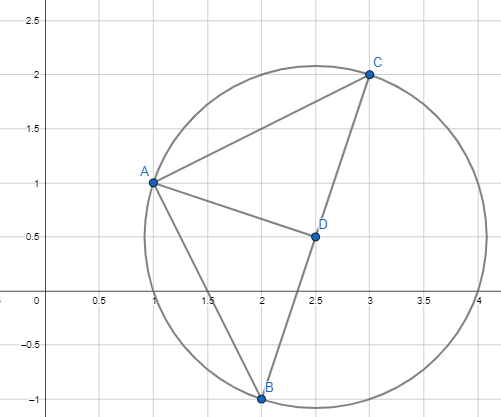
Now let O = (x, y) be the circumcenter of the triangle.
Now we can say that since O is circumcenter, OA = OB = OC = r.
Now Let us first calculate distance OA
We know that distance between two points $\left( {{x}_{1}},{{y}_{1}} \right)$ and $\left( {{x}_{2}},{{y}_{2}} \right)$ is given by $\sqrt{{{\left( {{x}_{2}}-{{x}_{1}} \right)}^{2}}+{{\left( {{y}_{2}}-{{y}_{1}} \right)}^{2}}}$
\[\begin{align}
& \Rightarrow r=\sqrt{{{\left( x-1 \right)}^{2}}+{{\left( y-1 \right)}^{2}}} \\
& \therefore {{r}^{2}}={{\left( x-1 \right)}^{2}}+{{\left( y-1 \right)}^{2}} \\
\end{align}\]
Now using ${{\left( a-b \right)}^{2}}={{a}^{2}}+{{b}^{2}}-2ab$ we get
\[{{r}^{2}}={{x}^{2}}+1-2x+{{y}^{2}}+1-2y...........\left( 1 \right)\]
Now Let us calculate distance OB.
We know that distance between two points $\left( {{x}_{1}},{{y}_{1}} \right)$ and $\left( {{x}_{2}},{{y}_{2}} \right)$ is given by $\sqrt{{{\left( {{x}_{2}}-{{x}_{1}} \right)}^{2}}+{{\left( {{y}_{2}}-{{y}_{1}} \right)}^{2}}}$
\[\begin{align}
& \Rightarrow r=\sqrt{{{\left( x-2 \right)}^{2}}+{{\left( y-\left( -1 \right) \right)}^{2}}} \\
& \therefore {{r}^{2}}={{\left( x-2 \right)}^{2}}+{{\left( y+1 \right)}^{2}} \\
\end{align}\]
Now using \[{{\left( a-b \right)}^{2}}={{a}^{2}}+{{b}^{2}}-2ab\] and ${{\left( a+b \right)}^{2}}={{a}^{2}}+{{b}^{2}}+2ab$ we get
\[{{r}^{2}}={{x}^{2}}+4-4x+{{y}^{2}}+1+2y...........\left( 2 \right)\]
And finally we calculate distance OC.
We know that distance between two points $\left( {{x}_{1}},{{y}_{1}} \right)$ and $\left( {{x}_{2}},{{y}_{2}} \right)$ is given by $\sqrt{{{\left( {{x}_{2}}-{{x}_{1}} \right)}^{2}}+{{\left( {{y}_{2}}-{{y}_{1}} \right)}^{2}}}$
\[\begin{align}
& \Rightarrow r=\sqrt{{{\left( x-3 \right)}^{2}}+{{\left( y-2 \right)}^{2}}} \\
& \therefore {{r}^{2}}={{\left( x-3 \right)}^{2}}+{{\left( y-2 \right)}^{2}} \\
\end{align}\]
Now using \[{{\left( a-b \right)}^{2}}={{a}^{2}}+{{b}^{2}}-2ab\] we get
\[{{r}^{2}}={{x}^{2}}+9-6x+{{y}^{2}}+4-4y...........\left( 3 \right)\]
Now equating equation (1) and equation (2) we get
\[\begin{align}
& {{x}^{2}}+1-2x+{{y}^{2}}+1-2y={{x}^{2}}+4-4x+{{y}^{2}}+1+2y \\
& \Rightarrow 1-2x+1-2y=4-4x+2y+1 \\
& \Rightarrow 2-2x-2y=5-4x+2y \\
& \Rightarrow 4x-2x-2y-2y=5-2 \\
& \therefore 2x-4y=3.......................................\left( 4 \right) \\
\end{align}\]
And again equating equation (1) and equation (3) we get.
\[\begin{align}
& {{x}^{2}}+1-2x+{{y}^{2}}+1-2y={{x}^{2}}+9-6x+{{y}^{2}}+4-4y \\
& \Rightarrow 1-2x+1-2y=9-6x+4-4y \\
& \Rightarrow 6x-2x+4y-2y=9+4-1-1 \\
& \therefore 4x+2y=11......................................(5) \\
\end{align}\]
Now multiplying equation (5) by 2 and adding the equation to equation (1) we get
$\begin{align}
& 8x+4y+2x-4y=22+3 \\
& \Rightarrow 10x=25 \\
& \therefore x=2.5 \\
\end{align}$
Now substituting x = 2.5 in equation (4) we get.
$\begin{align}
& 2\left( 2.5 \right)-4y=3 \\
& \Rightarrow 5-3=4y \\
& \Rightarrow 4y=2 \\
& \Rightarrow y=\dfrac{1}{2}=0.5 \\
& \therefore y=0.5 \\
\end{align}$
Hence we have x = 2.5 and y = 0.5.
Hence we get the coordinates of circumcenter is (2.5, 0.5)
Now we just need to find the circumradius.
Circumradius is nothing but the distance between circumcenter and any vertex. Let us take this vertex as A = (1, 1) for solving
Then we know that distance between two points $\left( {{x}_{1}},{{y}_{1}} \right)$ and $\left( {{x}_{2}},{{y}_{2}} \right)$ is given by $\sqrt{{{\left( {{x}_{2}}-{{x}_{1}} \right)}^{2}}+{{\left( {{y}_{2}}-{{y}_{1}} \right)}^{2}}}$
\[\begin{align}
& \Rightarrow r=\sqrt{{{\left( 2.5-1 \right)}^{2}}+{{\left( 0.5-1 \right)}^{2}}} \\
& \Rightarrow r=\sqrt{{{\left( 1.5 \right)}^{2}}+{{\left( -0.5 \right)}^{2}}} \\
& \Rightarrow r=\sqrt{2.25+0.25} \\
& \Rightarrow r=\sqrt{2.50} \\
& \Rightarrow r=\sqrt{\dfrac{250}{100}}=\dfrac{5\sqrt{10}}{10} \\
& \therefore r=\dfrac{\sqrt{10}}{2} \\
\end{align}\]
Hence we have circumcenter = (2.5, 0.5) and radius r = \[\dfrac{\sqrt{10}}{2}\].
Note:
Note that we can solve this problem by first calculating the distance AB, BC, and AC. Now we can see that the sides satisfy Pythagoras theorem and hence ABC is a right angle triangle.
Now we know the circumcenter of the right-angle triangle is nothing but the midpoint of the hypotenuse. Hence we can find the circumcenter by midpoint formula.
Complete step by step answer:
Now we are given that the vertices of triangle are (1, 1), (2, -1) and (3, 2)
Let us say A = (1, 1), B = (2, -1) and C = (3, 2).
Now let O = (x, y) be the circumcenter of the triangle.
Now we can say that since O is circumcenter, OA = OB = OC = r.
Now Let us first calculate distance OA
We know that distance between two points $\left( {{x}_{1}},{{y}_{1}} \right)$ and $\left( {{x}_{2}},{{y}_{2}} \right)$ is given by $\sqrt{{{\left( {{x}_{2}}-{{x}_{1}} \right)}^{2}}+{{\left( {{y}_{2}}-{{y}_{1}} \right)}^{2}}}$
\[\begin{align}
& \Rightarrow r=\sqrt{{{\left( x-1 \right)}^{2}}+{{\left( y-1 \right)}^{2}}} \\
& \therefore {{r}^{2}}={{\left( x-1 \right)}^{2}}+{{\left( y-1 \right)}^{2}} \\
\end{align}\]
Now using ${{\left( a-b \right)}^{2}}={{a}^{2}}+{{b}^{2}}-2ab$ we get
\[{{r}^{2}}={{x}^{2}}+1-2x+{{y}^{2}}+1-2y...........\left( 1 \right)\]
Now Let us calculate distance OB.
We know that distance between two points $\left( {{x}_{1}},{{y}_{1}} \right)$ and $\left( {{x}_{2}},{{y}_{2}} \right)$ is given by $\sqrt{{{\left( {{x}_{2}}-{{x}_{1}} \right)}^{2}}+{{\left( {{y}_{2}}-{{y}_{1}} \right)}^{2}}}$
\[\begin{align}
& \Rightarrow r=\sqrt{{{\left( x-2 \right)}^{2}}+{{\left( y-\left( -1 \right) \right)}^{2}}} \\
& \therefore {{r}^{2}}={{\left( x-2 \right)}^{2}}+{{\left( y+1 \right)}^{2}} \\
\end{align}\]
Now using \[{{\left( a-b \right)}^{2}}={{a}^{2}}+{{b}^{2}}-2ab\] and ${{\left( a+b \right)}^{2}}={{a}^{2}}+{{b}^{2}}+2ab$ we get
\[{{r}^{2}}={{x}^{2}}+4-4x+{{y}^{2}}+1+2y...........\left( 2 \right)\]
And finally we calculate distance OC.
We know that distance between two points $\left( {{x}_{1}},{{y}_{1}} \right)$ and $\left( {{x}_{2}},{{y}_{2}} \right)$ is given by $\sqrt{{{\left( {{x}_{2}}-{{x}_{1}} \right)}^{2}}+{{\left( {{y}_{2}}-{{y}_{1}} \right)}^{2}}}$
\[\begin{align}
& \Rightarrow r=\sqrt{{{\left( x-3 \right)}^{2}}+{{\left( y-2 \right)}^{2}}} \\
& \therefore {{r}^{2}}={{\left( x-3 \right)}^{2}}+{{\left( y-2 \right)}^{2}} \\
\end{align}\]
Now using \[{{\left( a-b \right)}^{2}}={{a}^{2}}+{{b}^{2}}-2ab\] we get
\[{{r}^{2}}={{x}^{2}}+9-6x+{{y}^{2}}+4-4y...........\left( 3 \right)\]
Now equating equation (1) and equation (2) we get
\[\begin{align}
& {{x}^{2}}+1-2x+{{y}^{2}}+1-2y={{x}^{2}}+4-4x+{{y}^{2}}+1+2y \\
& \Rightarrow 1-2x+1-2y=4-4x+2y+1 \\
& \Rightarrow 2-2x-2y=5-4x+2y \\
& \Rightarrow 4x-2x-2y-2y=5-2 \\
& \therefore 2x-4y=3.......................................\left( 4 \right) \\
\end{align}\]
And again equating equation (1) and equation (3) we get.
\[\begin{align}
& {{x}^{2}}+1-2x+{{y}^{2}}+1-2y={{x}^{2}}+9-6x+{{y}^{2}}+4-4y \\
& \Rightarrow 1-2x+1-2y=9-6x+4-4y \\
& \Rightarrow 6x-2x+4y-2y=9+4-1-1 \\
& \therefore 4x+2y=11......................................(5) \\
\end{align}\]
Now multiplying equation (5) by 2 and adding the equation to equation (1) we get
$\begin{align}
& 8x+4y+2x-4y=22+3 \\
& \Rightarrow 10x=25 \\
& \therefore x=2.5 \\
\end{align}$
Now substituting x = 2.5 in equation (4) we get.
$\begin{align}
& 2\left( 2.5 \right)-4y=3 \\
& \Rightarrow 5-3=4y \\
& \Rightarrow 4y=2 \\
& \Rightarrow y=\dfrac{1}{2}=0.5 \\
& \therefore y=0.5 \\
\end{align}$
Hence we have x = 2.5 and y = 0.5.
Hence we get the coordinates of circumcenter is (2.5, 0.5)
Now we just need to find the circumradius.
Circumradius is nothing but the distance between circumcenter and any vertex. Let us take this vertex as A = (1, 1) for solving
Then we know that distance between two points $\left( {{x}_{1}},{{y}_{1}} \right)$ and $\left( {{x}_{2}},{{y}_{2}} \right)$ is given by $\sqrt{{{\left( {{x}_{2}}-{{x}_{1}} \right)}^{2}}+{{\left( {{y}_{2}}-{{y}_{1}} \right)}^{2}}}$
\[\begin{align}
& \Rightarrow r=\sqrt{{{\left( 2.5-1 \right)}^{2}}+{{\left( 0.5-1 \right)}^{2}}} \\
& \Rightarrow r=\sqrt{{{\left( 1.5 \right)}^{2}}+{{\left( -0.5 \right)}^{2}}} \\
& \Rightarrow r=\sqrt{2.25+0.25} \\
& \Rightarrow r=\sqrt{2.50} \\
& \Rightarrow r=\sqrt{\dfrac{250}{100}}=\dfrac{5\sqrt{10}}{10} \\
& \therefore r=\dfrac{\sqrt{10}}{2} \\
\end{align}\]
Hence we have circumcenter = (2.5, 0.5) and radius r = \[\dfrac{\sqrt{10}}{2}\].
Note:
Note that we can solve this problem by first calculating the distance AB, BC, and AC. Now we can see that the sides satisfy Pythagoras theorem and hence ABC is a right angle triangle.
Now we know the circumcenter of the right-angle triangle is nothing but the midpoint of the hypotenuse. Hence we can find the circumcenter by midpoint formula.
Recently Updated Pages
Master Class 11 English: Engaging Questions & Answers for Success

Master Class 11 Social Science: Engaging Questions & Answers for Success
Master Class 11 Maths: Engaging Questions & Answers for Success
Master Class 11 Biology: Engaging Questions & Answers for Success
Master Class 11 Physics: Engaging Questions & Answers for Success
Master Class 11 Chemistry: Engaging Questions & Answers for Success
Trending doubts
Explain the Treaty of Vienna of 1815 class 10 social science CBSE
What is the Total Duration of Football Match?
First Cotton Mill of India
In which year voting age was reduced from 21 to 18?
10 examples of evaporation in daily life with explanations
What planets have no moons Which one has only one moon class 10 physics CBSE