




Find the centroid of a triangle whose vertices are $(0,6),(8,12)\text{ and }(8,0)$ .
Answer
 Verified
607.5k+ views
Hint: To find the value of centroid of a triangle whose vertices are $(0,6),(8,12)\text{ and }(8,0)$ , we will be using the formula \[\text{Centroid }=\left( \dfrac{{{x}_{1}}+{{x}_{2}}+{{x}_{3}}}{3},\dfrac{{{y}_{1}}+{{y}_{2}}+{{y}_{3}}}{3} \right)\] . We can now substitute the values from the given data to obtain the centroid of the given vertices.
Complete step by step answer:
We have to find the value of the centroid of a triangle whose vertices are $(0,6),(8,12)\text{ and }(8,0)$ .
Before finding this, let us recollect what a centroid of a triangle is.
Consider a triangle $ABC$ whose vertices are given as \[A({{x}_{1}},{{y}_{1}}),B({{x}_{2,}}{{y}_{2}}),C({{x}_{3}},{{y}_{3}})\] . This is illustrated below:
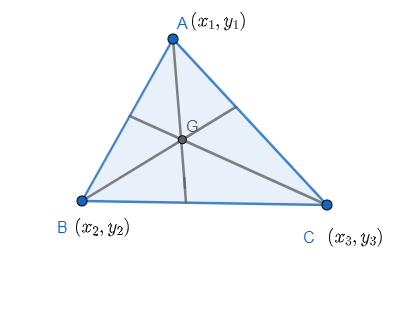
The centroid of a triangle, denoted as G in the figure, can be calculated by taking the average of X and Y coordinate points of all three vertices. Hence, the centroid of a triangle is given as
Hence, the centroid of a triangle is given as
\[G=\left( \dfrac{{{x}_{1}}+{{x}_{2}}+{{x}_{3}}}{3},\dfrac{{{y}_{1}}+{{y}_{2}}+{{y}_{3}}}{3} \right)...(i)\]
Now, let us compare this with the points given.
We have $(0,6),(8,12)\text{ and }(8,0)$ . Let us rewrite this as shown below.
$A(0,6),B(8,12)\text{ and C}(8,0)$ .
Now, we can compare this with the standard equation. Hence, we get
${{x}_{1}}=0,{{x}_{2}}=8,{{x}_{3}}=8$
\[{{y}_{1}}=6,{{y}_{2}}=12,{{y}_{3}}=0\]
Now we can substitute these in equation (i). We will get
\[G=\left( \dfrac{0+8+8}{3},\dfrac{6+12+0}{3} \right)\]
By solving this, we get
\[G=\left( \dfrac{16}{3},\dfrac{18}{3} \right)\]
Now, let us simplify this further. Hence, the centroid of the given vertices are
\[G=\left( \dfrac{16}{3},6 \right)\]
Thus, the centroid of a triangle whose vertices are $(0,6),(8,12)\text{ and }(8,0)$ is \[\left( \dfrac{16}{3},6 \right)\].
Note: One can make mistake when writing the centroid equation as \[G=\left( \dfrac{{{x}_{1}}+{{x}_{2}}+{{x}_{3}}}{2},\dfrac{{{y}_{1}}+{{y}_{2}}+{{y}_{3}}}{2} \right)\] . The easy way to memorize this is that the terms in the numerator of each coordinate is 3. Hence, we will divide the X-coordinate and Y-coordinate by 3.
Complete step by step answer:
We have to find the value of the centroid of a triangle whose vertices are $(0,6),(8,12)\text{ and }(8,0)$ .
Before finding this, let us recollect what a centroid of a triangle is.
Consider a triangle $ABC$ whose vertices are given as \[A({{x}_{1}},{{y}_{1}}),B({{x}_{2,}}{{y}_{2}}),C({{x}_{3}},{{y}_{3}})\] . This is illustrated below:
The centroid of a triangle, denoted as G in the figure, can be calculated by taking the average of X and Y coordinate points of all three vertices. Hence, the centroid of a triangle is given as
Hence, the centroid of a triangle is given as
\[G=\left( \dfrac{{{x}_{1}}+{{x}_{2}}+{{x}_{3}}}{3},\dfrac{{{y}_{1}}+{{y}_{2}}+{{y}_{3}}}{3} \right)...(i)\]
Now, let us compare this with the points given.
We have $(0,6),(8,12)\text{ and }(8,0)$ . Let us rewrite this as shown below.
$A(0,6),B(8,12)\text{ and C}(8,0)$ .
Now, we can compare this with the standard equation. Hence, we get
${{x}_{1}}=0,{{x}_{2}}=8,{{x}_{3}}=8$
\[{{y}_{1}}=6,{{y}_{2}}=12,{{y}_{3}}=0\]
Now we can substitute these in equation (i). We will get
\[G=\left( \dfrac{0+8+8}{3},\dfrac{6+12+0}{3} \right)\]
By solving this, we get
\[G=\left( \dfrac{16}{3},\dfrac{18}{3} \right)\]
Now, let us simplify this further. Hence, the centroid of the given vertices are
\[G=\left( \dfrac{16}{3},6 \right)\]
Thus, the centroid of a triangle whose vertices are $(0,6),(8,12)\text{ and }(8,0)$ is \[\left( \dfrac{16}{3},6 \right)\].
Note: One can make mistake when writing the centroid equation as \[G=\left( \dfrac{{{x}_{1}}+{{x}_{2}}+{{x}_{3}}}{2},\dfrac{{{y}_{1}}+{{y}_{2}}+{{y}_{3}}}{2} \right)\] . The easy way to memorize this is that the terms in the numerator of each coordinate is 3. Hence, we will divide the X-coordinate and Y-coordinate by 3.
Recently Updated Pages
Master Class 11 English: Engaging Questions & Answers for Success

Master Class 11 Maths: Engaging Questions & Answers for Success
Class 11 Question and Answer - Your Ultimate Solutions Guide
Master Class 11 Biology: Engaging Questions & Answers for Success
Master Class 11 Physics: Engaging Questions & Answers for Success
Master Class 11 Accountancy: Engaging Questions & Answers for Success
Trending doubts
Explain the Treaty of Vienna of 1815 class 10 social science CBSE
Who Won 36 Oscar Awards? Record Holder Revealed
What is the median of the first 10 natural numbers class 10 maths CBSE
Why is it 530 pm in india when it is 1200 afternoon class 10 social science CBSE
Select the word that is correctly spelled a Twelveth class 10 english CBSE
Why is there a time difference of about 5 hours between class 10 social science CBSE