




Find the centre of mass of three particles at the vertices of an equilateral triangle. The masses of the particle are 100g, 150g, and 200g respectively. Each side of the equilateral triangle is 0.5 m long.
Answer
 Verified
595.8k+ views
Hint: Recall the formula for the centre of mass. Express the centre of mass about the x-axis and about y-axis separately. The centre of mass about the x-axis and about y-axis are the coordinates of the centre of mass of the equilateral triangle.
Formula used:
\[{X_{CM}} = \dfrac{{{r_1}{m_1} + {r_2}{m_2} + {r_3}{m_3}}}{{{m_1} + {m_2} + {m_3}}}\]
Here, r is the distance of each particle from the origin and m is the mass of each particle.
Complete Step by Step Answer:
Let the three particles are situated at the vertices of the triangle as shown in the figure below.
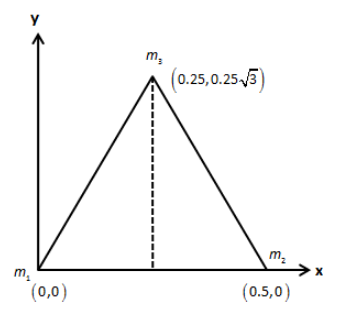
Since the triangle is in the xy-plane, it will have a centre of mass about the x-axis and about y-axis.Let us express the centre of mass of the above triangle about x-axis as follows,
\[{X_{CM}} = \dfrac{{{r_1}{m_1} + {r_2}{m_2} + {r_3}{m_3}}}{{{m_1} + {m_2} + {m_3}}}\]
Here, r is the horizontal distance of each particle from the origin and m is the mass of each particle.
Since the particle \[{m_1}\] is situated at the origin, the distance \[{r_1}\] is zero.Substituting 0 for \[{r_1}\], 0.5 m for \[{r_2}\], 0.25 m for \[{r_3}\], 100 g for \[{m_1}\], 150g for \[{m_2}\] and 200g for \[{m_3}\] in the above equation, we get,
\[{X_{CM}} = \dfrac{{\left( 0 \right)\left( {100} \right) + \left( {0.5} \right)\left( {150} \right) + \left( {0.25} \right)\left( {200} \right)}}{{100 + 150 + 200}}\]
\[ \Rightarrow {X_{CM}} = \dfrac{{125}}{{450}}\]
\[ \Rightarrow {X_{CM}} = 0.28\,{\text{m}}\]
Let us express the centre of mass of the above triangle about y-axis as follows,
\[{Y_{CM}} = \dfrac{{{r_1}{m_1} + {r_2}{m_2} + {r_3}{m_3}}}{{{m_1} + {m_2} + {m_3}}}\]
Here, r is the vertical distance of each particle from the origin and m is the mass of each particle.
Since the particle \[{m_1}\] and \[{m_2}\] are situated on the x-axis, the distance \[{r_1}\] and \[{r_2}\] is zero.Substituting 0 for \[{r_1}\], 0 for \[{r_2}\], \[0.25\sqrt 3 \] m for \[{r_3}\], 100 g for \[{m_1}\], 150g for \[{m_2}\] and 200g for \[{m_3}\] in the above equation, we get,
\[{Y_{CM}} = \dfrac{{\left( 0 \right)\left( {100} \right) + \left( 0 \right)\left( {150} \right) + \left( {0.25\sqrt 3 } \right)\left( {200} \right)}}{{100 + 150 + 200}}\]
\[ \Rightarrow {Y_{CM}} = \dfrac{{86.6}}{{450}}\]
\[ \therefore {Y_{CM}} = 0.19\,{\text{m}}\]
Thus, the centre of mass of the equilateral triangle is \[{X_{CM}} = 0.28\,{\text{m}}\] and \[{Y_{CM}} = 0.19\,{\text{m}}\].
Note: The rod, wire, etc, are one dimensional objects and therefore the centre of mass of these objects is measured from the one end of the rod. In the case of an equilateral triangle, the centre of mass is expressed as x and y-coordinates of the position of the centre of mass. The coordinates of the centre of mass of the above equilateral triangle are (0.28, 0.19).
Formula used:
\[{X_{CM}} = \dfrac{{{r_1}{m_1} + {r_2}{m_2} + {r_3}{m_3}}}{{{m_1} + {m_2} + {m_3}}}\]
Here, r is the distance of each particle from the origin and m is the mass of each particle.
Complete Step by Step Answer:
Let the three particles are situated at the vertices of the triangle as shown in the figure below.
Since the triangle is in the xy-plane, it will have a centre of mass about the x-axis and about y-axis.Let us express the centre of mass of the above triangle about x-axis as follows,
\[{X_{CM}} = \dfrac{{{r_1}{m_1} + {r_2}{m_2} + {r_3}{m_3}}}{{{m_1} + {m_2} + {m_3}}}\]
Here, r is the horizontal distance of each particle from the origin and m is the mass of each particle.
Since the particle \[{m_1}\] is situated at the origin, the distance \[{r_1}\] is zero.Substituting 0 for \[{r_1}\], 0.5 m for \[{r_2}\], 0.25 m for \[{r_3}\], 100 g for \[{m_1}\], 150g for \[{m_2}\] and 200g for \[{m_3}\] in the above equation, we get,
\[{X_{CM}} = \dfrac{{\left( 0 \right)\left( {100} \right) + \left( {0.5} \right)\left( {150} \right) + \left( {0.25} \right)\left( {200} \right)}}{{100 + 150 + 200}}\]
\[ \Rightarrow {X_{CM}} = \dfrac{{125}}{{450}}\]
\[ \Rightarrow {X_{CM}} = 0.28\,{\text{m}}\]
Let us express the centre of mass of the above triangle about y-axis as follows,
\[{Y_{CM}} = \dfrac{{{r_1}{m_1} + {r_2}{m_2} + {r_3}{m_3}}}{{{m_1} + {m_2} + {m_3}}}\]
Here, r is the vertical distance of each particle from the origin and m is the mass of each particle.
Since the particle \[{m_1}\] and \[{m_2}\] are situated on the x-axis, the distance \[{r_1}\] and \[{r_2}\] is zero.Substituting 0 for \[{r_1}\], 0 for \[{r_2}\], \[0.25\sqrt 3 \] m for \[{r_3}\], 100 g for \[{m_1}\], 150g for \[{m_2}\] and 200g for \[{m_3}\] in the above equation, we get,
\[{Y_{CM}} = \dfrac{{\left( 0 \right)\left( {100} \right) + \left( 0 \right)\left( {150} \right) + \left( {0.25\sqrt 3 } \right)\left( {200} \right)}}{{100 + 150 + 200}}\]
\[ \Rightarrow {Y_{CM}} = \dfrac{{86.6}}{{450}}\]
\[ \therefore {Y_{CM}} = 0.19\,{\text{m}}\]
Thus, the centre of mass of the equilateral triangle is \[{X_{CM}} = 0.28\,{\text{m}}\] and \[{Y_{CM}} = 0.19\,{\text{m}}\].
Note: The rod, wire, etc, are one dimensional objects and therefore the centre of mass of these objects is measured from the one end of the rod. In the case of an equilateral triangle, the centre of mass is expressed as x and y-coordinates of the position of the centre of mass. The coordinates of the centre of mass of the above equilateral triangle are (0.28, 0.19).
Recently Updated Pages
Master Class 11 English: Engaging Questions & Answers for Success

Master Class 11 Social Science: Engaging Questions & Answers for Success
Master Class 11 Maths: Engaging Questions & Answers for Success
Master Class 11 Biology: Engaging Questions & Answers for Success
Master Class 11 Physics: Engaging Questions & Answers for Success
Master Class 11 Chemistry: Engaging Questions & Answers for Success
Trending doubts
One Metric ton is equal to kg A 10000 B 1000 C 100 class 11 physics CBSE
Difference Between Prokaryotic Cells and Eukaryotic Cells
1 ton equals to A 100 kg B 1000 kg C 10 kg D 10000 class 11 physics CBSE
Find the value of the expression given below sin 30circ class 11 maths CBSE
Two of the body parts which do not appear in MRI are class 11 biology CBSE
What are hard magnetic materials class 11 physics CBSE