




How would you find the center and radius of ${x^2} + {y^2} - 6x = 0$?
Answer
 Verified
551.4k+ views
Hint: In this question, we have been given an equation of a circle.
The general equation of a circle is,
${(x - a)^2} + {(y - b)^2} = {r^2}$
Where, $(a,b)$ is a center, $r$ is a radius.
First, we group the same variables,
For example, ${x^2} + {y^2} - 4x - 16y = 0$ , we group the variables
${x^2} - 4x + {y^2} - 16y = 0$
And then we find the center and radius by using the square method.
Complete step by step answer:
The standard form for the equation of a circle with center $(a,b)$ and radius $r$ is,
${(x - a)^2} + {(y - b)^2} = {r^2}$
We need to convert the given equation into the standard equation.
${x^2} + {y^2} - 6x = 0$
Grouping the terms containing $x$, hence we get
${x^2} - 6x + {y^2} = 0$
Using completing the square method, we will add and subtract on both the sides by square of the half of the coefficient of $x$ , i.e., ${\left( {\dfrac{6}{2}} \right)^2} = {3^2} = 9$ , hence we get,
$({x^2} - 6x + {3^2}) - {3^2} + {y^2} = 0$
Shifting the constant to the other side,
$({x^2} - 6x + {3^2}) + {y^2} = {3^2}$
The ${(y - b)^2}$ term in the standard form can be written as ${(y - 0)^2}$.
Now the standard form of a circle is, we get
\[{(x - 3)^2} + {(y - 0)^2} = {3^2}\] ,
which is the required form of a circle with center at $(a,b)$ , hence we get,
Comparing the equation with the standard form of equation, we get,
$a = 3,b = 0$ and $r = 3$
Then the center point is $(3,0)$
And the radius is $3$ .
Hence, this is how you find the center and the radius. Let us plot the equation on the graph.
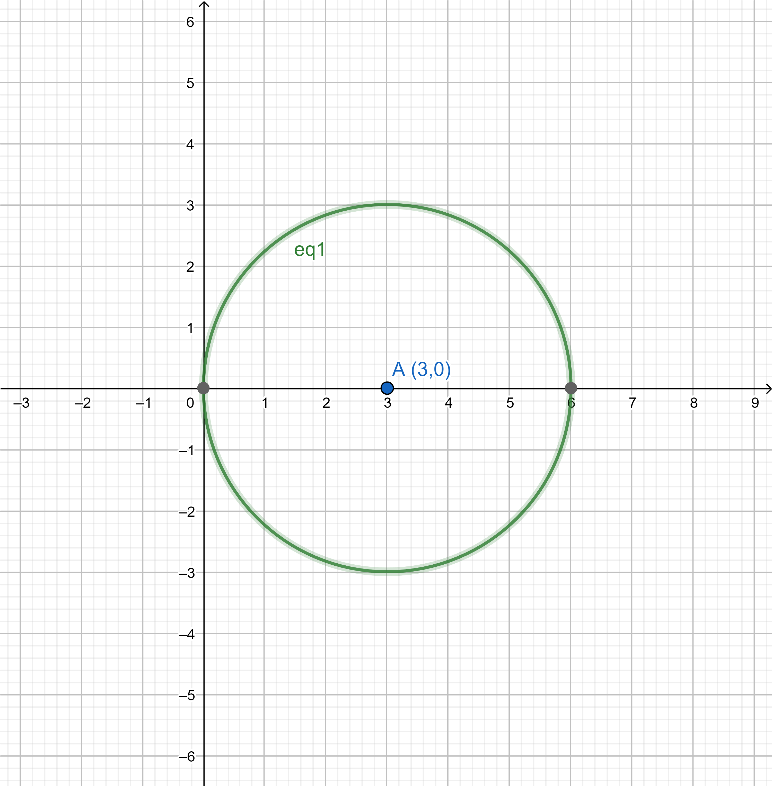
Note: The general equation of a circle is
${x^2} + {y^2} + 2gx + 2fy + c = 0$
Where the center is given by $( - g, - f)$ and the radius is given by $r = \sqrt {{g^2} + {f^2} - c} $ . The equation can be recognized because it is given by a quadratic expression in both $x$ and $y$ with no $xy$ them, and where the coefficients of ${x^2}$ and ${y^2}$ are equal. We recognize it is quadratic in both $x$ and $y$, and it has two additional properties. First, there is no term in $xy$. And secondly, the coefficient of ${x^2}$ is the same as the coefficients of ${y^2}$. The centre of the circle is then at $(a,b) = ( - g, - f)$ and, since $c = {g^2} + {f^2} - {r^2}$ , we have
${r^2} = {g^2} + {f^2} - c$
So that the radius of the circle is given by,
$r = \sqrt {{g^2} + {f^2} - c} $
The general equation of a circle is,
${(x - a)^2} + {(y - b)^2} = {r^2}$
Where, $(a,b)$ is a center, $r$ is a radius.
First, we group the same variables,
For example, ${x^2} + {y^2} - 4x - 16y = 0$ , we group the variables
${x^2} - 4x + {y^2} - 16y = 0$
And then we find the center and radius by using the square method.
Complete step by step answer:
The standard form for the equation of a circle with center $(a,b)$ and radius $r$ is,
${(x - a)^2} + {(y - b)^2} = {r^2}$
We need to convert the given equation into the standard equation.
${x^2} + {y^2} - 6x = 0$
Grouping the terms containing $x$, hence we get
${x^2} - 6x + {y^2} = 0$
Using completing the square method, we will add and subtract on both the sides by square of the half of the coefficient of $x$ , i.e., ${\left( {\dfrac{6}{2}} \right)^2} = {3^2} = 9$ , hence we get,
$({x^2} - 6x + {3^2}) - {3^2} + {y^2} = 0$
Shifting the constant to the other side,
$({x^2} - 6x + {3^2}) + {y^2} = {3^2}$
The ${(y - b)^2}$ term in the standard form can be written as ${(y - 0)^2}$.
Now the standard form of a circle is, we get
\[{(x - 3)^2} + {(y - 0)^2} = {3^2}\] ,
which is the required form of a circle with center at $(a,b)$ , hence we get,
Comparing the equation with the standard form of equation, we get,
$a = 3,b = 0$ and $r = 3$
Then the center point is $(3,0)$
And the radius is $3$ .
Hence, this is how you find the center and the radius. Let us plot the equation on the graph.
Note: The general equation of a circle is
${x^2} + {y^2} + 2gx + 2fy + c = 0$
Where the center is given by $( - g, - f)$ and the radius is given by $r = \sqrt {{g^2} + {f^2} - c} $ . The equation can be recognized because it is given by a quadratic expression in both $x$ and $y$ with no $xy$ them, and where the coefficients of ${x^2}$ and ${y^2}$ are equal. We recognize it is quadratic in both $x$ and $y$, and it has two additional properties. First, there is no term in $xy$. And secondly, the coefficient of ${x^2}$ is the same as the coefficients of ${y^2}$. The centre of the circle is then at $(a,b) = ( - g, - f)$ and, since $c = {g^2} + {f^2} - {r^2}$ , we have
${r^2} = {g^2} + {f^2} - c$
So that the radius of the circle is given by,
$r = \sqrt {{g^2} + {f^2} - c} $
Recently Updated Pages
Master Class 11 English: Engaging Questions & Answers for Success

Master Class 11 Maths: Engaging Questions & Answers for Success
Master Class 11 Biology: Engaging Questions & Answers for Success
Master Class 11 Physics: Engaging Questions & Answers for Success
Master Class 11 Accountancy: Engaging Questions & Answers for Success
Class 11 Question and Answer - Your Ultimate Solutions Guide
Trending doubts
One Metric ton is equal to kg A 10000 B 1000 C 100 class 11 physics CBSE
Discuss the various forms of bacteria class 11 biology CBSE
Draw a diagram of a plant cell and label at least eight class 11 biology CBSE
State the laws of reflection of light
Explain zero factorial class 11 maths CBSE
10 examples of friction in our daily life