




How do you find the average rate of change of $ f\left( t \right) = 2t + 7 $ from $ \left[ {1,2} \right] $
Answer
 Verified
592.5k+ views
Hint: In order to determine the average rate of change of the given function , use the standard formula for average rate of change as\[m = \dfrac{{\Delta f\left( t \right)}}{{\Delta t}} = \dfrac{{f\left( {{t_2}} \right) - f\left( {{t_1}} \right)}}{{{t_2} - {t_1}}}\]. $ {t_1},{t_2} $ are the lower and upper bound of the interval given respectively \[f\left( {{t_1}} \right),f\left( {{t_2}} \right)\]are the values of function obtained by putting $ {t_1},{t_2} $ in the function respectively. Put all the values in the average formula, to get the required result.
Complete step-by-step answer:
Here, we are given a function as $ f\left( t \right) = 2t + 7 $ and we are supposed to determine the average rate of change for this function over the interval $ \left[ {1,2} \right] $ .
As we know that there are two types of rate of change , one is instantaneous rate and the other is average rate.
So the average rate of change $ \left( m \right) $ for a function is the ratio of change of the value of a given function and the change in the value of the variable. Let $ f\left( t \right) $ be a function defined over an interval $ \left[ {{t_1},{t_2}} \right] $ . Here $ {t_1},{t_2} $ are the lower and the upper bound respectively .
Hence the average rate of change of $ f\left( t \right) $ is given as
Average rate of chance\[m = \dfrac{{\Delta f\left( t \right)}}{{\Delta t}} = \dfrac{{f\left( {{t_2}} \right) - f\left( {{t_1}} \right)}}{{{t_2} - {t_1}}}\]----(1)
In this question we are given $ {t_1},{t_2} $ as $ 1,2 $ respectively.
Now let’s find out the value for \[f\left( {{t_1}} \right)\]by substituting all the occurrences of variable $ t $ with the value of $ {t_1} = 1 $ , we have
$
f\left( {{t_1}} \right) = f\left( 1 \right) \\
\Rightarrow f\left( 1 \right) = 2\left( 1 \right) + 7 \\
\Rightarrow f\left( 1 \right) = 9 \;
$
Similarly find the value for \[f\left( {{t_2}} \right)\], replacing all the $ t $ with value of $ {t_2} = 2 $ in the function
\[
f\left( {{t_2}} \right) = f\left( 2 \right) \\
\Rightarrow f\left( 2 \right) = 2\left( 2 \right) + 7 \\
\Rightarrow f\left( 2 \right) = 4 + 7 \\
\Rightarrow f\left( 2 \right) = 11 \;
\]
Hence we have values as $ f\left( 1 \right) = 9 $ and $ f\left( 2 \right) = 11 $ .
Now putting these values in the formula of average rate of change i.e. in equation(1), we have
Average rate of chance=
\[m = \dfrac{{\Delta f\left( t \right)}}{{\Delta t}} = \dfrac{{11 - 9}}{{2 - 1}}\]
Simplifying further, we have
\[
m = \dfrac{2}{1} \\
m = 2 \;
\]
Therefore, the average rate of change of function $ f\left( t \right) = 2t + 7 $ in interval $ \left[ {1,2} \right] $ is equal to $ m = 2 $
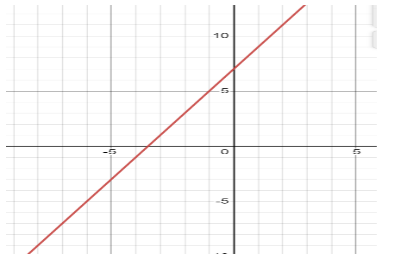
Note: 1. The graph the function $ f\left( t \right) = 2t + 7 $ given is
2.We should have a better knowledge in the topic of geometry to solve this type of question easily. We should know the average rate change form when the interval on the function is given
3. Note that we should always give at least two points on the function to find out the Average rate change.
4. Remember the topic of average rate of change and the instantaneous rate are the from the calculus part of mathematics
Complete step-by-step answer:
Here, we are given a function as $ f\left( t \right) = 2t + 7 $ and we are supposed to determine the average rate of change for this function over the interval $ \left[ {1,2} \right] $ .
As we know that there are two types of rate of change , one is instantaneous rate and the other is average rate.
So the average rate of change $ \left( m \right) $ for a function is the ratio of change of the value of a given function and the change in the value of the variable. Let $ f\left( t \right) $ be a function defined over an interval $ \left[ {{t_1},{t_2}} \right] $ . Here $ {t_1},{t_2} $ are the lower and the upper bound respectively .
Hence the average rate of change of $ f\left( t \right) $ is given as
Average rate of chance\[m = \dfrac{{\Delta f\left( t \right)}}{{\Delta t}} = \dfrac{{f\left( {{t_2}} \right) - f\left( {{t_1}} \right)}}{{{t_2} - {t_1}}}\]----(1)
In this question we are given $ {t_1},{t_2} $ as $ 1,2 $ respectively.
Now let’s find out the value for \[f\left( {{t_1}} \right)\]by substituting all the occurrences of variable $ t $ with the value of $ {t_1} = 1 $ , we have
$
f\left( {{t_1}} \right) = f\left( 1 \right) \\
\Rightarrow f\left( 1 \right) = 2\left( 1 \right) + 7 \\
\Rightarrow f\left( 1 \right) = 9 \;
$
Similarly find the value for \[f\left( {{t_2}} \right)\], replacing all the $ t $ with value of $ {t_2} = 2 $ in the function
\[
f\left( {{t_2}} \right) = f\left( 2 \right) \\
\Rightarrow f\left( 2 \right) = 2\left( 2 \right) + 7 \\
\Rightarrow f\left( 2 \right) = 4 + 7 \\
\Rightarrow f\left( 2 \right) = 11 \;
\]
Hence we have values as $ f\left( 1 \right) = 9 $ and $ f\left( 2 \right) = 11 $ .
Now putting these values in the formula of average rate of change i.e. in equation(1), we have
Average rate of chance=
\[m = \dfrac{{\Delta f\left( t \right)}}{{\Delta t}} = \dfrac{{11 - 9}}{{2 - 1}}\]
Simplifying further, we have
\[
m = \dfrac{2}{1} \\
m = 2 \;
\]
Therefore, the average rate of change of function $ f\left( t \right) = 2t + 7 $ in interval $ \left[ {1,2} \right] $ is equal to $ m = 2 $
Note: 1. The graph the function $ f\left( t \right) = 2t + 7 $ given is
2.We should have a better knowledge in the topic of geometry to solve this type of question easily. We should know the average rate change form when the interval on the function is given
3. Note that we should always give at least two points on the function to find out the Average rate change.
4. Remember the topic of average rate of change and the instantaneous rate are the from the calculus part of mathematics
Recently Updated Pages
Master Class 11 Social Science: Engaging Questions & Answers for Success

Master Class 11 English: Engaging Questions & Answers for Success
Master Class 11 Accountancy: Engaging Questions & Answers for Success
Master Class 11 Physics: Engaging Questions & Answers for Success
Master Class 11 Computer Science: Engaging Questions & Answers for Success
Master Class 11 Business Studies: Engaging Questions & Answers for Success
Trending doubts
One Metric ton is equal to kg A 10000 B 1000 C 100 class 11 physics CBSE
Find the value of the expression given below sin 30circ class 11 maths CBSE
Draw a diagram of nephron and explain its structur class 11 biology CBSE
10 examples of friction in our daily life
Proton was discovered by A Thomson B Rutherford C Chadwick class 11 chemistry CBSE
The teeth used for biting and cutting food are called class 11 biology CBSE