




How to find the asymptotes of $f\left( x \right)=\dfrac{{{x}^{2}}}{x+1}$?
Answer
 Verified
569.4k+ views
Hint: We recall that the vertical asymptotes of the function $\dfrac{f\left( x \right)}{g\left( x \right)}=\dfrac{{{f}_{1}}\left( x \right){{f}_{2}}\left( x \right)...}{{{g}_{1}}\left( x \right){{g}_{2}}\left( x \right)...}$ are obtained as ${{g}_{i}}\left( x \right)=0,i\ge 1$ if ${{f}_{i}}\left( x \right),{{g}_{i}}\left( x \right)$ do not have common zeros for all $i\ge 1,i\in N$. The horizontals asymptotes of $\dfrac{f\left( x \right)}{g\left( x \right)}$ with the condition that degree of $f\left( x \right)$ greater than degree of $g\left( x \right)$ does not exist. We express $f\left( x \right)=\dfrac{{{x}^{2}}}{x+1}-\left( x-1 \right)=\dfrac{2}{x+1}$ to find the oblique asymptotes. \[\]
Complete step by step solution:
We know that asymptotes are lines which meet the curve of any function at infinity. We know when we are given a rational function $\dfrac{f\left( x \right)}{g\left( x \right)}$ we first factorize the numerator and denominator into linear factors as;
\[\dfrac{f\left( x \right)}{g\left( x \right)}=\dfrac{{{f}_{1}}\left( x \right){{f}_{2}}\left( x \right)...}{{{g}_{1}}\left( x \right){{g}_{2}}\left( x \right)...}\]
We find the vertical asymptotes are obtained the zeros of denominators ${{g}_{i}}\left( x \right)=0,i\ge 1$ if there are no common zeros among numerator factors and denominator factors ${{f}_{j}}\left( x \right),{{g}_{i}}\left( x \right)$ for any $i\ge 1,j\ge 1,i\in N,j\in N$. If there is a common zero say at $x=a$ which means ${{f}_{j}}\left( a \right)={{g}_{i}}\left( a \right)=0$ then we get hole in the curve of $f\left( x \right)$ at $x=a$.\[\]
We find the horizontal asymptotes comparing the degree of numerator and denominator. If the degree of numerator is $n$ and degree of denominator is $d$ and $d < n$ then there does not exist any horizontal asymptote.\[\]
We are asked to find asymptotes for
\[f\left( x \right)=\dfrac{{{x}^{2}}}{x+1}\]
We factorize the numerator and denominator to have;
\[f\left( x \right)=\dfrac{{{x}^{2}}}{x+1}=\dfrac{x\cdot x}{x+1}\]
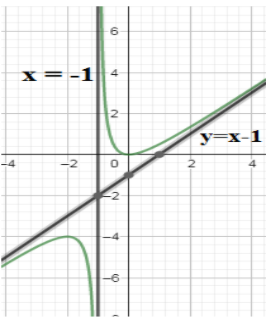
We see that the zeros in the numerator are $x=0,0$ and in the denominator is $x=-1$. Since there are no common zeros one vertical asymptote is
\[x+1=0\Rightarrow x=-1\]
We see the degree of numerator $n=2$ and degree of denominator $d=1$. Since we have $n > d$ there will not be any horizontal asymptote. The oblique asymptotes are obtained with observation. Let us consider
\[\begin{align}
& \dfrac{{{x}^{2}}}{x+1}=\dfrac{{{x}^{2}}-1+1}{x+1} \\
& \Rightarrow \dfrac{{{x}^{2}}}{x+1}=\dfrac{{{x}^{2}}-1}{x+1}+\dfrac{1}{x+1} \\
& \Rightarrow \dfrac{{{x}^{2}}}{x+1}=x-1+\dfrac{1}{x+1} \\
& \Rightarrow \dfrac{{{x}^{2}}}{x+1}-\left( x-1 \right)=\dfrac{1}{x+1} \\
\end{align}\]
If we observe that as we increase $x$ to infinity the function $f\left( x \right)=\dfrac{{{x}^{2}}}{x+1}$ and the difference $\dfrac{1}{x+1}$ goes to zero. So $y=x-1$ is an oblique asymptote of $f\left( x \right)=\dfrac{{{x}^{2}}}{x+1}$.\[\]
Note: We note that if $d=n$ then $y=\dfrac{a}{b}$ is a horizontal asymptote where $a,b$ are the coefficients of highest degree term in the numerator $f\left( x \right)$ and denominator $g\left( x \right)$ respectively. If $d > n$ then $y=0$ is the asymptote of $y=\dfrac{f\left( x \right)}{g\left( x \right)}$. We can also find $\displaystyle \lim_{x \to \infty }\dfrac{f\left( x \right)}{g\left( x \right)}=0$ as the horizontal asymptote.
Complete step by step solution:
We know that asymptotes are lines which meet the curve of any function at infinity. We know when we are given a rational function $\dfrac{f\left( x \right)}{g\left( x \right)}$ we first factorize the numerator and denominator into linear factors as;
\[\dfrac{f\left( x \right)}{g\left( x \right)}=\dfrac{{{f}_{1}}\left( x \right){{f}_{2}}\left( x \right)...}{{{g}_{1}}\left( x \right){{g}_{2}}\left( x \right)...}\]
We find the vertical asymptotes are obtained the zeros of denominators ${{g}_{i}}\left( x \right)=0,i\ge 1$ if there are no common zeros among numerator factors and denominator factors ${{f}_{j}}\left( x \right),{{g}_{i}}\left( x \right)$ for any $i\ge 1,j\ge 1,i\in N,j\in N$. If there is a common zero say at $x=a$ which means ${{f}_{j}}\left( a \right)={{g}_{i}}\left( a \right)=0$ then we get hole in the curve of $f\left( x \right)$ at $x=a$.\[\]
We find the horizontal asymptotes comparing the degree of numerator and denominator. If the degree of numerator is $n$ and degree of denominator is $d$ and $d < n$ then there does not exist any horizontal asymptote.\[\]
We are asked to find asymptotes for
\[f\left( x \right)=\dfrac{{{x}^{2}}}{x+1}\]
We factorize the numerator and denominator to have;
\[f\left( x \right)=\dfrac{{{x}^{2}}}{x+1}=\dfrac{x\cdot x}{x+1}\]
We see that the zeros in the numerator are $x=0,0$ and in the denominator is $x=-1$. Since there are no common zeros one vertical asymptote is
\[x+1=0\Rightarrow x=-1\]
We see the degree of numerator $n=2$ and degree of denominator $d=1$. Since we have $n > d$ there will not be any horizontal asymptote. The oblique asymptotes are obtained with observation. Let us consider
\[\begin{align}
& \dfrac{{{x}^{2}}}{x+1}=\dfrac{{{x}^{2}}-1+1}{x+1} \\
& \Rightarrow \dfrac{{{x}^{2}}}{x+1}=\dfrac{{{x}^{2}}-1}{x+1}+\dfrac{1}{x+1} \\
& \Rightarrow \dfrac{{{x}^{2}}}{x+1}=x-1+\dfrac{1}{x+1} \\
& \Rightarrow \dfrac{{{x}^{2}}}{x+1}-\left( x-1 \right)=\dfrac{1}{x+1} \\
\end{align}\]
If we observe that as we increase $x$ to infinity the function $f\left( x \right)=\dfrac{{{x}^{2}}}{x+1}$ and the difference $\dfrac{1}{x+1}$ goes to zero. So $y=x-1$ is an oblique asymptote of $f\left( x \right)=\dfrac{{{x}^{2}}}{x+1}$.\[\]
Note: We note that if $d=n$ then $y=\dfrac{a}{b}$ is a horizontal asymptote where $a,b$ are the coefficients of highest degree term in the numerator $f\left( x \right)$ and denominator $g\left( x \right)$ respectively. If $d > n$ then $y=0$ is the asymptote of $y=\dfrac{f\left( x \right)}{g\left( x \right)}$. We can also find $\displaystyle \lim_{x \to \infty }\dfrac{f\left( x \right)}{g\left( x \right)}=0$ as the horizontal asymptote.
Recently Updated Pages
Three beakers labelled as A B and C each containing 25 mL of water were taken A small amount of NaOH anhydrous CuSO4 and NaCl were added to the beakers A B and C respectively It was observed that there was an increase in the temperature of the solutions contained in beakers A and B whereas in case of beaker C the temperature of the solution falls Which one of the following statements isarecorrect i In beakers A and B exothermic process has occurred ii In beakers A and B endothermic process has occurred iii In beaker C exothermic process has occurred iv In beaker C endothermic process has occurred

Master Class 11 Social Science: Engaging Questions & Answers for Success
Master Class 11 Physics: Engaging Questions & Answers for Success
Master Class 11 Maths: Engaging Questions & Answers for Success
Master Class 11 Economics: Engaging Questions & Answers for Success
Master Class 11 Computer Science: Engaging Questions & Answers for Success
Three beakers labelled as A B and C each containing 25 mL of water were taken A small amount of NaOH anhydrous CuSO4 and NaCl were added to the beakers A B and C respectively It was observed that there was an increase in the temperature of the solutions contained in beakers A and B whereas in case of beaker C the temperature of the solution falls Which one of the following statements isarecorrect i In beakers A and B exothermic process has occurred ii In beakers A and B endothermic process has occurred iii In beaker C exothermic process has occurred iv In beaker C endothermic process has occurred
Master Class 11 Social Science: Engaging Questions & Answers for Success
Master Class 11 Physics: Engaging Questions & Answers for Success
Trending doubts
One Metric ton is equal to kg A 10000 B 1000 C 100 class 11 physics CBSE
There are 720 permutations of the digits 1 2 3 4 5 class 11 maths CBSE
State and prove Bernoullis theorem class 11 physics CBSE
Draw a diagram of a plant cell and label at least eight class 11 biology CBSE
Difference Between Prokaryotic Cells and Eukaryotic Cells
1 Quintal is equal to a 110 kg b 10 kg c 100kg d 1000 class 11 physics CBSE