




Find the area of triangle ABC where \[A\left( {1, - 4} \right)\], and mid-point of the sides through A being \[\left( {2, - 1} \right)\] and \[\left( {0, - 1} \right)\].
Answer
 Verified
610.2k+ views
Hint: Here, we need to find the area of triangle ABC. We will use mid-point formula to find the vertices of the triangle. Then, we will use the formula for area of triangle using co-ordinates of the vertices of the triangle to find the required area of the triangle ABC
Formula Used:
We will use the following formulas:
According to the mid-point formula, the co-ordinates of the mid-point of the line segment joining two points \[P\left( {{x_1},{y_1}} \right)\] and \[Q\left( {{x_2},{y_2}} \right)\] are given by \[\left( {\dfrac{{{x_1} + {x_2}}}{2},\dfrac{{{y_1} + {y_2}}}{2}} \right)\].
The area of a triangle with having the vertices \[P\left( {{x_1},{y_1}} \right)\], \[Q\left( {{x_2},{y_2}} \right)\] and \[R\left( {{x_3},{y_3}} \right)\] is given by \[\dfrac{1}{2}\left| {{x_1}\left( {{y_2} - {y_3}} \right) + {x_2}\left( {{y_3} - {y_1}} \right) + {x_3}\left( {{y_1} - {y_2}} \right)} \right|\].
Complete step-by-step answer:
Let the other vertex of the triangle be \[B\left( {a,b} \right)\] and \[C\left( {p,q} \right)\].
We can draw a triangle using the given information and then represent these points in the figure.
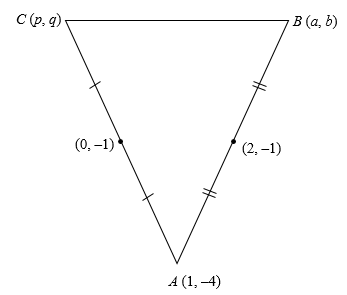
It is given that the mid-point of the sides through A being \[\left( {2, - 1} \right)\] and \[\left( {0, - 1} \right)\].
Thus, the mid-point of side AB is \[\left( {2, - 1} \right)\], and the mid-point of side AC is \[\left( {0, - 1} \right)\].
Now, we will use the mid-point formula in the line segment AB.
The co-ordinates of the mid-point of the line segment joining the points \[A\left( {1, - 4} \right)\] and \[B\left( {a,b} \right)\] are \[\left( {2, - 1} \right)\].
Therefore, substituting \[{x_1} = 1\], \[{y_1} = - 4\], \[{x_2} = a\], and \[{y_2} = b\] in the mid-point formula, \[\left( {\dfrac{{{x_1} + {x_2}}}{2},\dfrac{{{y_1} + {y_2}}}{2}} \right)\], we get
\[ \Rightarrow \left( {2, - 1} \right) = \left( {\dfrac{{1 + a}}{2},\dfrac{{ - 4 + b}}{2}} \right)\]
Comparing the abscissa and the ordinate, we get the equations
\[ \Rightarrow 2 = \dfrac{{1 + a}}{2}\] and \[ - 1 = \dfrac{{ - 4 + b}}{2}\]
We will simplify these equations to get the co-ordinates of the vertex B of triangle ABC.
Multiplying both sides of the equation \[2 = \dfrac{{1 + a}}{2}\] by 2, we get
\[ \Rightarrow 4 = 1 + a\]
Subtracting 1 from both sides, we get
\[ \Rightarrow 4 - 1 = 1 + a - 1\]
Thus, we get
\[ \Rightarrow a = 3\]
Multiplying both sides of the equation \[ - 1 = \dfrac{{ - 4 + b}}{2}\] by 2, we get
\[ \Rightarrow - 2 = - 4 + b\]
Adding 4 on both sides, we get
\[ \Rightarrow - 2 + 4 = - 4 + b + 4\]
Thus, we get
\[ \Rightarrow b = 2\]
Substituting \[a = 3\] and \[b = 2\] in the point \[B\left( {a,b} \right)\], we get
\[\left( {a,b} \right) = \left( {3,2} \right)\]
Therefore, the co-ordinates of vertex B of the triangle ABC are \[\left( {3,2} \right)\].
Now, the co-ordinates of the mid-point of the line segment joining the points \[A\left( {1, - 4} \right)\] and \[C\left( {p,q} \right)\] are \[\left( {0, - 1} \right)\].
Therefore, substituting \[{x_1} = 1\], \[{y_1} = - 4\], \[{x_2} = p\], and \[{y_2} = q\] in the mid-point formula, we get
\[ \Rightarrow \left( {0, - 1} \right) = \left( {\dfrac{{1 + p}}{2},\dfrac{{ - 4 + q}}{2}} \right)\]
Comparing the abscissa and the ordinate, we get the equations
\[ \Rightarrow 0 = \dfrac{{1 + p}}{2}\] and \[ - 1 = \dfrac{{ - 4 + q}}{2}\]
We will simplify these equations to get the co-ordinates of the vertex B of triangle ABC.
Multiplying both sides of the equation \[0 = \dfrac{{1 + p}}{2}\] by 2, we get
\[ \Rightarrow 0 = 1 + p\]
Subtracting 1 from both sides of the equation, we get
\[ \Rightarrow 0 - 1 = 1 + p - 1\]
Thus, we get
\[ \Rightarrow p = - 1\]
Multiplying both sides of the equation \[ - 1 = \dfrac{{ - 4 + q}}{2}\] by 2, we get
\[ \Rightarrow - 2 = - 4 + q\]
Adding 4 on both sides of the equation, we get
\[ \Rightarrow - 2 + 4 = - 4 + q + 4\]
Thus, we get
\[ \Rightarrow q = 2\]
Substituting \[p = - 1\] and \[q = 2\] in the point \[C\left( {p,q} \right)\], we get
\[\left( {p,q} \right) = \left( { - 1,2} \right)\]
Therefore, the co-ordinates of vertex C of the triangle ABC are \[\left( { - 1,2} \right)\].
Thus, we get the three vertices of the triangle as \[A\left( {1, - 4} \right)\], \[B\left( {3,2} \right)\], and \[C\left( { - 1,2} \right)\].
Now, we will find the area of the triangle using the co-ordinates of the vertices.
Therefore, substituting \[{x_1} = 1\], \[{y_1} = - 4\], \[{x_2} = 3\], \[{y_2} = 2\], \[{x_3} = - 1\], and \[{y_3} = 2\] in the formula \[\dfrac{1}{2}\left| {{x_1}\left( {{y_2} - {y_3}} \right) + {x_2}\left( {{y_3} - {y_1}} \right) + {x_3}\left( {{y_1} - {y_2}} \right)} \right|\], we get
\[ \Rightarrow \] Area of triangle ABC \[ = \dfrac{1}{2}\left| {1\left( {2 - 2} \right) + 3\left( {2 - \left( { - 4} \right)} \right) + \left( { - 1} \right)\left( { - 4 - 2} \right)} \right|\]
Simplifying the expressions in the parentheses, we get
\[ \Rightarrow \] Area of triangle ABC \[ = \dfrac{1}{2}\left| {1\left( {2 - 2} \right) + 3\left( {2 + 4} \right) + \left( { - 1} \right)\left( { - 4 - 2} \right)} \right|\]
Adding and subtracting the terms, we get
\[ \Rightarrow \] Area of triangle ABC \[ = \dfrac{1}{2}\left| {1\left( 0 \right) + 3\left( 6 \right) + \left( { - 1} \right)\left( { - 6} \right)} \right|\]
Multiplying the terms, we get
\[ \Rightarrow \] Area of triangle ABC \[ = \dfrac{1}{2}\left| {0 + 18 + 6} \right|\]
Adding the terms, we get
\[ \Rightarrow \] Area of triangle ABC \[ = \dfrac{1}{2}\left| {24} \right| = \dfrac{1}{2} \times 24\]
Therefore, we get
\[ \Rightarrow \] Area of triangle ABC \[ = 12\] square units
Thus, we get the area of triangle ABC as 12 square units.
Note: We used the terms ‘abscissa’ and ‘ordinate’ in the solution. The abscissa of a point \[\left( {x,y} \right)\] is \[x\], and the ordinate of a point \[\left( {x,y} \right)\] is \[y\].
The mid-point formula is derived from the section formula. According to the section formula, the co-ordinates of a point dividing the line segment joining two points \[P\left( {{x_1},{y_1}} \right)\] and \[Q\left( {{x_2},{y_2}} \right)\] in the ratio \[m:n\], are given by \[\left( {\dfrac{{m{x_1} + n{x_2}}}{{m + n}},\dfrac{{m{y_1} + n{y_2}}}{{m + n}}} \right)\]. If a point divides a line segment joining two points in the ratio 1: 1, then that point is the mid-point of the line segment.
Formula Used:
We will use the following formulas:
According to the mid-point formula, the co-ordinates of the mid-point of the line segment joining two points \[P\left( {{x_1},{y_1}} \right)\] and \[Q\left( {{x_2},{y_2}} \right)\] are given by \[\left( {\dfrac{{{x_1} + {x_2}}}{2},\dfrac{{{y_1} + {y_2}}}{2}} \right)\].
The area of a triangle with having the vertices \[P\left( {{x_1},{y_1}} \right)\], \[Q\left( {{x_2},{y_2}} \right)\] and \[R\left( {{x_3},{y_3}} \right)\] is given by \[\dfrac{1}{2}\left| {{x_1}\left( {{y_2} - {y_3}} \right) + {x_2}\left( {{y_3} - {y_1}} \right) + {x_3}\left( {{y_1} - {y_2}} \right)} \right|\].
Complete step-by-step answer:
Let the other vertex of the triangle be \[B\left( {a,b} \right)\] and \[C\left( {p,q} \right)\].
We can draw a triangle using the given information and then represent these points in the figure.
It is given that the mid-point of the sides through A being \[\left( {2, - 1} \right)\] and \[\left( {0, - 1} \right)\].
Thus, the mid-point of side AB is \[\left( {2, - 1} \right)\], and the mid-point of side AC is \[\left( {0, - 1} \right)\].
Now, we will use the mid-point formula in the line segment AB.
The co-ordinates of the mid-point of the line segment joining the points \[A\left( {1, - 4} \right)\] and \[B\left( {a,b} \right)\] are \[\left( {2, - 1} \right)\].
Therefore, substituting \[{x_1} = 1\], \[{y_1} = - 4\], \[{x_2} = a\], and \[{y_2} = b\] in the mid-point formula, \[\left( {\dfrac{{{x_1} + {x_2}}}{2},\dfrac{{{y_1} + {y_2}}}{2}} \right)\], we get
\[ \Rightarrow \left( {2, - 1} \right) = \left( {\dfrac{{1 + a}}{2},\dfrac{{ - 4 + b}}{2}} \right)\]
Comparing the abscissa and the ordinate, we get the equations
\[ \Rightarrow 2 = \dfrac{{1 + a}}{2}\] and \[ - 1 = \dfrac{{ - 4 + b}}{2}\]
We will simplify these equations to get the co-ordinates of the vertex B of triangle ABC.
Multiplying both sides of the equation \[2 = \dfrac{{1 + a}}{2}\] by 2, we get
\[ \Rightarrow 4 = 1 + a\]
Subtracting 1 from both sides, we get
\[ \Rightarrow 4 - 1 = 1 + a - 1\]
Thus, we get
\[ \Rightarrow a = 3\]
Multiplying both sides of the equation \[ - 1 = \dfrac{{ - 4 + b}}{2}\] by 2, we get
\[ \Rightarrow - 2 = - 4 + b\]
Adding 4 on both sides, we get
\[ \Rightarrow - 2 + 4 = - 4 + b + 4\]
Thus, we get
\[ \Rightarrow b = 2\]
Substituting \[a = 3\] and \[b = 2\] in the point \[B\left( {a,b} \right)\], we get
\[\left( {a,b} \right) = \left( {3,2} \right)\]
Therefore, the co-ordinates of vertex B of the triangle ABC are \[\left( {3,2} \right)\].
Now, the co-ordinates of the mid-point of the line segment joining the points \[A\left( {1, - 4} \right)\] and \[C\left( {p,q} \right)\] are \[\left( {0, - 1} \right)\].
Therefore, substituting \[{x_1} = 1\], \[{y_1} = - 4\], \[{x_2} = p\], and \[{y_2} = q\] in the mid-point formula, we get
\[ \Rightarrow \left( {0, - 1} \right) = \left( {\dfrac{{1 + p}}{2},\dfrac{{ - 4 + q}}{2}} \right)\]
Comparing the abscissa and the ordinate, we get the equations
\[ \Rightarrow 0 = \dfrac{{1 + p}}{2}\] and \[ - 1 = \dfrac{{ - 4 + q}}{2}\]
We will simplify these equations to get the co-ordinates of the vertex B of triangle ABC.
Multiplying both sides of the equation \[0 = \dfrac{{1 + p}}{2}\] by 2, we get
\[ \Rightarrow 0 = 1 + p\]
Subtracting 1 from both sides of the equation, we get
\[ \Rightarrow 0 - 1 = 1 + p - 1\]
Thus, we get
\[ \Rightarrow p = - 1\]
Multiplying both sides of the equation \[ - 1 = \dfrac{{ - 4 + q}}{2}\] by 2, we get
\[ \Rightarrow - 2 = - 4 + q\]
Adding 4 on both sides of the equation, we get
\[ \Rightarrow - 2 + 4 = - 4 + q + 4\]
Thus, we get
\[ \Rightarrow q = 2\]
Substituting \[p = - 1\] and \[q = 2\] in the point \[C\left( {p,q} \right)\], we get
\[\left( {p,q} \right) = \left( { - 1,2} \right)\]
Therefore, the co-ordinates of vertex C of the triangle ABC are \[\left( { - 1,2} \right)\].
Thus, we get the three vertices of the triangle as \[A\left( {1, - 4} \right)\], \[B\left( {3,2} \right)\], and \[C\left( { - 1,2} \right)\].
Now, we will find the area of the triangle using the co-ordinates of the vertices.
Therefore, substituting \[{x_1} = 1\], \[{y_1} = - 4\], \[{x_2} = 3\], \[{y_2} = 2\], \[{x_3} = - 1\], and \[{y_3} = 2\] in the formula \[\dfrac{1}{2}\left| {{x_1}\left( {{y_2} - {y_3}} \right) + {x_2}\left( {{y_3} - {y_1}} \right) + {x_3}\left( {{y_1} - {y_2}} \right)} \right|\], we get
\[ \Rightarrow \] Area of triangle ABC \[ = \dfrac{1}{2}\left| {1\left( {2 - 2} \right) + 3\left( {2 - \left( { - 4} \right)} \right) + \left( { - 1} \right)\left( { - 4 - 2} \right)} \right|\]
Simplifying the expressions in the parentheses, we get
\[ \Rightarrow \] Area of triangle ABC \[ = \dfrac{1}{2}\left| {1\left( {2 - 2} \right) + 3\left( {2 + 4} \right) + \left( { - 1} \right)\left( { - 4 - 2} \right)} \right|\]
Adding and subtracting the terms, we get
\[ \Rightarrow \] Area of triangle ABC \[ = \dfrac{1}{2}\left| {1\left( 0 \right) + 3\left( 6 \right) + \left( { - 1} \right)\left( { - 6} \right)} \right|\]
Multiplying the terms, we get
\[ \Rightarrow \] Area of triangle ABC \[ = \dfrac{1}{2}\left| {0 + 18 + 6} \right|\]
Adding the terms, we get
\[ \Rightarrow \] Area of triangle ABC \[ = \dfrac{1}{2}\left| {24} \right| = \dfrac{1}{2} \times 24\]
Therefore, we get
\[ \Rightarrow \] Area of triangle ABC \[ = 12\] square units
Thus, we get the area of triangle ABC as 12 square units.
Note: We used the terms ‘abscissa’ and ‘ordinate’ in the solution. The abscissa of a point \[\left( {x,y} \right)\] is \[x\], and the ordinate of a point \[\left( {x,y} \right)\] is \[y\].
The mid-point formula is derived from the section formula. According to the section formula, the co-ordinates of a point dividing the line segment joining two points \[P\left( {{x_1},{y_1}} \right)\] and \[Q\left( {{x_2},{y_2}} \right)\] in the ratio \[m:n\], are given by \[\left( {\dfrac{{m{x_1} + n{x_2}}}{{m + n}},\dfrac{{m{y_1} + n{y_2}}}{{m + n}}} \right)\]. If a point divides a line segment joining two points in the ratio 1: 1, then that point is the mid-point of the line segment.
Recently Updated Pages
Master Class 11 English: Engaging Questions & Answers for Success

Master Class 11 Social Science: Engaging Questions & Answers for Success
Master Class 11 Maths: Engaging Questions & Answers for Success
Master Class 11 Biology: Engaging Questions & Answers for Success
Master Class 11 Physics: Engaging Questions & Answers for Success
Master Class 11 Chemistry: Engaging Questions & Answers for Success
Trending doubts
Explain the Treaty of Vienna of 1815 class 10 social science CBSE
What is the Total Duration of Football Match?
The shortest day of the year in India
In which year voting age was reduced from 21 to 18?
10 examples of evaporation in daily life with explanations
What planets have no moons Which one has only one moon class 10 physics CBSE