




Find the area of triangle ABC, coordinates of whose vertices are $A\left( 4,1 \right),B\left( 6,6 \right)$ and $C\left( 8,4 \right)$.
Answer
 Verified
577.2k+ views
Hint: Assume the coordinates of vertices $A\left( 4,1 \right),B\left( 6,6 \right)$ and $C\left( 8,4 \right)$ as $\left( {{x}_{1}},{{y}_{1}} \right),\left( {{x}_{2}},{{y}_{2}} \right)$ and $\left( {{x}_{3}},{{y}_{3}} \right)$ respectively. Apply the formula for area of triangle in coordinate form given as : $Area=\dfrac{1}{2}\left[ {{x}_{1}}\left( {{y}_{2}}-{{y}_{3}} \right)+{{x}_{2}}\left( {{y}_{3}}-{{y}_{1}} \right)+{{x}_{3}}\left( {{y}_{1}}-{{y}_{2}} \right) \right]$ . If the area turns out to be positive then that will be the required answer but if it turns out to be negative then take modulus so that it becomes positive.
Complete step-by-step solution:
Here, we have been provided with a triangle ABC whose vertices are given as $A\left( 4,1 \right),B\left( 6,6 \right)$ and $C\left( 8,4 \right)$.
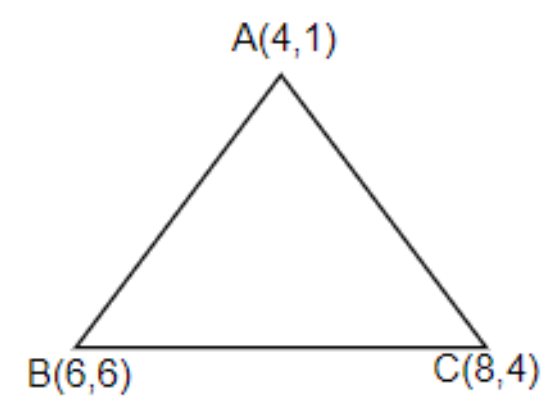
Now, assuming the coordinates of A, B and C as $\left( {{x}_{1}},{{y}_{1}} \right),\left( {{x}_{2}},{{y}_{2}} \right)$ and $\left( {{x}_{3}},{{y}_{3}} \right)$, we get,
$\begin{align}
& A\left( 4,1 \right)=\left( {{x}_{1}},{{y}_{1}} \right) \\
& B\left( 6,6 \right)=\left( {{x}_{2}},{{y}_{2}} \right) \\
& C\left( 8,4 \right)=\left( {{x}_{3}},{{y}_{3}} \right) \\
\end{align}$
Now, we know that area of triangle with coordinates $\left( {{x}_{1}},{{y}_{1}} \right),\left( {{x}_{2}},{{y}_{2}} \right)$ and $\left( {{x}_{3}},{{y}_{3}} \right)$ is given by the expression :
$Area=\dfrac{1}{2}\left[ {{x}_{1}}\left( {{y}_{2}}-{{y}_{3}} \right)+{{x}_{2}}\left( {{y}_{3}}-{{y}_{1}} \right)+{{x}_{3}}\left( {{y}_{1}}-{{y}_{2}} \right) \right]$
Now, substituting the values of ${{x}_{1}},{{x}_{2}},{{x}_{3}},{{y}_{1}},{{y}_{2}}$ and ${{y}_{3}}$in the above expression for area, we get,
$\begin{align}
& Ar.\left( \Delta ABC \right)=\dfrac{1}{2}\left[ 4\left( 6-4 \right)+6\left( 4-1 \right)+8\left( 1-6 \right) \right] \\
& \Rightarrow Ar.\left( \Delta ABC \right)=\dfrac{1}{2}\left[ 4\times 2+6\times 3+8\times \left( -5 \right) \right] \\
& \Rightarrow Ar.\left( \Delta ABC \right)=\dfrac{1}{2}\left[ 8+18-40 \right] \\
& \Rightarrow Ar.\left( \Delta ABC \right)=\dfrac{-14}{2} \\
& \Rightarrow Ar.\left( \Delta ABC \right)=-7\text{ square units} \\
\end{align}$
As we can see that the area of the $\Delta ABC$ turns out to be a negative value and we know that area cannot be negative. So, we must take the modulus on both sides to get the value of the area positive. Therefore, taking modulus, we get,
$\therefore Ar.\left( \Delta ABC \right)=\left| -7 \right|=7\text{ square units}$
Hence, the area of the $\Delta ABC$ is 7 square units.
Note: One may note that the formula for area of triangle in simplified form, can also be given as : $Area=\dfrac{1}{2}\left[ \left( {{x}_{1}}{{y}_{2}}-{{y}_{1}}{{x}_{2}} \right)+\left( {{x}_{2}}{{y}_{3}}-{{y}_{2}}{{x}_{3}} \right)+\left( {{x}_{3}}{{y}_{1}}-{{y}_{3}}{{x}_{1}} \right) \right]$. Always remember that if by substituting the values of given coordinates in the formula for area, the area turns out to be negative then we have to take modulus to make it positive. Actually we can choose any of the vertices as $\left( {{x}_{1}},{{y}_{1}} \right),\left( {{x}_{2}},{{y}_{2}} \right)$ and $\left( {{x}_{3}},{{y}_{3}} \right)$. It will not change the answer.
Complete step-by-step solution:
Here, we have been provided with a triangle ABC whose vertices are given as $A\left( 4,1 \right),B\left( 6,6 \right)$ and $C\left( 8,4 \right)$.
Now, assuming the coordinates of A, B and C as $\left( {{x}_{1}},{{y}_{1}} \right),\left( {{x}_{2}},{{y}_{2}} \right)$ and $\left( {{x}_{3}},{{y}_{3}} \right)$, we get,
$\begin{align}
& A\left( 4,1 \right)=\left( {{x}_{1}},{{y}_{1}} \right) \\
& B\left( 6,6 \right)=\left( {{x}_{2}},{{y}_{2}} \right) \\
& C\left( 8,4 \right)=\left( {{x}_{3}},{{y}_{3}} \right) \\
\end{align}$
Now, we know that area of triangle with coordinates $\left( {{x}_{1}},{{y}_{1}} \right),\left( {{x}_{2}},{{y}_{2}} \right)$ and $\left( {{x}_{3}},{{y}_{3}} \right)$ is given by the expression :
$Area=\dfrac{1}{2}\left[ {{x}_{1}}\left( {{y}_{2}}-{{y}_{3}} \right)+{{x}_{2}}\left( {{y}_{3}}-{{y}_{1}} \right)+{{x}_{3}}\left( {{y}_{1}}-{{y}_{2}} \right) \right]$
Now, substituting the values of ${{x}_{1}},{{x}_{2}},{{x}_{3}},{{y}_{1}},{{y}_{2}}$ and ${{y}_{3}}$in the above expression for area, we get,
$\begin{align}
& Ar.\left( \Delta ABC \right)=\dfrac{1}{2}\left[ 4\left( 6-4 \right)+6\left( 4-1 \right)+8\left( 1-6 \right) \right] \\
& \Rightarrow Ar.\left( \Delta ABC \right)=\dfrac{1}{2}\left[ 4\times 2+6\times 3+8\times \left( -5 \right) \right] \\
& \Rightarrow Ar.\left( \Delta ABC \right)=\dfrac{1}{2}\left[ 8+18-40 \right] \\
& \Rightarrow Ar.\left( \Delta ABC \right)=\dfrac{-14}{2} \\
& \Rightarrow Ar.\left( \Delta ABC \right)=-7\text{ square units} \\
\end{align}$
As we can see that the area of the $\Delta ABC$ turns out to be a negative value and we know that area cannot be negative. So, we must take the modulus on both sides to get the value of the area positive. Therefore, taking modulus, we get,
$\therefore Ar.\left( \Delta ABC \right)=\left| -7 \right|=7\text{ square units}$
Hence, the area of the $\Delta ABC$ is 7 square units.
Note: One may note that the formula for area of triangle in simplified form, can also be given as : $Area=\dfrac{1}{2}\left[ \left( {{x}_{1}}{{y}_{2}}-{{y}_{1}}{{x}_{2}} \right)+\left( {{x}_{2}}{{y}_{3}}-{{y}_{2}}{{x}_{3}} \right)+\left( {{x}_{3}}{{y}_{1}}-{{y}_{3}}{{x}_{1}} \right) \right]$. Always remember that if by substituting the values of given coordinates in the formula for area, the area turns out to be negative then we have to take modulus to make it positive. Actually we can choose any of the vertices as $\left( {{x}_{1}},{{y}_{1}} \right),\left( {{x}_{2}},{{y}_{2}} \right)$ and $\left( {{x}_{3}},{{y}_{3}} \right)$. It will not change the answer.
Recently Updated Pages
Master Class 11 Computer Science: Engaging Questions & Answers for Success

Master Class 11 Business Studies: Engaging Questions & Answers for Success
Master Class 11 Economics: Engaging Questions & Answers for Success
Master Class 11 English: Engaging Questions & Answers for Success
Master Class 11 Maths: Engaging Questions & Answers for Success
Master Class 11 Biology: Engaging Questions & Answers for Success
Trending doubts
One Metric ton is equal to kg A 10000 B 1000 C 100 class 11 physics CBSE
There are 720 permutations of the digits 1 2 3 4 5 class 11 maths CBSE
Discuss the various forms of bacteria class 11 biology CBSE
Draw a diagram of a plant cell and label at least eight class 11 biology CBSE
State the laws of reflection of light
Explain zero factorial class 11 maths CBSE