




Find the area of the triangle with vertices $A\left( 1,1,2 \right),B\left( 2,3,5 \right)$ and $C\left( 1,5,5 \right)$.
Answer
 Verified
489.6k+ views
Hint: We first try to find the sides of the tringle. The vector form of the sides gives the formula for the area as $\Delta ABC=\dfrac{1}{2}\left| \overrightarrow{AB}\times \overrightarrow{BC} \right|$. We use the determinant form to find the cross product of the sides. The half of the modulus gives us the area.
Complete step by step answer:
We first convert them to vector form and find the sides AB and BC.Therefore,
\[\overrightarrow{AB}=\left( 2-1 \right)\widehat{i}+\left( 3-1 \right)\widehat{j}+\left( 5-2 \right)\widehat{k} \\
\Rightarrow \overrightarrow{AB} =\widehat{i}+2\widehat{j}+3\widehat{k}\]
And,
\[\overrightarrow{BC}=\left( 1-2 \right)\widehat{i}+\left( 5-3 \right)\widehat{j}+\left( 5-5 \right)\widehat{k} \\
\Rightarrow \overrightarrow{BC} =-\widehat{i}+2\widehat{j}\]
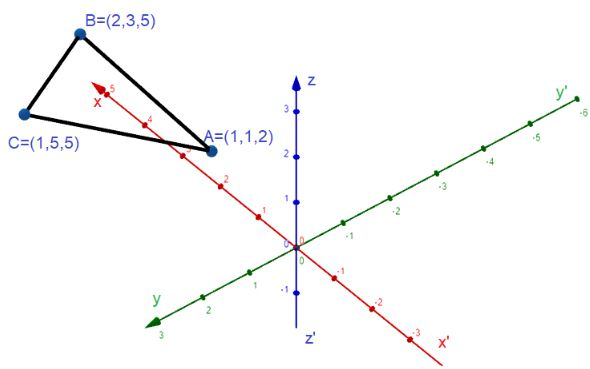
The area of the $\Delta ABC$ will be $\Delta ABC=\dfrac{1}{2}\left| \overrightarrow{AB}\times \overrightarrow{BC} \right|$.
$\overrightarrow{AB}\times \overrightarrow{BC}=\left| \begin{matrix}
\widehat{i} & \widehat{j} & \widehat{k} \\
1 & 2 & 3 \\
-1 & 2 & 0 \\
\end{matrix} \right|=\left( 0-6 \right)\widehat{i}+\left( 0+3 \right)\widehat{j}+\left( 2+2 \right)\widehat{k}=-6\widehat{i}+3\widehat{j}+4\widehat{k}$.
Now,
$\left| \overrightarrow{AB}\times \overrightarrow{BC} \right|=\sqrt{{{\left( -6 \right)}^{2}}+{{3}^{2}}+{{4}^{2}}} \\
\Rightarrow \left| \overrightarrow{AB}\times \overrightarrow{BC} \right|=\sqrt{61}$
The area of the triangle will be,
$\Delta ABC=\dfrac{1}{2}\left| \overrightarrow{AB}\times \overrightarrow{BC} \right| \\
\therefore \Delta ABC=\dfrac{61}{2}$
Therefore, the area of the triangle with vertices $A\left( 1,1,2 \right),B\left( 2,3,5 \right)$ and $C\left( 1,5,5 \right)$ is $\dfrac{61}{2}$ square units.
Note: The main condition for the formula $\Delta ABC=\dfrac{1}{2}\left| \overrightarrow{AB}\times \overrightarrow{BC} \right|$ to work is that we have broken the sides of the into their projection forms which are in perpendicular to each other. Therefore, it is quite similar to the area form of 2-D coordinate points.
Complete step by step answer:
We first convert them to vector form and find the sides AB and BC.Therefore,
\[\overrightarrow{AB}=\left( 2-1 \right)\widehat{i}+\left( 3-1 \right)\widehat{j}+\left( 5-2 \right)\widehat{k} \\
\Rightarrow \overrightarrow{AB} =\widehat{i}+2\widehat{j}+3\widehat{k}\]
And,
\[\overrightarrow{BC}=\left( 1-2 \right)\widehat{i}+\left( 5-3 \right)\widehat{j}+\left( 5-5 \right)\widehat{k} \\
\Rightarrow \overrightarrow{BC} =-\widehat{i}+2\widehat{j}\]
The area of the $\Delta ABC$ will be $\Delta ABC=\dfrac{1}{2}\left| \overrightarrow{AB}\times \overrightarrow{BC} \right|$.
$\overrightarrow{AB}\times \overrightarrow{BC}=\left| \begin{matrix}
\widehat{i} & \widehat{j} & \widehat{k} \\
1 & 2 & 3 \\
-1 & 2 & 0 \\
\end{matrix} \right|=\left( 0-6 \right)\widehat{i}+\left( 0+3 \right)\widehat{j}+\left( 2+2 \right)\widehat{k}=-6\widehat{i}+3\widehat{j}+4\widehat{k}$.
Now,
$\left| \overrightarrow{AB}\times \overrightarrow{BC} \right|=\sqrt{{{\left( -6 \right)}^{2}}+{{3}^{2}}+{{4}^{2}}} \\
\Rightarrow \left| \overrightarrow{AB}\times \overrightarrow{BC} \right|=\sqrt{61}$
The area of the triangle will be,
$\Delta ABC=\dfrac{1}{2}\left| \overrightarrow{AB}\times \overrightarrow{BC} \right| \\
\therefore \Delta ABC=\dfrac{61}{2}$
Therefore, the area of the triangle with vertices $A\left( 1,1,2 \right),B\left( 2,3,5 \right)$ and $C\left( 1,5,5 \right)$ is $\dfrac{61}{2}$ square units.
Note: The main condition for the formula $\Delta ABC=\dfrac{1}{2}\left| \overrightarrow{AB}\times \overrightarrow{BC} \right|$ to work is that we have broken the sides of the into their projection forms which are in perpendicular to each other. Therefore, it is quite similar to the area form of 2-D coordinate points.
Recently Updated Pages
Master Class 11 Computer Science: Engaging Questions & Answers for Success

Master Class 11 Business Studies: Engaging Questions & Answers for Success
Master Class 11 Economics: Engaging Questions & Answers for Success
Master Class 11 English: Engaging Questions & Answers for Success
Master Class 11 Maths: Engaging Questions & Answers for Success
Master Class 11 Biology: Engaging Questions & Answers for Success
Trending doubts
One Metric ton is equal to kg A 10000 B 1000 C 100 class 11 physics CBSE
There are 720 permutations of the digits 1 2 3 4 5 class 11 maths CBSE
Discuss the various forms of bacteria class 11 biology CBSE
Draw a diagram of a plant cell and label at least eight class 11 biology CBSE
State the laws of reflection of light
Explain zero factorial class 11 maths CBSE