



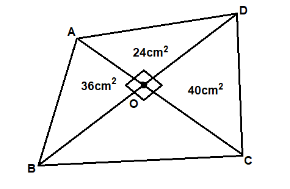
Find the area of the triangle BOC.
Answer
 Verified
580.8k+ views
Hint: As we can see the above quadrilateral is divided into four right angled triangles. Each pair of consecutive triangles has a common side. And the areas of three triangles are given. Find the base and height of the fourth triangle using the other three triangles. From the areas find the bases and heights of the three triangles and use them for the area of the fourth triangle.
Complete step-by-step answer:
Area of a right angled triangle is $ \dfrac{1}{2} \times b \times h $ , where b is the base of the triangle and h is the height of the triangle.
We are given a quadrilateral which is divided into four right angled triangles, and the areas of three triangles are given.
We have to calculate the area of the fourth triangle.
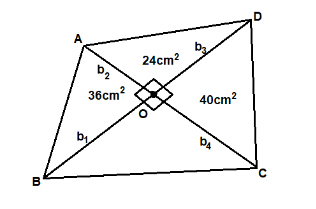
Four triangles are sharing four sides, let the sides be $ {b_1},{b_2},{b_3},{b_4} $
In triangle ABO and triangle ADO, AO is the common side. In triangles ADO and DOC, OD is the common side.
Area of the triangle ABO is $ 36c{m^2} $
$
Are{a_{ABO}} = \dfrac{1}{2} \times b \times h = \dfrac{1}{2} \times {b_1} \times {b_2} \\
\Rightarrow 36 = \dfrac{1}{2}{b_1}{b_2} \\
\Rightarrow {b_1}{b_2} = 72 \to eq\left( 1 \right) \\
$
Area of the triangle ADO is $ 24c{m^2} $
$
Are{a_{ADO}} = \dfrac{1}{2} \times b \times h = \dfrac{1}{2} \times {b_2} \times {b_3} \\
\Rightarrow 24 = \dfrac{1}{2}{b_2}{b_3} \\
\Rightarrow {b_2}{b_3} = 48 \to eq\left( 2 \right) \\
$
Area of the triangle DOC is $ 40c{m^2} $
$
Are{a_{DOC}} = \dfrac{1}{2} \times b \times h = \dfrac{1}{2} \times {b_3} \times {b_4} \\
\Rightarrow 40 = \dfrac{1}{2}{b_3}{b_4} \\
\Rightarrow {b_3}{b_4} = 80 \to eq\left( 3 \right) \\
$
On dividing equation 2 by equation 3, we get
$
\dfrac{{{b_2}{b_3}}}{{{b_3}{b_4}}} = \dfrac{{48}}{{80}} \\
\Rightarrow \dfrac{{{b_2}}}{{{b_4}}} = \dfrac{3}{5} \\
\Rightarrow {b_2} = \dfrac{{3{b_4}}}{5} \to eq\left( 4 \right) \\
$
On substituting equation 4 in equation 1, we get
$
{b_1}{b_2} = 72 \\
\Rightarrow {b_1}\left( {\dfrac{{3{b_4}}}{5}} \right) = 72 \\
\Rightarrow \dfrac{{3{b_1}{b_4}}}{5} = 72 \\
\Rightarrow {b_1}{b_4} = \dfrac{{72 \times 5}}{3} = 120 \to eq\left( 5 \right) \\
$
Substitute equation 5 in the area of the triangle BOC.
Area of the triangle BOC is ?.
$
Are{a_{BOC}} = \dfrac{1}{2} \times {b_1} \times {b_4} = \dfrac{1}{2}{b_1}{b_4} \\
{b_1}{b_4} = 120 \\
\therefore Are{a_{BOC}} = \dfrac{1}{2} \times 120 = 60c{m^2} \\
$
Therefore, the area of the triangle BOC is $ 60c{m^2} $
Note: General area of triangle without given base and height is $ \sqrt {s\left( {s - a} \right)\left( {s - b} \right)\left( {s - c} \right)} ,s = \dfrac{{a + b + c}}{2} $ , where a, b and c are the lengths of the sides of the triangle. This area formula can be applied to the right angled triangle also. In quadrilaterals such as rectangle, square, parallelogram and rhombus the diagonals bisect each other and they are equal. But the given quadrilateral is not one of these, so the diagonals don't bisect each other.
Complete step-by-step answer:
Area of a right angled triangle is $ \dfrac{1}{2} \times b \times h $ , where b is the base of the triangle and h is the height of the triangle.
We are given a quadrilateral which is divided into four right angled triangles, and the areas of three triangles are given.
We have to calculate the area of the fourth triangle.
Four triangles are sharing four sides, let the sides be $ {b_1},{b_2},{b_3},{b_4} $
In triangle ABO and triangle ADO, AO is the common side. In triangles ADO and DOC, OD is the common side.
Area of the triangle ABO is $ 36c{m^2} $
$
Are{a_{ABO}} = \dfrac{1}{2} \times b \times h = \dfrac{1}{2} \times {b_1} \times {b_2} \\
\Rightarrow 36 = \dfrac{1}{2}{b_1}{b_2} \\
\Rightarrow {b_1}{b_2} = 72 \to eq\left( 1 \right) \\
$
Area of the triangle ADO is $ 24c{m^2} $
$
Are{a_{ADO}} = \dfrac{1}{2} \times b \times h = \dfrac{1}{2} \times {b_2} \times {b_3} \\
\Rightarrow 24 = \dfrac{1}{2}{b_2}{b_3} \\
\Rightarrow {b_2}{b_3} = 48 \to eq\left( 2 \right) \\
$
Area of the triangle DOC is $ 40c{m^2} $
$
Are{a_{DOC}} = \dfrac{1}{2} \times b \times h = \dfrac{1}{2} \times {b_3} \times {b_4} \\
\Rightarrow 40 = \dfrac{1}{2}{b_3}{b_4} \\
\Rightarrow {b_3}{b_4} = 80 \to eq\left( 3 \right) \\
$
On dividing equation 2 by equation 3, we get
$
\dfrac{{{b_2}{b_3}}}{{{b_3}{b_4}}} = \dfrac{{48}}{{80}} \\
\Rightarrow \dfrac{{{b_2}}}{{{b_4}}} = \dfrac{3}{5} \\
\Rightarrow {b_2} = \dfrac{{3{b_4}}}{5} \to eq\left( 4 \right) \\
$
On substituting equation 4 in equation 1, we get
$
{b_1}{b_2} = 72 \\
\Rightarrow {b_1}\left( {\dfrac{{3{b_4}}}{5}} \right) = 72 \\
\Rightarrow \dfrac{{3{b_1}{b_4}}}{5} = 72 \\
\Rightarrow {b_1}{b_4} = \dfrac{{72 \times 5}}{3} = 120 \to eq\left( 5 \right) \\
$
Substitute equation 5 in the area of the triangle BOC.
Area of the triangle BOC is ?.
$
Are{a_{BOC}} = \dfrac{1}{2} \times {b_1} \times {b_4} = \dfrac{1}{2}{b_1}{b_4} \\
{b_1}{b_4} = 120 \\
\therefore Are{a_{BOC}} = \dfrac{1}{2} \times 120 = 60c{m^2} \\
$
Therefore, the area of the triangle BOC is $ 60c{m^2} $
Note: General area of triangle without given base and height is $ \sqrt {s\left( {s - a} \right)\left( {s - b} \right)\left( {s - c} \right)} ,s = \dfrac{{a + b + c}}{2} $ , where a, b and c are the lengths of the sides of the triangle. This area formula can be applied to the right angled triangle also. In quadrilaterals such as rectangle, square, parallelogram and rhombus the diagonals bisect each other and they are equal. But the given quadrilateral is not one of these, so the diagonals don't bisect each other.
Recently Updated Pages
Master Class 9 General Knowledge: Engaging Questions & Answers for Success

Master Class 9 Social Science: Engaging Questions & Answers for Success
Master Class 9 English: Engaging Questions & Answers for Success
Master Class 9 Maths: Engaging Questions & Answers for Success
Master Class 9 Science: Engaging Questions & Answers for Success
Class 9 Question and Answer - Your Ultimate Solutions Guide
Trending doubts
Difference Between Plant Cell and Animal Cell
Fill the blanks with the suitable prepositions 1 The class 9 english CBSE
Who is eligible for RTE class 9 social science CBSE
Which places in India experience sunrise first and class 9 social science CBSE
What is pollution? How many types of pollution? Define it
Name 10 Living and Non living things class 9 biology CBSE