




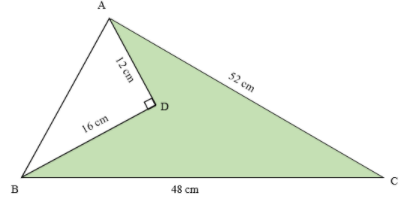
Find the area of the shaded region in the figure.
Answer
 Verified
628.2k+ views
Hint:
Here, we need to find the area of the shaded region. We will use the Pythagoras’s theorem to find the length of the missing side of triangle ABC. Then, using the area of triangle formula and the Heron’s formula, we will find the area of the shaded region in the figure.
Formula Used:
We will use the following formulas:
1) The area of a triangle is given by the formula \[\dfrac{1}{2}bh\], where \[b\] is the base of the triangle, and \[h\] is the height of the triangle.
2) Heron’s formula states that the area of a triangle is given by \[\sqrt {s\left( {s - a} \right)\left( {s - b} \right)\left( {s - c} \right)} \], where \[s\] is the semi-perimeter of the triangle, and \[a\], \[b\], and \[c\] are the lengths of the sides of the triangle.
Complete step by step solution:
First, we will find the length of the line segment AB.
We will use the Pythagoras’s theorem in the right angled triangle ADB.
Using the Pythagoras’s theorem in right angled triangle ADB, we get
\[A{B^2} = D{B^2} + A{D^2}\]
Substituting \[DB = 16\] cm and \[AD = 12\] cm in the equation, we get
\[ \Rightarrow A{B^2} = {16^2} + {12^2}\]
Applying the exponents on the bases, we get
\[ \Rightarrow A{B^2} = 256 + 144\]
Adding the terms in the expression, we get
\[ \Rightarrow A{B^2} = 400\]
Taking the square root on both the sides, we get
\[ \Rightarrow AB = 20\] cm
Now, we will find the area of triangle ABD using the formula \[\dfrac{1}{2}bh\].
Thus, we get
Area of triangle ABD \[ = \dfrac{1}{2} \times DB \times AD\]
Substituting \[DB = 16\] cm and \[AD = 12\] cm in the equation, we get
\[ \Rightarrow \] Area of triangle ABD \[ = \dfrac{1}{2} \times 16 \times 12\]
Simplifying the expression, we get
\[ \Rightarrow \] Area of triangle ABD \[ = 96{\rm{ c}}{{\rm{m}}^2}\]
Now, we will find the area of the triangle ABC.
The perimeter of a triangle is the sum of the lengths of all the three sides.
The lengths of the three sides of the triangle ABC are 20 cm, 48 cm, and 52 cm.
Therefore, we get
Perimeter of triangle ABC \[ = 20 + 48 + 52\]
Adding the terms, we get
\[ \Rightarrow \] Perimeter of triangle ABC \[ = 120\] cm
We will now use Heron’s formula to find the area of the triangle using the length of its sides.
The semi-perimeter of a triangle is half of its perimeter.
Therefore, we get
\[s = \dfrac{{120}}{2} = 60\] cm
Now, substituting \[s = 60\] cm, \[a = 20\] cm, \[b = 48\] cm, and \[c = 52\] cm in Heron’s formula, \[\sqrt {s\left( {s - a} \right)\left( {s - b} \right)\left( {s - c} \right)} \], we get
Area of the triangle ABC \[ = \sqrt {60\left( {60 - 20} \right)\left( {60 - 48} \right)\left( {60 - 52} \right)} {\rm{ c}}{{\rm{m}}^2}\]
Subtracting the terms in the parentheses, we get
\[ \Rightarrow \] Area of the triangle ABC \[ = \sqrt {60\left( {40} \right)\left( {12} \right)\left( 8 \right)} {\rm{ c}}{{\rm{m}}^2}\]
Rewriting the expression, we get
\[ \Rightarrow \] Area of the triangle ABC \[ = \sqrt {\left( {60 \times 8} \right) \times \left( {40 \times 12} \right)} {\rm{ c}}{{\rm{m}}^2}\]
Multiplying the terms, we get
\[ \Rightarrow \] Area of the triangle ABC\[ = \sqrt {480 \times 480} {\rm{ c}}{{\rm{m}}^2}\]
Simplifying the expression, we get
\[ \Rightarrow \]Area of the triangle ABC \[ = \sqrt {{{480}^2}} {\rm{ c}}{{\rm{m}}^2} = 480{\rm{ c}}{{\rm{m}}^2}\]
Now, from the figure, we can observe that the area of the shaded region is the difference in the areas of triangle ABC, and the area of the triangle ABD. This can be written as
\[ \Rightarrow \]Area of shaded region \[ = \] Area of triangle ABC \[ + \] Area of triangle ABD
Thus, we get
\[ \Rightarrow \]Area of shaded region \[ = 480{\rm{ c}}{{\rm{m}}^2} - 96{\rm{ c}}{{\rm{m}}^2}\]
Subtracting the terms, we get
\[ \Rightarrow \]Area of shaded region \[ = 384{\rm{ c}}{{\rm{m}}^2}\]
Therefore, we get the area of the shaded region as 384 \[{\rm{c}}{{\rm{m}}^2}\].
Note:
We have used the Heron’s formula instead of the formula \[\dfrac{1}{2} \times {\rm{Base}} \times {\rm{Altitude}}\] to find the area of the triangle because we have the lengths of the sides of the triangle, but not the altitude of triangle ABC.
We used Pythagoras’s theorem in the solution to find the side AB. The Pythagoras’s theorem states that the square of the hypotenuse of a right angled triangle is equal to the sum of squares of the other two sides, that is \[{\rm{Hypotenus}}{{\rm{e}}^2} = {\rm{Perpendicula}}{{\rm{r}}^2} + {\rm{Bas}}{{\rm{e}}^2}\].
Here, we need to find the area of the shaded region. We will use the Pythagoras’s theorem to find the length of the missing side of triangle ABC. Then, using the area of triangle formula and the Heron’s formula, we will find the area of the shaded region in the figure.
Formula Used:
We will use the following formulas:
1) The area of a triangle is given by the formula \[\dfrac{1}{2}bh\], where \[b\] is the base of the triangle, and \[h\] is the height of the triangle.
2) Heron’s formula states that the area of a triangle is given by \[\sqrt {s\left( {s - a} \right)\left( {s - b} \right)\left( {s - c} \right)} \], where \[s\] is the semi-perimeter of the triangle, and \[a\], \[b\], and \[c\] are the lengths of the sides of the triangle.
Complete step by step solution:
First, we will find the length of the line segment AB.
We will use the Pythagoras’s theorem in the right angled triangle ADB.
Using the Pythagoras’s theorem in right angled triangle ADB, we get
\[A{B^2} = D{B^2} + A{D^2}\]
Substituting \[DB = 16\] cm and \[AD = 12\] cm in the equation, we get
\[ \Rightarrow A{B^2} = {16^2} + {12^2}\]
Applying the exponents on the bases, we get
\[ \Rightarrow A{B^2} = 256 + 144\]
Adding the terms in the expression, we get
\[ \Rightarrow A{B^2} = 400\]
Taking the square root on both the sides, we get
\[ \Rightarrow AB = 20\] cm
Now, we will find the area of triangle ABD using the formula \[\dfrac{1}{2}bh\].
Thus, we get
Area of triangle ABD \[ = \dfrac{1}{2} \times DB \times AD\]
Substituting \[DB = 16\] cm and \[AD = 12\] cm in the equation, we get
\[ \Rightarrow \] Area of triangle ABD \[ = \dfrac{1}{2} \times 16 \times 12\]
Simplifying the expression, we get
\[ \Rightarrow \] Area of triangle ABD \[ = 96{\rm{ c}}{{\rm{m}}^2}\]
Now, we will find the area of the triangle ABC.
The perimeter of a triangle is the sum of the lengths of all the three sides.
The lengths of the three sides of the triangle ABC are 20 cm, 48 cm, and 52 cm.
Therefore, we get
Perimeter of triangle ABC \[ = 20 + 48 + 52\]
Adding the terms, we get
\[ \Rightarrow \] Perimeter of triangle ABC \[ = 120\] cm
We will now use Heron’s formula to find the area of the triangle using the length of its sides.
The semi-perimeter of a triangle is half of its perimeter.
Therefore, we get
\[s = \dfrac{{120}}{2} = 60\] cm
Now, substituting \[s = 60\] cm, \[a = 20\] cm, \[b = 48\] cm, and \[c = 52\] cm in Heron’s formula, \[\sqrt {s\left( {s - a} \right)\left( {s - b} \right)\left( {s - c} \right)} \], we get
Area of the triangle ABC \[ = \sqrt {60\left( {60 - 20} \right)\left( {60 - 48} \right)\left( {60 - 52} \right)} {\rm{ c}}{{\rm{m}}^2}\]
Subtracting the terms in the parentheses, we get
\[ \Rightarrow \] Area of the triangle ABC \[ = \sqrt {60\left( {40} \right)\left( {12} \right)\left( 8 \right)} {\rm{ c}}{{\rm{m}}^2}\]
Rewriting the expression, we get
\[ \Rightarrow \] Area of the triangle ABC \[ = \sqrt {\left( {60 \times 8} \right) \times \left( {40 \times 12} \right)} {\rm{ c}}{{\rm{m}}^2}\]
Multiplying the terms, we get
\[ \Rightarrow \] Area of the triangle ABC\[ = \sqrt {480 \times 480} {\rm{ c}}{{\rm{m}}^2}\]
Simplifying the expression, we get
\[ \Rightarrow \]Area of the triangle ABC \[ = \sqrt {{{480}^2}} {\rm{ c}}{{\rm{m}}^2} = 480{\rm{ c}}{{\rm{m}}^2}\]
Now, from the figure, we can observe that the area of the shaded region is the difference in the areas of triangle ABC, and the area of the triangle ABD. This can be written as
\[ \Rightarrow \]Area of shaded region \[ = \] Area of triangle ABC \[ + \] Area of triangle ABD
Thus, we get
\[ \Rightarrow \]Area of shaded region \[ = 480{\rm{ c}}{{\rm{m}}^2} - 96{\rm{ c}}{{\rm{m}}^2}\]
Subtracting the terms, we get
\[ \Rightarrow \]Area of shaded region \[ = 384{\rm{ c}}{{\rm{m}}^2}\]
Therefore, we get the area of the shaded region as 384 \[{\rm{c}}{{\rm{m}}^2}\].
Note:
We have used the Heron’s formula instead of the formula \[\dfrac{1}{2} \times {\rm{Base}} \times {\rm{Altitude}}\] to find the area of the triangle because we have the lengths of the sides of the triangle, but not the altitude of triangle ABC.
We used Pythagoras’s theorem in the solution to find the side AB. The Pythagoras’s theorem states that the square of the hypotenuse of a right angled triangle is equal to the sum of squares of the other two sides, that is \[{\rm{Hypotenus}}{{\rm{e}}^2} = {\rm{Perpendicula}}{{\rm{r}}^2} + {\rm{Bas}}{{\rm{e}}^2}\].
Recently Updated Pages
Class 10 Question and Answer - Your Ultimate Solutions Guide

Master Class 10 Computer Science: Engaging Questions & Answers for Success
Master Class 10 General Knowledge: Engaging Questions & Answers for Success
Master Class 12 Economics: Engaging Questions & Answers for Success
Master Class 12 Social Science: Engaging Questions & Answers for Success
Master Class 12 English: Engaging Questions & Answers for Success
Trending doubts
Explain the Treaty of Vienna of 1815 class 10 social science CBSE
The slogan Jai Hind was given by A Lal Bahadur Shastri class 10 social science CBSE
10 examples of evaporation in daily life with explanations
What is the full form of POSCO class 10 social science CBSE
Identify the feminine form of noun nephew a shenephew class 10 english CBSE
CSIR full form?