




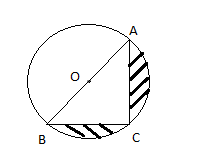
Find the area of the shaded region in figure, if AC = 3 cm, BC = 4 cm and O is the center of the circle.
Answer
 Verified
615.9k+ views
Hint: Use the facts that chord passing through the center is a diameter and angle inscribed in a circle is a right angle to find the length of AB through the Pythagoras’ theorem formula (In a right angled triangle, (length of the hypotenuse)2 = (length of one side)2 + (length of the other side)2)
Compute radius = half of the diameter = half of length of AB and find the area of semicircle ACB using the formula area of a circle $\pi {r^2}$
Finally, compute Area of the shaded region = Area of the semicircle ACB - Area of the triangle ACB.
Complete step by step solution: We are given a circle with center O and chords AB, AC, and BC.
We need to find the area of the shaded portion of the circle.
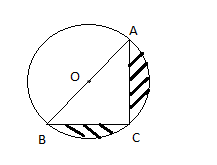
Here, we can see from the given figure that the chord AB is passing through point O which is the center of the given circle.
Therefore, AB is the diameter of the circle.
This implies that arch ACB is a semi-circle.
This also means that $\angle ACB$is an inscribed angle.
Now, we know that any angle inscribed in a semicircle is a right angle.
Therefore,$\vartriangle ACB$is a right angled triangle.
We know the lengths of the sides AC and BC.
We can use this information to compute the length of side AB which is also the hypotenuse of $\vartriangle ACB$ using the Pythagoras’ theorem formula.
The Pythagoras’ theorem formula is given as follows:
In a right angled triangle, (length of the hypotenuse)2 = (length of one side)2 + (length of the other side)2
Now, consider$\vartriangle ACB$
Applying the Pythagoras’ theorem formula, we have
$ A{B^2} = A{C^2} + B{C^2} \\
\Rightarrow A{B^2} = {3^2} + {4^2} = 9 + 16 = 25 \\ $
On taking square roots of both the sides, we get AB = 5 cm.
This means that the length of the diameter of the circle is also 5 cm.
Therefore, the length of its radius = $diameter \div 2 = 5 \div 2 = 2.5$ cm.
Now, from the figure we can see that
Area of the shaded region = Area of the semicircle ACB - Area of the triangle ACB……..equation (1)
So, let’s compute the area of the semicircle ACB.
Area of circle = $\pi {r^2}$ where r denotes the radius of the circle.
Therefore, area of semicircle ACB =$\dfrac{1}{2}\pi {r^2}$
We have r = radius = 2.5 cm
So, area of semicircle ACB =\[\dfrac{1}{2} \times \dfrac{{22}}{7} \times {(2.5)^2} = \dfrac{{11}}{7} \times 6.25 = 9.281\]$ cm^2$
Area of a right angled triangle = $\dfrac{1}{2} \times $ product of the lengths of the perpendicular sides.
Therefore, area of $\vartriangle ACB = \dfrac{1}{2} \times AC \times BC = \dfrac{1}{2} \times 3 \times 4 = 6 cm^2$
After substituting the values in equation (1), we get
Area of the shaded region $ = 9.281 - 6 = 3.281 cm^2$
Hence the required area is $3.281 cm^2$
Note: This method will work only if one of the sides of the triangle passes through the center of the circle.
Compute radius = half of the diameter = half of length of AB and find the area of semicircle ACB using the formula area of a circle $\pi {r^2}$
Finally, compute Area of the shaded region = Area of the semicircle ACB - Area of the triangle ACB.
Complete step by step solution: We are given a circle with center O and chords AB, AC, and BC.
We need to find the area of the shaded portion of the circle.
Here, we can see from the given figure that the chord AB is passing through point O which is the center of the given circle.
Therefore, AB is the diameter of the circle.
This implies that arch ACB is a semi-circle.
This also means that $\angle ACB$is an inscribed angle.
Now, we know that any angle inscribed in a semicircle is a right angle.
Therefore,$\vartriangle ACB$is a right angled triangle.
We know the lengths of the sides AC and BC.
We can use this information to compute the length of side AB which is also the hypotenuse of $\vartriangle ACB$ using the Pythagoras’ theorem formula.
The Pythagoras’ theorem formula is given as follows:
In a right angled triangle, (length of the hypotenuse)2 = (length of one side)2 + (length of the other side)2
Now, consider$\vartriangle ACB$
Applying the Pythagoras’ theorem formula, we have
$ A{B^2} = A{C^2} + B{C^2} \\
\Rightarrow A{B^2} = {3^2} + {4^2} = 9 + 16 = 25 \\ $
On taking square roots of both the sides, we get AB = 5 cm.
This means that the length of the diameter of the circle is also 5 cm.
Therefore, the length of its radius = $diameter \div 2 = 5 \div 2 = 2.5$ cm.
Now, from the figure we can see that
Area of the shaded region = Area of the semicircle ACB - Area of the triangle ACB……..equation (1)
So, let’s compute the area of the semicircle ACB.
Area of circle = $\pi {r^2}$ where r denotes the radius of the circle.
Therefore, area of semicircle ACB =$\dfrac{1}{2}\pi {r^2}$
We have r = radius = 2.5 cm
So, area of semicircle ACB =\[\dfrac{1}{2} \times \dfrac{{22}}{7} \times {(2.5)^2} = \dfrac{{11}}{7} \times 6.25 = 9.281\]$ cm^2$
Area of a right angled triangle = $\dfrac{1}{2} \times $ product of the lengths of the perpendicular sides.
Therefore, area of $\vartriangle ACB = \dfrac{1}{2} \times AC \times BC = \dfrac{1}{2} \times 3 \times 4 = 6 cm^2$
After substituting the values in equation (1), we get
Area of the shaded region $ = 9.281 - 6 = 3.281 cm^2$
Hence the required area is $3.281 cm^2$
Note: This method will work only if one of the sides of the triangle passes through the center of the circle.
Recently Updated Pages
Master Class 10 Computer Science: Engaging Questions & Answers for Success

Master Class 10 General Knowledge: Engaging Questions & Answers for Success
Master Class 10 English: Engaging Questions & Answers for Success
Master Class 10 Social Science: Engaging Questions & Answers for Success
Master Class 10 Maths: Engaging Questions & Answers for Success
Master Class 10 Science: Engaging Questions & Answers for Success
Trending doubts
Explain the Treaty of Vienna of 1815 class 10 social science CBSE
Who Won 36 Oscar Awards? Record Holder Revealed
What is the median of the first 10 natural numbers class 10 maths CBSE
Why is it 530 pm in india when it is 1200 afternoon class 10 social science CBSE
Select the word that is correctly spelled a Twelveth class 10 english CBSE
Why is there a time difference of about 5 hours between class 10 social science CBSE