




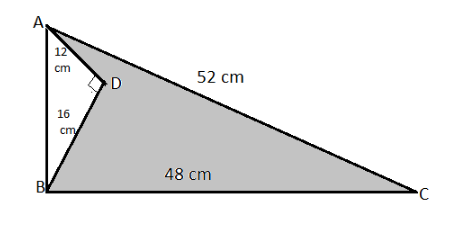
Find the area of the shaded region in figure.
Answer
 Verified
609k+ views
Hint: Here, we use formula for the area of the right angled triangle and the heron’s formula. Step by step first find the area of one triangle which is the part of the bigger triangle, then the area of the bigger triangle and find the difference between the two for the required answer.
Complete step-by-step answer:
Now, as per the required solution-
The area of the shaded region $ = Area{\text{ of }}\Delta {\text{ABC - }}Area{\text{ of }}\Delta {\text{ABD}} $ ...... (a)
Now, first we will find the area of $ \Delta ABD, $
We are given measures of its two sides, $ BD = 16{\text{ cm, AD = 12cm}} $
By using the hypotenuse theorem,
$ A{B^2} = B{D^2} + A{D^2} $
Place values in the above equation –
$
\Rightarrow A{B^2} = {16^2} + {12^2} \\
\Rightarrow A{B^2} = 256 + 144 \\
\Rightarrow A{B^2} = 400 \\
$
Take square-root on both the sides of the equation –
$ \Rightarrow AB = 20{\text{ cm}} $
Now, the area of the triangle $ = \dfrac{1}{2}bh $
Area of $ \Delta ABD = \dfrac{1}{2} \times 12 \times 16 $
Simplification –
Area of $ \Delta ABD = 96{\text{ c}}{{\text{m}}^2} $ .... (b)
Also, In $ \Delta ABC, $ Semi-perimeter of the triangle is sum of all the three sides divided by two.
$ s = \dfrac{1}{2}(AB + BC + CA) $
Place values in the above equation -
$ s = \dfrac{1}{2}(20 + 52 + 48) $
Simplify the above equation
$
\Rightarrow s = \dfrac{1}{2}(120) \\
\Rightarrow s = 60\;{\text{cm}} \\
$
By using the Heron’s formula –
Area of $ \Delta ABC, $
$ A = \sqrt {s(s - a)(s - b)(s - c)} $
Where “a” is the measure of side BC
“b” is the measure of side AC
“c” is the measure of side AB
Place values in the above equation –
$ A = \sqrt {60(60 - 20)(60 - 48)(60 - 52)} $
Simplify the above equation –
\[
\Rightarrow A = \sqrt {60(40)(8)(12)} \\
\Rightarrow A = \sqrt {{{48}^2} \times {{10}^2}} \\
\]
Square and square-root cancel each other on the right hand side of the equation –
$
\Rightarrow A = 48 \times 10 \\
\Rightarrow A = 480c{m^2}\;{\text{ }}.....{\text{ (c)}} \\
$
Place the value of equation (b) and the equation (c) in the equation (a)
The area of the shaded region $ = Area{\text{ of }}\Delta {\text{ABC - }}Area{\text{ of }}\Delta {\text{ABD}} $
The area of the shaded region $ = 480 - 96 $
The area of the shaded region $ = 384c{m^2} $
Note: Follow the step by step approach to solve this sum. Be good in multiples and apply the concept of square-root correctly. Remember basic formulas to find the area of the closed figures.
Complete step-by-step answer:
Now, as per the required solution-
The area of the shaded region $ = Area{\text{ of }}\Delta {\text{ABC - }}Area{\text{ of }}\Delta {\text{ABD}} $ ...... (a)
Now, first we will find the area of $ \Delta ABD, $
We are given measures of its two sides, $ BD = 16{\text{ cm, AD = 12cm}} $
By using the hypotenuse theorem,
$ A{B^2} = B{D^2} + A{D^2} $
Place values in the above equation –
$
\Rightarrow A{B^2} = {16^2} + {12^2} \\
\Rightarrow A{B^2} = 256 + 144 \\
\Rightarrow A{B^2} = 400 \\
$
Take square-root on both the sides of the equation –
$ \Rightarrow AB = 20{\text{ cm}} $
Now, the area of the triangle $ = \dfrac{1}{2}bh $
Area of $ \Delta ABD = \dfrac{1}{2} \times 12 \times 16 $
Simplification –
Area of $ \Delta ABD = 96{\text{ c}}{{\text{m}}^2} $ .... (b)
Also, In $ \Delta ABC, $ Semi-perimeter of the triangle is sum of all the three sides divided by two.
$ s = \dfrac{1}{2}(AB + BC + CA) $
Place values in the above equation -
$ s = \dfrac{1}{2}(20 + 52 + 48) $
Simplify the above equation
$
\Rightarrow s = \dfrac{1}{2}(120) \\
\Rightarrow s = 60\;{\text{cm}} \\
$
By using the Heron’s formula –
Area of $ \Delta ABC, $
$ A = \sqrt {s(s - a)(s - b)(s - c)} $
Where “a” is the measure of side BC
“b” is the measure of side AC
“c” is the measure of side AB
Place values in the above equation –
$ A = \sqrt {60(60 - 20)(60 - 48)(60 - 52)} $
Simplify the above equation –
\[
\Rightarrow A = \sqrt {60(40)(8)(12)} \\
\Rightarrow A = \sqrt {{{48}^2} \times {{10}^2}} \\
\]
Square and square-root cancel each other on the right hand side of the equation –
$
\Rightarrow A = 48 \times 10 \\
\Rightarrow A = 480c{m^2}\;{\text{ }}.....{\text{ (c)}} \\
$
Place the value of equation (b) and the equation (c) in the equation (a)
The area of the shaded region $ = Area{\text{ of }}\Delta {\text{ABC - }}Area{\text{ of }}\Delta {\text{ABD}} $
The area of the shaded region $ = 480 - 96 $
The area of the shaded region $ = 384c{m^2} $
Note: Follow the step by step approach to solve this sum. Be good in multiples and apply the concept of square-root correctly. Remember basic formulas to find the area of the closed figures.
Recently Updated Pages
Master Class 12 Economics: Engaging Questions & Answers for Success

Master Class 12 English: Engaging Questions & Answers for Success
Master Class 12 Social Science: Engaging Questions & Answers for Success
Master Class 12 Maths: Engaging Questions & Answers for Success
Master Class 12 Physics: Engaging Questions & Answers for Success
Master Class 9 General Knowledge: Engaging Questions & Answers for Success
Trending doubts
Differentiate between the Western and the Eastern class 9 social science CBSE
Write the 6 fundamental rights of India and explain in detail
Define development
Describe any five main characteristics of alluvial class 9 social science CBSE
What is the importance of natural resources? Why is it necessary to conserve them?
Distinguish between the following Ferrous and nonferrous class 9 social science CBSE