




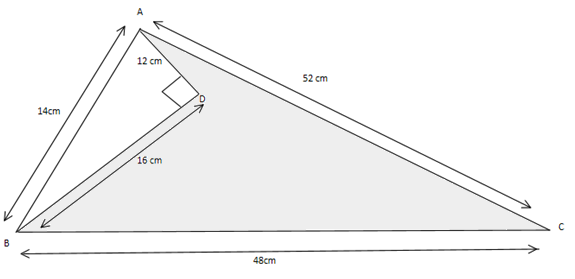
Find the area of the shaded region in figure.
Answer
 Verified
618.9k+ views
Hint:
First find the area of a right angle triangle $ADB$ using the area of triangle formula $\dfrac{1}{2} \times base \times height$, then find the area of triangle $ABC$, finally by subtracting the area of triangle $ADB$ from the area of triangle $ABC$ we get the area for shaded region.
Complete step by step solution:
From the figure it is shown that the triangle $ABC$ is right angled at point $D$. So we can apply Pythagoras theorem.
Pythagoras theorem is given by:
$Hypotenus{e^2} = Perpendicula{r^2} + Bas{e^2}$
From the figure we can say that:
$AD = $Base
$BD = $Perpendicular or height
$AB = $Hypotenuse
Therefore in the right angle triangle $ADB$
\[A{B^2} = A{D^2} + B{D^2}\]
On substituting the values of base and perpendicular in the above equation, we have
$A{B^2} = {12^2} + {16^2}$
$A{B^2} = 144 + 256$
Taking square root on both the sides
We get, $AB = \sqrt {144 + 256} $
$ = \sqrt {400} = \sqrt {{{20}^2}} = 20cm$
Therefore $AB = 20cm$
Now, consider triangle $ABC$, by Pythagoras theorem we have,
$A{C^2} = A{B^2} + B{C^2} = {20^2} + {48^2}$
$ = 400 + 2304$
$ = 2704 = {52^2} = A{C^2}$
Therefore we can say that the triangle $ABC$is right angled at$B$.
Now, to find the area of the shaded region, first we need to find the area of triangle $ADB$ and also the area of triangle $ABC$.
(Area of triangle formula is given by:$\dfrac{1}{2} \times base \times height$)
By using the area of triangle formula we have,
Area of triangle $ADB$ $ = \dfrac{1}{2} \times base \times height$
$ = \dfrac{1}{2} \times 12 \times 16$
$ = 96c{m^2}$
($c{m^2}$Is because when we multiply base in terms of $cm$with height in terms $cm$ we get square of$cm$)
Area of triangle $ABC = \dfrac{1}{2} \times base \times height$
$ = \dfrac{1}{2} \times 20 \times 48$
$ = 480c{m^2}$
Now, to find the area of shaded region as shown in figure
We have,
Area of shaded region $ = $ Area of triangle $ABC$ $ - $ Area of triangle $ADB$
$ = 480 - 96$
$ = 384c{m^2}$
Note:
Pythagoras theorem works only for right-angled triangles. Sometimes they may give or they may not give the value of $AB$ as shown in above fig. If it is given also, if the triangle is a right angled triangle then apply Pythagoras theorem and solve it.
First find the area of a right angle triangle $ADB$ using the area of triangle formula $\dfrac{1}{2} \times base \times height$, then find the area of triangle $ABC$, finally by subtracting the area of triangle $ADB$ from the area of triangle $ABC$ we get the area for shaded region.
Complete step by step solution:
From the figure it is shown that the triangle $ABC$ is right angled at point $D$. So we can apply Pythagoras theorem.
Pythagoras theorem is given by:
$Hypotenus{e^2} = Perpendicula{r^2} + Bas{e^2}$
From the figure we can say that:
$AD = $Base
$BD = $Perpendicular or height
$AB = $Hypotenuse
Therefore in the right angle triangle $ADB$
\[A{B^2} = A{D^2} + B{D^2}\]
On substituting the values of base and perpendicular in the above equation, we have
$A{B^2} = {12^2} + {16^2}$
$A{B^2} = 144 + 256$
Taking square root on both the sides
We get, $AB = \sqrt {144 + 256} $
$ = \sqrt {400} = \sqrt {{{20}^2}} = 20cm$
Therefore $AB = 20cm$
Now, consider triangle $ABC$, by Pythagoras theorem we have,
$A{C^2} = A{B^2} + B{C^2} = {20^2} + {48^2}$
$ = 400 + 2304$
$ = 2704 = {52^2} = A{C^2}$
Therefore we can say that the triangle $ABC$is right angled at$B$.
Now, to find the area of the shaded region, first we need to find the area of triangle $ADB$ and also the area of triangle $ABC$.
(Area of triangle formula is given by:$\dfrac{1}{2} \times base \times height$)
By using the area of triangle formula we have,
Area of triangle $ADB$ $ = \dfrac{1}{2} \times base \times height$
$ = \dfrac{1}{2} \times 12 \times 16$
$ = 96c{m^2}$
($c{m^2}$Is because when we multiply base in terms of $cm$with height in terms $cm$ we get square of$cm$)
Area of triangle $ABC = \dfrac{1}{2} \times base \times height$
$ = \dfrac{1}{2} \times 20 \times 48$
$ = 480c{m^2}$
Now, to find the area of shaded region as shown in figure
We have,
Area of shaded region $ = $ Area of triangle $ABC$ $ - $ Area of triangle $ADB$
$ = 480 - 96$
$ = 384c{m^2}$
Note:
Pythagoras theorem works only for right-angled triangles. Sometimes they may give or they may not give the value of $AB$ as shown in above fig. If it is given also, if the triangle is a right angled triangle then apply Pythagoras theorem and solve it.
Recently Updated Pages
Basicity of sulphurous acid and sulphuric acid are

Master Class 12 Economics: Engaging Questions & Answers for Success
Master Class 12 Biology: Engaging Questions & Answers for Success
Master Class 11 English: Engaging Questions & Answers for Success
Master Class 11 Physics: Engaging Questions & Answers for Success
Master Class 11 Computer Science: Engaging Questions & Answers for Success
Trending doubts
What is the Total Duration of Football Match?
Explain the Treaty of Vienna of 1815 class 10 social science CBSE
In football, which nation is called "La Roja"?
Why is there a time difference of about 5 hours between class 10 social science CBSE
10 examples of evaporation in daily life with explanations
What is the full form of POSCO class 10 social science CBSE