




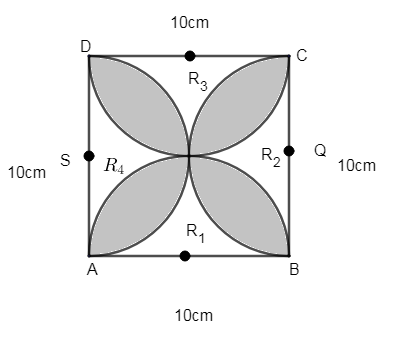
Find the area of the shaded region in figure, where ABCD is a square of side 10cm. Use (\[\pi =3.14\])
(a) \[32c{{m}^{2}}\]
(b) \[41c{{m}^{2}}\]
(c) \[49c{{m}^{2}}\]
(d) \[57c{{m}^{2}}\]
Answer
 Verified
632.4k+ views
Hint: Assume that the semicircle is drawn with the side of the square. To get the required area, subtract the area of the non-shaded region from the area of the square. You can divide it into 4 regions.
Complete step by step answer:
We have been given a square ABCD of side 10cm.
Thus we can find the area of square ABCD first.
We know that area of square = \[{{\left( side \right)}^{2}}\].
\[\therefore \] Area of square ABCD \[={{10}^{2}}=10\times 10=100c{{m}^{2}}\].
Now let us consider that the semicircle is drawn with the side of the square as diameter.
So, the diameter of the semi-circle = side of square = 10cm.
So, the radius of semi-circle \[=\dfrac{side}{2}=\dfrac{10}{2}=5\]cm
We know that area of semi-circle = \[\dfrac{1}{2}\times \] area of circle \[=\dfrac{\pi {{r}^{2}}}{2}\].
\[\therefore \] Area of semicircle AD
\[=\dfrac{1}{2}\times \pi {{r}^{2}}=\dfrac{1}{2}\times \pi \times {{5}^{2}}\]
\[\begin{align}
& =\dfrac{1}{2}\times \pi \times 5\times 5 \\
& =\dfrac{3.14\times 25}{2} \\
\end{align}\]
Thus the area of semi-circle AD = Area of semicircle BC = area of semi-circle AB = area of semi-circle CD \[=\dfrac{3.14\times 25}{2}\]
Let us mark the unshaded region as I, II, III, IV.
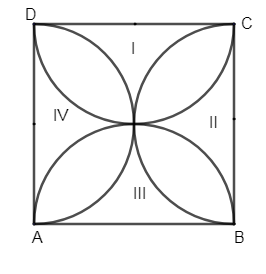
Area of shaded region = Area of ABCD – (area of I + II + III + IV)
Now let us find,
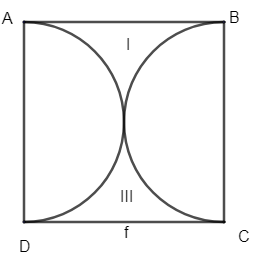
Area of region I + Area of region III = Area of square ABCD – (area of semicircle AD & BC)
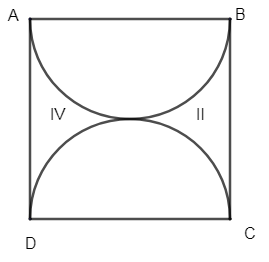
Similarly, area of region II + IV = Area of square ABCD – (Area of semi-circle AB & CD)
So, area of region (I + II + III + IV) = 2 (area of square ABCD) – (square of semi-circle AD + BC + AB + CD)
\[\therefore \] Area of region (I + II + III + IV) = (\[2\times \] area of square) – (\[4\times \] area of semi-circle)
\[\because \] All the areas of the semi-circle are equal.
i.e. \[AD=BC=AB=CD=\dfrac{3.14\times 25}{2}\]
\[\therefore \] Area of region (I + II + III + IV)
\[=\left( 2\times 100 \right)-\left( 4\times \dfrac{3.14\times 25}{2} \right)\]
\[\begin{align}
& =200-\left( 50\times 3.14 \right) \\
& =43c{{m}^{2}} \\
\end{align}\]
So, now the area of shaded region = Area of ABCD – area of region (I + II + III + IV)
= 100 – 43 = \[57c{{m}^{2}}\].
Hence we got the area of the shaded region = \[57c{{m}^{2}}\].
\[\therefore \] Option (d) is the correct answer.
Note: Remember how to take the region I, II, III and IV. As it’s a square then the area of the semi-circle will be the same. But you should get the basic idea of how the regions are considered from the figure. Thus to get the required area subtract the area of the non- shaded region from the area of square.
Complete step by step answer:
We have been given a square ABCD of side 10cm.
Thus we can find the area of square ABCD first.
We know that area of square = \[{{\left( side \right)}^{2}}\].
\[\therefore \] Area of square ABCD \[={{10}^{2}}=10\times 10=100c{{m}^{2}}\].
Now let us consider that the semicircle is drawn with the side of the square as diameter.
So, the diameter of the semi-circle = side of square = 10cm.
So, the radius of semi-circle \[=\dfrac{side}{2}=\dfrac{10}{2}=5\]cm
We know that area of semi-circle = \[\dfrac{1}{2}\times \] area of circle \[=\dfrac{\pi {{r}^{2}}}{2}\].
\[\therefore \] Area of semicircle AD
\[=\dfrac{1}{2}\times \pi {{r}^{2}}=\dfrac{1}{2}\times \pi \times {{5}^{2}}\]
\[\begin{align}
& =\dfrac{1}{2}\times \pi \times 5\times 5 \\
& =\dfrac{3.14\times 25}{2} \\
\end{align}\]
Thus the area of semi-circle AD = Area of semicircle BC = area of semi-circle AB = area of semi-circle CD \[=\dfrac{3.14\times 25}{2}\]
Let us mark the unshaded region as I, II, III, IV.
Area of shaded region = Area of ABCD – (area of I + II + III + IV)
Now let us find,
Area of region I + Area of region III = Area of square ABCD – (area of semicircle AD & BC)
Similarly, area of region II + IV = Area of square ABCD – (Area of semi-circle AB & CD)
So, area of region (I + II + III + IV) = 2 (area of square ABCD) – (square of semi-circle AD + BC + AB + CD)
\[\therefore \] Area of region (I + II + III + IV) = (\[2\times \] area of square) – (\[4\times \] area of semi-circle)
\[\because \] All the areas of the semi-circle are equal.
i.e. \[AD=BC=AB=CD=\dfrac{3.14\times 25}{2}\]
\[\therefore \] Area of region (I + II + III + IV)
\[=\left( 2\times 100 \right)-\left( 4\times \dfrac{3.14\times 25}{2} \right)\]
\[\begin{align}
& =200-\left( 50\times 3.14 \right) \\
& =43c{{m}^{2}} \\
\end{align}\]
So, now the area of shaded region = Area of ABCD – area of region (I + II + III + IV)
= 100 – 43 = \[57c{{m}^{2}}\].
Hence we got the area of the shaded region = \[57c{{m}^{2}}\].
\[\therefore \] Option (d) is the correct answer.
Note: Remember how to take the region I, II, III and IV. As it’s a square then the area of the semi-circle will be the same. But you should get the basic idea of how the regions are considered from the figure. Thus to get the required area subtract the area of the non- shaded region from the area of square.
Recently Updated Pages
Master Class 10 Social Science: Engaging Questions & Answers for Success

Master Class 10 Science: Engaging Questions & Answers for Success
Master Class 10 Maths: Engaging Questions & Answers for Success
Master Class 10 General Knowledge: Engaging Questions & Answers for Success
Master Class 10 Computer Science: Engaging Questions & Answers for Success
Class 10 Question and Answer - Your Ultimate Solutions Guide
Trending doubts
What is the full form of PNG A Petrol Natural Gas B class 10 chemistry CBSE
Why is there a time difference of about 5 hours between class 10 social science CBSE
Distinguish between the reserved forests and protected class 10 biology CBSE
Metals which do not react with dilute acids beginarray20l class 10 chemistry CBSE
If a trait A exists in 10 of a population of an asexually class 10 biology CBSE
Find the value of log sqrt 2 64 class 10 maths CBSE