




Find the area of the region enclosed between the circles \[{{x}^{2}}+{{y}^{2}}=1\] and \[{{\left( x-1 \right)}^{2}}+{{y}^{2}}=1\].
Answer
 Verified
647.1k+ views
Hint: By using elimination method find the points of intersection of 2 curves. By looking at their equations, apply general coordinate geometry techniques to find their shapes. Draw the curves together on a graph. By using their diagrams mark the area which is common in both of them. So, by this common area, try to find symmetry in the shaded region. Now find which curve forms which area from where to where? Try to integrate the curves respectively and then add them.
Complete step-by-step answer:
Elimination method:
First write 2 curve equations which you need to solve to find intersection points. Then try to convert one variable in terms of another variable by using any one of the equations. Now substitute this variable in terms of others into the remaining equation. Now the remaining equation turns into an equation of one variable. By normal geometry find the variable. Using previous relations, find the other variable. Thus, you get the intersection point(s).
Given equations in the question can be written as follows:
\[\Rightarrow {{x}^{2}}+{{y}^{2}}=1\] - (1)
\[\Rightarrow {{\left( x-1 \right)}^{2}}+{{y}^{2}}=1\] - (2)
By general co – ordinate geometry equation, \[{{\left( x-g \right)}^{2}}+{{\left( y-h \right)}^{2}}={{a}^{2}}\] is a circle with center (g, h) and radius a.
From this we can say the following statements:
\[{{x}^{2}}+{{y}^{2}}=1\] is a circle with radius 1 and center at (0, 0).
\[{{\left( x-1 \right)}^{2}}+{{y}^{2}}=1\] is a circle with radius 1 and center at (1, 0).
By subtracting \[{{x}^{2}}\] on both sides from equation (1), we get:
\[\Rightarrow {{y}^{2}}=1-{{x}^{2}}\] - (3)
By substituting this into equation (2), we get:
\[\Rightarrow {{\left( x-1 \right)}^{2}}+1-{{x}^{2}}=1\]
We know \[{{\left( a-b \right)}^{2}}={{a}^{2}}-2ab+{{b}^{2}}\], by substituting this into above we get:
\[\Rightarrow {{x}^{2}}-2x+1+1-{{x}^{2}}=1\]
By simplifying the above we can say, 2 – 2x = 1.
By subtracting 2 and the dividing with -2 on both sides, we get:
\[\Rightarrow x=\dfrac{1}{2}\]
Substituting this into equation (3), we get: \[{{y}^{2}}=1-\dfrac{1}{4}\]
\[\Rightarrow {{y}^{2}}=\dfrac{3}{4}\]
By applying square root on both sides, we get:
\[\Rightarrow y=\pm \dfrac{\sqrt{3}}{2}\]
So, intersection points are given by \[\left( \dfrac{1}{2},\dfrac{\sqrt{3}}{2} \right),\left( \dfrac{1}{2},\dfrac{-\sqrt{3}}{2} \right)\].
Now we will draw both the circles and mark the areas.
From the derived centers and radii we can draw them as:
Curves: -
\[{{x}^{2}}+{{y}^{2}}=1\]
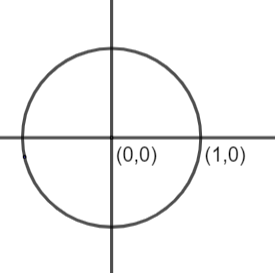
\[{{\left( x-1 \right)}^{2}}+{{y}^{2}}=1\]
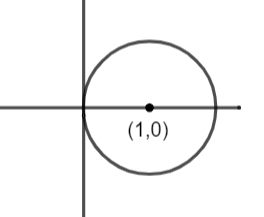
Areas: - \[{{x}^{2}}+{{y}^{2}}\le 1\], \[\le \] implies bounded region.
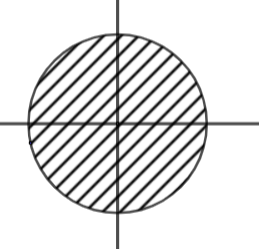
\[{{\left( x-1 \right)}^{2}}+{{y}^{2}}\le 1\]
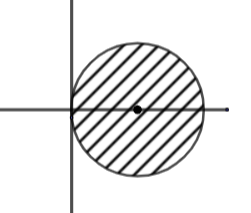
Combined: -
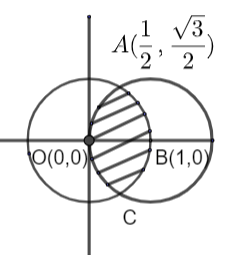
Required area = Shaded region = OABC
Area OABC is symmetric with x – axis. So,
Area OABC = \[2\times \] (area of OAB with x - axis).
Area of OAB can be written as a combination of area from O to A of curve – 2 and area of A to B of curve – 1.
Area of a curve f (x) with x – axis while the x varies from \[{{x}_{1}}\] to \[{{x}_{2}}\] is given by
Area = \[\int\limits_{{{x}_{1}}}^{{{x}_{2}}}{f\left( x \right)dx}\]
Area of OABC = \[2\times \left( \int\limits_{0}^{A}{Curve-2dx}+\int\limits_{A}^{B}{Curve-1dx} \right)\]
We know, Curve – 2 \[\Rightarrow {{\left( x-1 \right)}^{2}}+{{y}^{2}}=1\]
By subtracting \[{{\left( x-1 \right)}^{2}}\] and applying square root on both sides, we get:
Curve – 2 \[=\sqrt{1-{{\left( x-1 \right)}^{2}}}\]
Similarly, we can say Curve – 1 \[=\sqrt{1-{{x}^{2}}}\]
Also we know, O = (0, 0), A = \[\left( \dfrac{1}{2},\dfrac{\sqrt{3}}{2} \right)\], B = (1, 0)
So, area = \[2\times \left( \int\limits_{0}^{\dfrac{1}{2}}{\sqrt{1-{{\left( x-1 \right)}^{2}}}dx}+\int\limits_{\dfrac{1}{2}}^{1}{\sqrt{1-{{x}^{2}}}dx} \right)\]
Let x – 1 = t in the first part. So, dx = dt.
If x = 0, t = x – 1 = -1; if x = \[\dfrac{1}{2}\], t = \[\dfrac{1}{2}-1=\dfrac{-1}{2}\].
By substituting these all, we get:
Area = \[2\times \left( \int\limits_{-1}^{\dfrac{-1}{2}}{\sqrt{1-{{t}^{2}}}dt}+\int\limits_{\dfrac{1}{2}}^{1}{\sqrt{1-{{x}^{2}}}dx} \right)\]
By basic integration we can say the integration as:
\[\Rightarrow \int{\sqrt{{{a}^{2}}-{{x}^{2}}}dx}=\dfrac{x}{2}\sqrt{{{a}^{2}}-{{x}^{2}}}+\dfrac{{{a}^{2}}}{2}{{\sin }^{-1}}\dfrac{x}{a}\]
By substituting this into above equation, we get:
Area = \[2\times \left( \left[ \dfrac{t}{2}\sqrt{1-{{t}^{2}}}+\dfrac{1}{2}{{\sin }^{-1}}t \right]_{0}^{\dfrac{-1}{2}}+\left[ \dfrac{x}{2}\sqrt{1-{{x}^{2}}}+\dfrac{1}{2}{{\sin }^{-1}}x \right]_{\dfrac{1}{2}}^{1} \right)\]
We know \[{{\sin }^{-1}}1=\dfrac{\pi }{2}\], \[{{\sin }^{-1}}\left( \dfrac{1}{2} \right)=\dfrac{\pi }{6}\], \[{{\sin }^{-1}}\left( -1 \right)=\dfrac{-\pi }{2}\], \[{{\sin }^{-1}}\left( \dfrac{-1}{2} \right)=\dfrac{-\pi }{6}\].
By substituting limits, we get area as:
Area = \[2\times \left( \dfrac{-1}{4}\sqrt{1-\dfrac{1}{4}}+\dfrac{1}{2}{{\sin }^{-1}}\left( \dfrac{-1}{2} \right)-\dfrac{-1}{2}\sqrt{1-1}-\dfrac{1}{2}{{\sin }^{-1}}\left( -1 \right)+\dfrac{1}{2}\sqrt{1-1}+\dfrac{{{\sin }^{-1}}1}{2}-\dfrac{1}{4}\sqrt{1-\dfrac{1}{4}}-\dfrac{1}{2}{{\sin }^{-1}}\dfrac{1}{2} \right)\]
By substituting sine values and simplifying, we get area as:
Area = \[2\times \left[ -\dfrac{\sqrt{3}}{8}-\dfrac{\pi }{12}+\dfrac{\pi }{4}-\dfrac{\pi }{4}-\dfrac{\sqrt{3}}{8}-\dfrac{\pi }{12} \right]\]
By simplifying more we get area as:
Area = \[2\times \left[ -\dfrac{\sqrt{3}}{4}+\dfrac{\pi }{2}-\dfrac{\pi }{6} \right]=2\times \left[ \dfrac{\pi }{3}-\dfrac{\sqrt{3}}{4} \right]\]
By multiplying 2 inside bracket we get area as:
Area = \[\dfrac{2\pi }{3}-\dfrac{\sqrt{3}}{2}\]
Therefore the area between the given circle is \[\left( \dfrac{2\pi }{3}-\dfrac{\sqrt{3}}{2} \right)\] square units.
Note: Do not forget to take the negative root in case of y because we have intersection even at \[{{4}^{th}}\] quadrant we need two roots for y. Alternatively you can integrate each circle separately and then add both areas which will give similar results. Be careful while integrating. You must see which circle’s area to consider, generally students confuse and take curves – 1 first but you must take curves – 2 carefully observe.
Complete step-by-step answer:
Elimination method:
First write 2 curve equations which you need to solve to find intersection points. Then try to convert one variable in terms of another variable by using any one of the equations. Now substitute this variable in terms of others into the remaining equation. Now the remaining equation turns into an equation of one variable. By normal geometry find the variable. Using previous relations, find the other variable. Thus, you get the intersection point(s).
Given equations in the question can be written as follows:
\[\Rightarrow {{x}^{2}}+{{y}^{2}}=1\] - (1)
\[\Rightarrow {{\left( x-1 \right)}^{2}}+{{y}^{2}}=1\] - (2)
By general co – ordinate geometry equation, \[{{\left( x-g \right)}^{2}}+{{\left( y-h \right)}^{2}}={{a}^{2}}\] is a circle with center (g, h) and radius a.
From this we can say the following statements:
\[{{x}^{2}}+{{y}^{2}}=1\] is a circle with radius 1 and center at (0, 0).
\[{{\left( x-1 \right)}^{2}}+{{y}^{2}}=1\] is a circle with radius 1 and center at (1, 0).
By subtracting \[{{x}^{2}}\] on both sides from equation (1), we get:
\[\Rightarrow {{y}^{2}}=1-{{x}^{2}}\] - (3)
By substituting this into equation (2), we get:
\[\Rightarrow {{\left( x-1 \right)}^{2}}+1-{{x}^{2}}=1\]
We know \[{{\left( a-b \right)}^{2}}={{a}^{2}}-2ab+{{b}^{2}}\], by substituting this into above we get:
\[\Rightarrow {{x}^{2}}-2x+1+1-{{x}^{2}}=1\]
By simplifying the above we can say, 2 – 2x = 1.
By subtracting 2 and the dividing with -2 on both sides, we get:
\[\Rightarrow x=\dfrac{1}{2}\]
Substituting this into equation (3), we get: \[{{y}^{2}}=1-\dfrac{1}{4}\]
\[\Rightarrow {{y}^{2}}=\dfrac{3}{4}\]
By applying square root on both sides, we get:
\[\Rightarrow y=\pm \dfrac{\sqrt{3}}{2}\]
So, intersection points are given by \[\left( \dfrac{1}{2},\dfrac{\sqrt{3}}{2} \right),\left( \dfrac{1}{2},\dfrac{-\sqrt{3}}{2} \right)\].
Now we will draw both the circles and mark the areas.
From the derived centers and radii we can draw them as:
Curves: -
\[{{x}^{2}}+{{y}^{2}}=1\]
\[{{\left( x-1 \right)}^{2}}+{{y}^{2}}=1\]
Areas: - \[{{x}^{2}}+{{y}^{2}}\le 1\], \[\le \] implies bounded region.
\[{{\left( x-1 \right)}^{2}}+{{y}^{2}}\le 1\]
Combined: -
Required area = Shaded region = OABC
Area OABC is symmetric with x – axis. So,
Area OABC = \[2\times \] (area of OAB with x - axis).
Area of OAB can be written as a combination of area from O to A of curve – 2 and area of A to B of curve – 1.
Area of a curve f (x) with x – axis while the x varies from \[{{x}_{1}}\] to \[{{x}_{2}}\] is given by
Area = \[\int\limits_{{{x}_{1}}}^{{{x}_{2}}}{f\left( x \right)dx}\]
Area of OABC = \[2\times \left( \int\limits_{0}^{A}{Curve-2dx}+\int\limits_{A}^{B}{Curve-1dx} \right)\]
We know, Curve – 2 \[\Rightarrow {{\left( x-1 \right)}^{2}}+{{y}^{2}}=1\]
By subtracting \[{{\left( x-1 \right)}^{2}}\] and applying square root on both sides, we get:
Curve – 2 \[=\sqrt{1-{{\left( x-1 \right)}^{2}}}\]
Similarly, we can say Curve – 1 \[=\sqrt{1-{{x}^{2}}}\]
Also we know, O = (0, 0), A = \[\left( \dfrac{1}{2},\dfrac{\sqrt{3}}{2} \right)\], B = (1, 0)
So, area = \[2\times \left( \int\limits_{0}^{\dfrac{1}{2}}{\sqrt{1-{{\left( x-1 \right)}^{2}}}dx}+\int\limits_{\dfrac{1}{2}}^{1}{\sqrt{1-{{x}^{2}}}dx} \right)\]
Let x – 1 = t in the first part. So, dx = dt.
If x = 0, t = x – 1 = -1; if x = \[\dfrac{1}{2}\], t = \[\dfrac{1}{2}-1=\dfrac{-1}{2}\].
By substituting these all, we get:
Area = \[2\times \left( \int\limits_{-1}^{\dfrac{-1}{2}}{\sqrt{1-{{t}^{2}}}dt}+\int\limits_{\dfrac{1}{2}}^{1}{\sqrt{1-{{x}^{2}}}dx} \right)\]
By basic integration we can say the integration as:
\[\Rightarrow \int{\sqrt{{{a}^{2}}-{{x}^{2}}}dx}=\dfrac{x}{2}\sqrt{{{a}^{2}}-{{x}^{2}}}+\dfrac{{{a}^{2}}}{2}{{\sin }^{-1}}\dfrac{x}{a}\]
By substituting this into above equation, we get:
Area = \[2\times \left( \left[ \dfrac{t}{2}\sqrt{1-{{t}^{2}}}+\dfrac{1}{2}{{\sin }^{-1}}t \right]_{0}^{\dfrac{-1}{2}}+\left[ \dfrac{x}{2}\sqrt{1-{{x}^{2}}}+\dfrac{1}{2}{{\sin }^{-1}}x \right]_{\dfrac{1}{2}}^{1} \right)\]
We know \[{{\sin }^{-1}}1=\dfrac{\pi }{2}\], \[{{\sin }^{-1}}\left( \dfrac{1}{2} \right)=\dfrac{\pi }{6}\], \[{{\sin }^{-1}}\left( -1 \right)=\dfrac{-\pi }{2}\], \[{{\sin }^{-1}}\left( \dfrac{-1}{2} \right)=\dfrac{-\pi }{6}\].
By substituting limits, we get area as:
Area = \[2\times \left( \dfrac{-1}{4}\sqrt{1-\dfrac{1}{4}}+\dfrac{1}{2}{{\sin }^{-1}}\left( \dfrac{-1}{2} \right)-\dfrac{-1}{2}\sqrt{1-1}-\dfrac{1}{2}{{\sin }^{-1}}\left( -1 \right)+\dfrac{1}{2}\sqrt{1-1}+\dfrac{{{\sin }^{-1}}1}{2}-\dfrac{1}{4}\sqrt{1-\dfrac{1}{4}}-\dfrac{1}{2}{{\sin }^{-1}}\dfrac{1}{2} \right)\]
By substituting sine values and simplifying, we get area as:
Area = \[2\times \left[ -\dfrac{\sqrt{3}}{8}-\dfrac{\pi }{12}+\dfrac{\pi }{4}-\dfrac{\pi }{4}-\dfrac{\sqrt{3}}{8}-\dfrac{\pi }{12} \right]\]
By simplifying more we get area as:
Area = \[2\times \left[ -\dfrac{\sqrt{3}}{4}+\dfrac{\pi }{2}-\dfrac{\pi }{6} \right]=2\times \left[ \dfrac{\pi }{3}-\dfrac{\sqrt{3}}{4} \right]\]
By multiplying 2 inside bracket we get area as:
Area = \[\dfrac{2\pi }{3}-\dfrac{\sqrt{3}}{2}\]
Therefore the area between the given circle is \[\left( \dfrac{2\pi }{3}-\dfrac{\sqrt{3}}{2} \right)\] square units.
Note: Do not forget to take the negative root in case of y because we have intersection even at \[{{4}^{th}}\] quadrant we need two roots for y. Alternatively you can integrate each circle separately and then add both areas which will give similar results. Be careful while integrating. You must see which circle’s area to consider, generally students confuse and take curves – 1 first but you must take curves – 2 carefully observe.
Recently Updated Pages
Basicity of sulphurous acid and sulphuric acid are

Master Class 12 Economics: Engaging Questions & Answers for Success
Master Class 12 Biology: Engaging Questions & Answers for Success
Master Class 11 English: Engaging Questions & Answers for Success
Master Class 11 Physics: Engaging Questions & Answers for Success
Master Class 11 Computer Science: Engaging Questions & Answers for Success
Trending doubts
Draw a labelled sketch of the human eye class 12 physics CBSE
The chemical formula of tear gas is A CO Cl 2 B C 10 class 12 chemistry CBSE
Draw ray diagrams each showing i myopic eye and ii class 12 physics CBSE
Which are the Top 10 Largest Countries of the World?
Differentiate between homogeneous and heterogeneous class 12 chemistry CBSE
Which is the correct genotypic ratio of mendel dihybrid class 12 biology CBSE