




Find the area of the polygon $MNOPQR$ if$MP = 9cm$,$MD = 7cm$, $MC = 6cm$, $MB = 4cm$,$MA = 2cm$ $NA,OC,QD$ and $RB$ are perpendiculars to diagonal $MP$.
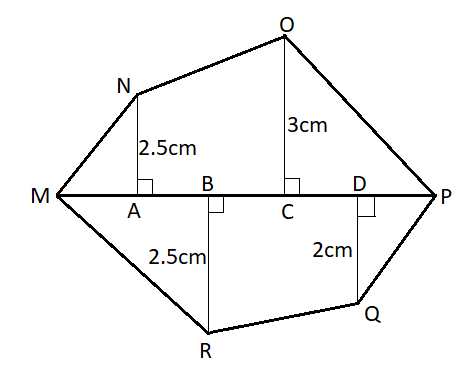
Answer
 Verified
494.7k+ views
Hint: In this problem, we have to find the area of the polygon. Polygon means that a flat shape with at least three and usually five or more angles and straight lines. Using the given data we can solve the problem. Understanding the figure and understanding the given data is important to solve the problem.
Formulae used in the problem:
Area of the triangle $ = \dfrac{1}{2} \times b \times h$
Here, $b = $ breadth
$h = $ height
Area of the trapezium$ = \left( {\dfrac{{a + b}}{2}} \right)h$
$a = base$
Complete step by step answer:
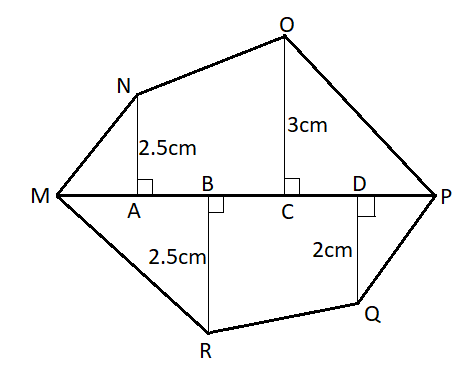
In the above step, the given picture is the figure of the polygon.
In this picture, we see that the,
$MP = 9cm $
$MD = 7cm $
$MC = 6cm $
$MB = 4cm $
$MA = 2cm $
And then, $NA,OC,QD,RB$ are perpendiculars to the diagonal $MP$ .
Now we are going to find the area of the given polygon by using the given data.
In this polygon, there are many triangles and trapezium.
Therefore we have to find the area of all triangles and trapezium and add the found values to find the area of a polygon.
Therefore from the figure,
Area of the polygon $ = $ area of the triangle $MAN$ $ + $ area of the trapezium $ACON$ $ + $ area of the triangle $CPO$ $ + $ area of the trapezium $BDQR + $ area of the triangle $DPQ$
Now we are going to find the area of required triangles,
Area of the triangle $MAN$=$\dfrac{1}{2} \times MA \times MN$
Now apply the values, we get
$ = \dfrac{1}{2} \times 2 \times 2.5$
Now simplify this we get,
$ = 2.5$
By following the above steps, find the area of other triangles.
Area of the triangle $CPO$ $ = \dfrac{1}{2} \times CP \times OC$
Now value of
$CP = MP - MC $
$= 9 - 6 $
$= 3 $
Now apply the values, we get
$ = \dfrac{1}{2} \times 3 \times 3$
Simplify this we get,
$= \dfrac{9}{2} $
$= 4.5 $
Now area of the triangle $MBR = \dfrac{1}{2} \times MB \times BR$
Now apply the values, we get
$ = \dfrac{1}{2} \times 4 \times 2.5$
$ = 2 \times 2.5$
Simplify this we get,
$ = 5$
Now area of the triangle $DPQ = \dfrac{1}{2} \times DP \times QD$
$DP = MP - MD $
$= 9 - 7 $
$= 2cm $
Now apply the values,
$\dfrac{1}{2} \times 2 \times 2$
$ = 2$
Now we are going to find the values of trapezium
Area of trapezium $ACON$ $ = \left( {\dfrac{{2.5 + 3}}{2}} \right)4$
Now simplify this we get,
$= 5.5 \times 2 $
$= 11 $
Area of the trapezium $BDQR = \left( {\dfrac{{2.5 + 2}}{2}} \right)3$
Simplify this we get,
$= \dfrac{{4.5 \times 3}}{2} $
$= \dfrac{{13.5}}{2} $
Now we get,
\[ = 6.75\]
Now the area of a polygon \[ = 2.5 + 11 + 4.5 + 5 + 6.75 + 2\]
Hence the area of a polygon \[ = 31.75c{m^2}\]
Note:
In geometry, a polygon is a plane Figure described by a finite number of a straight line. A trapezium which is a quadrilateral with one pair of opposite sides parallel. In this problem, understanding the data and figures is important to solve this problem.
Formulae used in the problem:
Area of the triangle $ = \dfrac{1}{2} \times b \times h$
Here, $b = $ breadth
$h = $ height
Area of the trapezium$ = \left( {\dfrac{{a + b}}{2}} \right)h$
$a = base$
Complete step by step answer:
In the above step, the given picture is the figure of the polygon.
In this picture, we see that the,
$MP = 9cm $
$MD = 7cm $
$MC = 6cm $
$MB = 4cm $
$MA = 2cm $
And then, $NA,OC,QD,RB$ are perpendiculars to the diagonal $MP$ .
Now we are going to find the area of the given polygon by using the given data.
In this polygon, there are many triangles and trapezium.
Therefore we have to find the area of all triangles and trapezium and add the found values to find the area of a polygon.
Therefore from the figure,
Area of the polygon $ = $ area of the triangle $MAN$ $ + $ area of the trapezium $ACON$ $ + $ area of the triangle $CPO$ $ + $ area of the trapezium $BDQR + $ area of the triangle $DPQ$
Now we are going to find the area of required triangles,
Area of the triangle $MAN$=$\dfrac{1}{2} \times MA \times MN$
Now apply the values, we get
$ = \dfrac{1}{2} \times 2 \times 2.5$
Now simplify this we get,
$ = 2.5$
By following the above steps, find the area of other triangles.
Area of the triangle $CPO$ $ = \dfrac{1}{2} \times CP \times OC$
Now value of
$CP = MP - MC $
$= 9 - 6 $
$= 3 $
Now apply the values, we get
$ = \dfrac{1}{2} \times 3 \times 3$
Simplify this we get,
$= \dfrac{9}{2} $
$= 4.5 $
Now area of the triangle $MBR = \dfrac{1}{2} \times MB \times BR$
Now apply the values, we get
$ = \dfrac{1}{2} \times 4 \times 2.5$
$ = 2 \times 2.5$
Simplify this we get,
$ = 5$
Now area of the triangle $DPQ = \dfrac{1}{2} \times DP \times QD$
$DP = MP - MD $
$= 9 - 7 $
$= 2cm $
Now apply the values,
$\dfrac{1}{2} \times 2 \times 2$
$ = 2$
Now we are going to find the values of trapezium
Area of trapezium $ACON$ $ = \left( {\dfrac{{2.5 + 3}}{2}} \right)4$
Now simplify this we get,
$= 5.5 \times 2 $
$= 11 $
Area of the trapezium $BDQR = \left( {\dfrac{{2.5 + 2}}{2}} \right)3$
Simplify this we get,
$= \dfrac{{4.5 \times 3}}{2} $
$= \dfrac{{13.5}}{2} $
Now we get,
\[ = 6.75\]
Now the area of a polygon \[ = 2.5 + 11 + 4.5 + 5 + 6.75 + 2\]
Hence the area of a polygon \[ = 31.75c{m^2}\]
Note:
In geometry, a polygon is a plane Figure described by a finite number of a straight line. A trapezium which is a quadrilateral with one pair of opposite sides parallel. In this problem, understanding the data and figures is important to solve this problem.
Recently Updated Pages
Master Class 11 English: Engaging Questions & Answers for Success

Master Class 11 Maths: Engaging Questions & Answers for Success
Class 11 Question and Answer - Your Ultimate Solutions Guide
Master Class 11 Biology: Engaging Questions & Answers for Success
Master Class 11 Physics: Engaging Questions & Answers for Success
Master Class 11 Accountancy: Engaging Questions & Answers for Success
Trending doubts
Explain the Treaty of Vienna of 1815 class 10 social science CBSE
Who Won 36 Oscar Awards? Record Holder Revealed
What is the median of the first 10 natural numbers class 10 maths CBSE
Why is it 530 pm in india when it is 1200 afternoon class 10 social science CBSE
Select the word that is correctly spelled a Twelveth class 10 english CBSE
Why is there a time difference of about 5 hours between class 10 social science CBSE