




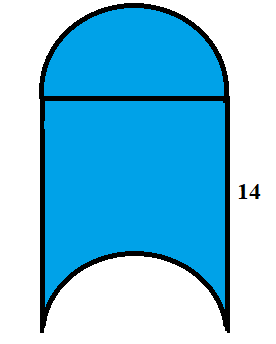
Find the area of the blue shaded portion, where the length of the lower part is 14 units and radius of the upper semi-circle is 7 units.
(a) 196
(b) 98
(c) 200
(d) None of these
Answer
 Verified
614.4k+ views
Hint: Let us ignore the bottom semi-circle and consider it as a part of the figure. So the area = area of rectangle + area of the semicircle above. But we do not need the semi-circle below. So area = area of rectangle + area of the semicircle above – area of semi-circle below. Now note that the area the semi-circle above = area of semi-circle below. Cancel them and find the area of the rectangle which is the final answer.
Complete step-by-step answer:
In this question, we are given the figure:
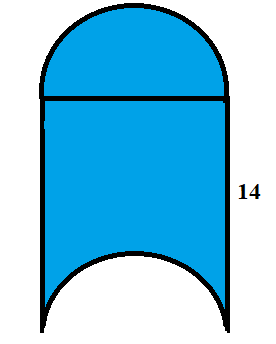
It is given that the length of the lower part is 14 units and radius of the upper semi-circle is 7 units.
We need to find the area of the blue shaded region.
In the figure, note that at the bottom, a semicircle is removed from the rectangle.
This removed semicircle has the radius same as the semi-circle above.
For a moment, let us ignore the removed semi-circle. The figure will look like the following:
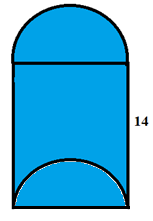
So, the area of this figure will be the area of the rectangle + area of the semicircle above.
Now, we need to remove the area of the semicircle below from the equation above.
So, required area = area of rectangle + area of the semicircle above – area of semi-circle below.
Now, since the radius of both the semi circles is the same, so the area of both the semi-circles will also be the same. So, in the equation above, the second and the third terms will cancel each other out.
Using this, we will get the following:
Required area = area of rectangle
Now, we are given that the length of the rectangle = 14 units.
Notice that the width of the rectangle is equal to the diameter of the semicircle = 14 units.
Area of rectangle = length of rectangle ${\times}$ width of rectangle
So, area of rectangle = 14 ${\times}$ 14
Hence, the area of the shaded region = 196 sq. units.
Hence, option (a) is correct.
Note: In this question, it is very important to note that the radius of both the semi circles is the same, so the area of both the semi-circles will also be the same. Using this, you can directly cancel these out. This will save a lot of time as compared to actually calculating the areas of the semi-circles.
Complete step-by-step answer:
In this question, we are given the figure:
It is given that the length of the lower part is 14 units and radius of the upper semi-circle is 7 units.
We need to find the area of the blue shaded region.
In the figure, note that at the bottom, a semicircle is removed from the rectangle.
This removed semicircle has the radius same as the semi-circle above.
For a moment, let us ignore the removed semi-circle. The figure will look like the following:
So, the area of this figure will be the area of the rectangle + area of the semicircle above.
Now, we need to remove the area of the semicircle below from the equation above.
So, required area = area of rectangle + area of the semicircle above – area of semi-circle below.
Now, since the radius of both the semi circles is the same, so the area of both the semi-circles will also be the same. So, in the equation above, the second and the third terms will cancel each other out.
Using this, we will get the following:
Required area = area of rectangle
Now, we are given that the length of the rectangle = 14 units.
Notice that the width of the rectangle is equal to the diameter of the semicircle = 14 units.
Area of rectangle = length of rectangle ${\times}$ width of rectangle
So, area of rectangle = 14 ${\times}$ 14
Hence, the area of the shaded region = 196 sq. units.
Hence, option (a) is correct.
Note: In this question, it is very important to note that the radius of both the semi circles is the same, so the area of both the semi-circles will also be the same. Using this, you can directly cancel these out. This will save a lot of time as compared to actually calculating the areas of the semi-circles.
Recently Updated Pages
Master Class 10 Computer Science: Engaging Questions & Answers for Success

Master Class 10 General Knowledge: Engaging Questions & Answers for Success
Master Class 10 English: Engaging Questions & Answers for Success
Master Class 10 Social Science: Engaging Questions & Answers for Success
Master Class 10 Maths: Engaging Questions & Answers for Success
Master Class 10 Science: Engaging Questions & Answers for Success
Trending doubts
What is the median of the first 10 natural numbers class 10 maths CBSE
Which women's tennis player has 24 Grand Slam singles titles?
Who is the Brand Ambassador of Incredible India?
Why is there a time difference of about 5 hours between class 10 social science CBSE
Write a letter to the principal requesting him to grant class 10 english CBSE
A moving boat is observed from the top of a 150 m high class 10 maths CBSE