




Find the area of rhombus with sides 20 cm and length of one of the diagonal as 28 cm.
a. \[56\sqrt {51} \,\,c{m^2}\]
b. \[18\sqrt {51} \,\,c{m^2}\]
c. \[25\sqrt {51} \,\,c{m^2}\]
d. None of these
Answer
 Verified
563.7k+ views
Hint: Here in this question, we have to find the value of another diagonal of the rhombus. To solve this by using a formula of area of rhombus i.e., \[Area = \dfrac{{{d_1} \times {d_2}}}{2}\]. On substituting the data given in question and by further simplification, we get the required value of the given question.
Complete step-by-step answer:
A rhombus is a quadrilateral with two pairs of parallel sides. The opposite sides of a parallelogram are equal in length, and the opposite angles are equal in measure. All sides of the rhombus are equal.
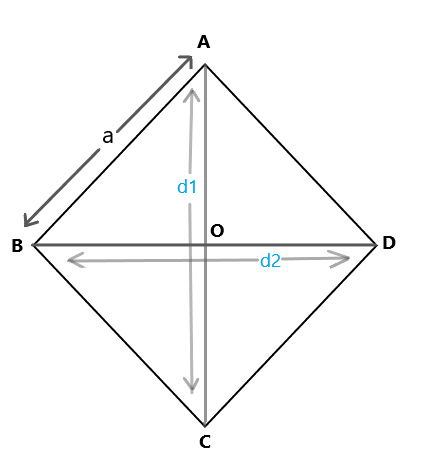
Consider the diagram the a represents the length of the rhombus. The d1 and d2 represents the diagonal of the rhombus.
Now consider the given question
The length of the rhombus = 20 cm
The diagonal i.e., d1 \[({d_1})\]= 28 cm.
Here we have to determine the area of the rhombus, the formula for the area of rhombus is given by \[A = \dfrac{{{d_1} \times {d_2}}}{2}\]. The value of another diagonal is not known. First we determine the value of the other diagonal and then we determine the area.
Now consider the \[\vartriangle ABO\], since it is right angled triangle we can use the Pythagoras theorem to \[\vartriangle ABO\]
Therefore we have
\[ \Rightarrow A{B^2} = A{O^2} + B{O^2}\]---------(1)
Here the value of AB = 20 cm and here Ac is the diagonal and AO is half of the diagonal, therefore the value of AO = 14 cm. On substituting the values in (1) we have
\[ \Rightarrow {20^2} = {14^2} + B{O^2}\]
On simplifying we have
\[ \Rightarrow 400 = 196 + B{O^2}\]
\[ \Rightarrow B{O^2} = 400 - 196\]
\[ \Rightarrow B{O^2} = 204\]
On taking square root on both sides we get
\[ \Rightarrow BO = 2\sqrt {51} \,\,cm\]
Half of the diagonal BC is \[2\sqrt {51} \], therefore the diagonal BC is \[2 \times 2\sqrt {51} = 4\sqrt {51} \,\,cm\]
Now we have \[{d_1} = 28\,\,cm\] and \[{d_2} = 4\sqrt {51} \,\,cm\].
The area of the rhombus is given by
\[Area = \dfrac{{{d_1} \times {d_2}}}{2}\]
On substituting the values we have
\[ \Rightarrow Area = \dfrac{{28 \times 4\sqrt {51} }}{2}\]
On simplifying we get
\[ \Rightarrow Area = 56\sqrt {51} \,\,c{m^2}\]
So, the correct answer is “Option A”.
Note: When we write the diagonals for the rhombus then we have 4 equal triangles. and Each triangle will be in the form of the right-angled triangle. If we do not know the value of any one side then by applying the Pythagoras theorem, we can determine the value. The unit for area and the perimeter is different. We should take care of it.
Complete step-by-step answer:
A rhombus is a quadrilateral with two pairs of parallel sides. The opposite sides of a parallelogram are equal in length, and the opposite angles are equal in measure. All sides of the rhombus are equal.
Consider the diagram the a represents the length of the rhombus. The d1 and d2 represents the diagonal of the rhombus.
Now consider the given question
The length of the rhombus = 20 cm
The diagonal i.e., d1 \[({d_1})\]= 28 cm.
Here we have to determine the area of the rhombus, the formula for the area of rhombus is given by \[A = \dfrac{{{d_1} \times {d_2}}}{2}\]. The value of another diagonal is not known. First we determine the value of the other diagonal and then we determine the area.
Now consider the \[\vartriangle ABO\], since it is right angled triangle we can use the Pythagoras theorem to \[\vartriangle ABO\]
Therefore we have
\[ \Rightarrow A{B^2} = A{O^2} + B{O^2}\]---------(1)
Here the value of AB = 20 cm and here Ac is the diagonal and AO is half of the diagonal, therefore the value of AO = 14 cm. On substituting the values in (1) we have
\[ \Rightarrow {20^2} = {14^2} + B{O^2}\]
On simplifying we have
\[ \Rightarrow 400 = 196 + B{O^2}\]
\[ \Rightarrow B{O^2} = 400 - 196\]
\[ \Rightarrow B{O^2} = 204\]
On taking square root on both sides we get
\[ \Rightarrow BO = 2\sqrt {51} \,\,cm\]
Half of the diagonal BC is \[2\sqrt {51} \], therefore the diagonal BC is \[2 \times 2\sqrt {51} = 4\sqrt {51} \,\,cm\]
Now we have \[{d_1} = 28\,\,cm\] and \[{d_2} = 4\sqrt {51} \,\,cm\].
The area of the rhombus is given by
\[Area = \dfrac{{{d_1} \times {d_2}}}{2}\]
On substituting the values we have
\[ \Rightarrow Area = \dfrac{{28 \times 4\sqrt {51} }}{2}\]
On simplifying we get
\[ \Rightarrow Area = 56\sqrt {51} \,\,c{m^2}\]
So, the correct answer is “Option A”.
Note: When we write the diagonals for the rhombus then we have 4 equal triangles. and Each triangle will be in the form of the right-angled triangle. If we do not know the value of any one side then by applying the Pythagoras theorem, we can determine the value. The unit for area and the perimeter is different. We should take care of it.
Recently Updated Pages
Master Class 11 English: Engaging Questions & Answers for Success

Master Class 11 Social Science: Engaging Questions & Answers for Success
Master Class 11 Maths: Engaging Questions & Answers for Success
Master Class 11 Biology: Engaging Questions & Answers for Success
Master Class 11 Physics: Engaging Questions & Answers for Success
Master Class 11 Chemistry: Engaging Questions & Answers for Success
Trending doubts
Explain the Treaty of Vienna of 1815 class 10 social science CBSE
What is the Total Duration of Football Match?
First Cotton Mill of India
In which year voting age was reduced from 21 to 18?
10 examples of evaporation in daily life with explanations
What planets have no moons Which one has only one moon class 10 physics CBSE