



How do you find the area of rhombus using its perimeter?
Answer
 Verified
591.9k+ views
Hint: Rhombus is a type of parallelogram in which all the sides are equal and the diagonals intersect each other perpendicularly. In this question, we need to find the relation between area and perimeter of rhombus. We are going to use the formula $ Area\left( A \right) = B \times H $ to find relation between them, where we have to take B as $ \dfrac{P}{4} $ and find H using trigonometric functions.
Complete step-by-step answer:
In this question, we have to find the area of rhombus in terms of its perimeter.
First of all, let us draw a figure of rhombus.
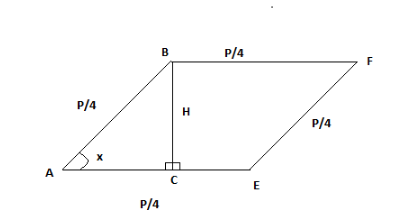
In the above figure, $ \square ABFE $ is a rhombus, in which we have taken the length of each side as perimeter divided by 4 $ \left( {\dfrac{P}{4}} \right) $ and $ \angle BAE = x $ and we have supposed the height of rhombus $ H $ .
Here, we can see that AB $ \parallel $ EF and AE $ \parallel $ BF and AB=BF=EF=AE and BC is the height of the rhombus.
Now first of all let us find the perimeter of rhombus. We know that the perimeter of rhombus is equal to the sum of all the sides of rhombus.
Therefore, Perimeter of rhombus $ = AB + BF + EF + AE $
Now as all sides are equal, let us suppose that $ AB = BF = EF = AE = a $
Therefore, $ P = a + a + a + a $
$ \Rightarrow P = 4a $
If the perimeter is 4a, we can divide the perimeter by 4 and obtain the sides of rhombus.
$ \Rightarrow a = \dfrac{P}{4} $
So, now AB=BF=EF=AE= $ \dfrac{P}{4} $ .
Now, we have to find the area of the rhombus. For that we are going to use the trigonometric functions in $ \Delta ABC $ .
Now, in $ \Delta ABC $ , angle C is right angle.
So we can use trigonometric functions in $ \Delta ABC $ .
In $ \Delta ABC $ ,
$ \Rightarrow \sin x = \dfrac{{{\text{Opposite}}}}{{{\text{Hypotenuse}}}} $
Here, opposite = BC = H
And hypotenuse = AB = $ \dfrac{P}{4} $ .
Therefore, $ \sin x = \dfrac{{BC}}{{AB}} $
$ \Rightarrow \sin x = \dfrac{H}{{\dfrac{P}{4}}} $
Take 4 to numerator, we get
$ \Rightarrow \sin x = \dfrac{{4H}}{P} $
We need to find the value of H, so make H as the subject of the equation.
$ \Rightarrow H = \dfrac{{P\sin x}}{4} $ - - - - - - - - - (1)
Now, as rhombus is a parallelogram, we can find its area by multiplying its base with its height.
Here, the base is $ \dfrac{P}{4} $ and the height we have found in equation (1).
Therefore, area of rhombus $ = B \times H $
Where, $ B = \dfrac{P}{4},H = \dfrac{{P\sin x}}{4} $
$
\Rightarrow Area\left( A \right) = \dfrac{P}{4} \times \dfrac{{P\sin x}}{4} \\
\Rightarrow Area\left( A \right) = \dfrac{{{P^2}\sin x}}{{16}} \\
$
Hence, using this formula, we can find the area of rhombus using its perimeter.
Note: Area of rhombus can be found using 3 different formulas.
I.When the length of the diagonals is known we can use,
$ Area\left( A \right) = \dfrac{1}{2}\left( {{d_1} \times {d_2}} \right) $
II.When the length of base and height is known we can use,
$ Area\left( A \right) = B \times H $
III.When an internal angle is given and the length of base is known we can use,
$ Area\left( A \right) = {b^2}\sin a $
Complete step-by-step answer:
In this question, we have to find the area of rhombus in terms of its perimeter.
First of all, let us draw a figure of rhombus.
In the above figure, $ \square ABFE $ is a rhombus, in which we have taken the length of each side as perimeter divided by 4 $ \left( {\dfrac{P}{4}} \right) $ and $ \angle BAE = x $ and we have supposed the height of rhombus $ H $ .
Here, we can see that AB $ \parallel $ EF and AE $ \parallel $ BF and AB=BF=EF=AE and BC is the height of the rhombus.
Now first of all let us find the perimeter of rhombus. We know that the perimeter of rhombus is equal to the sum of all the sides of rhombus.
Therefore, Perimeter of rhombus $ = AB + BF + EF + AE $
Now as all sides are equal, let us suppose that $ AB = BF = EF = AE = a $
Therefore, $ P = a + a + a + a $
$ \Rightarrow P = 4a $
If the perimeter is 4a, we can divide the perimeter by 4 and obtain the sides of rhombus.
$ \Rightarrow a = \dfrac{P}{4} $
So, now AB=BF=EF=AE= $ \dfrac{P}{4} $ .
Now, we have to find the area of the rhombus. For that we are going to use the trigonometric functions in $ \Delta ABC $ .
Now, in $ \Delta ABC $ , angle C is right angle.
So we can use trigonometric functions in $ \Delta ABC $ .
In $ \Delta ABC $ ,
$ \Rightarrow \sin x = \dfrac{{{\text{Opposite}}}}{{{\text{Hypotenuse}}}} $
Here, opposite = BC = H
And hypotenuse = AB = $ \dfrac{P}{4} $ .
Therefore, $ \sin x = \dfrac{{BC}}{{AB}} $
$ \Rightarrow \sin x = \dfrac{H}{{\dfrac{P}{4}}} $
Take 4 to numerator, we get
$ \Rightarrow \sin x = \dfrac{{4H}}{P} $
We need to find the value of H, so make H as the subject of the equation.
$ \Rightarrow H = \dfrac{{P\sin x}}{4} $ - - - - - - - - - (1)
Now, as rhombus is a parallelogram, we can find its area by multiplying its base with its height.
Here, the base is $ \dfrac{P}{4} $ and the height we have found in equation (1).
Therefore, area of rhombus $ = B \times H $
Where, $ B = \dfrac{P}{4},H = \dfrac{{P\sin x}}{4} $
$
\Rightarrow Area\left( A \right) = \dfrac{P}{4} \times \dfrac{{P\sin x}}{4} \\
\Rightarrow Area\left( A \right) = \dfrac{{{P^2}\sin x}}{{16}} \\
$
Hence, using this formula, we can find the area of rhombus using its perimeter.
Note: Area of rhombus can be found using 3 different formulas.
I.When the length of the diagonals is known we can use,
$ Area\left( A \right) = \dfrac{1}{2}\left( {{d_1} \times {d_2}} \right) $
II.When the length of base and height is known we can use,
$ Area\left( A \right) = B \times H $
III.When an internal angle is given and the length of base is known we can use,
$ Area\left( A \right) = {b^2}\sin a $

Recently Updated Pages
What are the two major island groups in India class 9 social science CBSE

What is Jhum cultivation class 9 biology CBSE
Write an Article on Save Earth Save Life
Silk is obtained from of the silk moth APupa BLarva class 9 chemistry CBSE
Write chemical formulas of the following compounds class 9 chemistry CBSE
The Indo Gangetic Plains of India are fertile due to class 9 social science CBSE
Trending doubts
Fill the blanks with the suitable prepositions 1 The class 9 english CBSE
Who was referred to as Amitraghata by the Greeks AChandragupta class 9 social science CBSE
Difference Between Plant Cell and Animal Cell
Name 10 Living and Non living things class 9 biology CBSE
What is the full form of pH?
On an outline map of India show its neighbouring c class 9 social science CBSE