




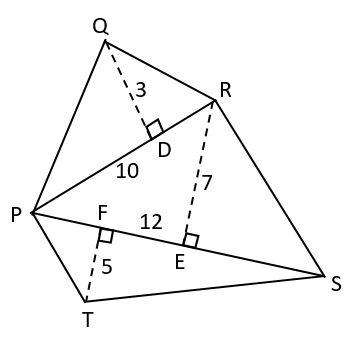
Find the area of pentagon$PQRST$in which $QD \bot PR,RE \bot PS$and $TF \bot PS$such that $PR = 10$cm, $PS = 12cm,$$QD = 3cm,$$RE = 7cm$and $TF = 5cm.$
Answer
 Verified
586.2k+ views
Hint: It is better to understand a pentagon is a five-sided polygon in geometry. In the given question, the sides of the pentagon are different so do not use the properties of a regular pentagon.
Complete step by step Solution:
From the given figure,
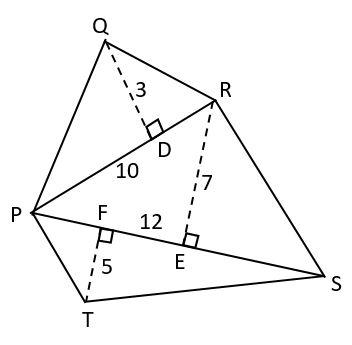
We can observe that the pentagon can be separated into three triangles namely, $\Delta PQR,$ $\Delta PRS$and $\Delta PTS$
If we find the areas of these three triangles, then the sum of areas of all three angles will give us the area of the given pentagon i.e.
$ar(\Delta PQR) + ar(\Delta PRS) + ar(\Delta PTS) = ar(PQRST)$ . . . (1)
We know that, for a triangle with base b and perpendicular h, the area of a triangle is
$ = \dfrac{1}{2} \times b \times h$
In $\Delta PQR$
It is given that $QD \bot PR$
Thus we can write
\[ar(\Delta PQR) = \dfrac{1}{2} \times PR \times QD\]
Substituting the given values of PR and QD, we get
$ar(\Delta PQR) = \dfrac{1}{2} \times 10 \times 3$
$ \Rightarrow ar(\Delta PQR) = 15c{m^2}$ . . . (2)
In $\Delta PRS$
It is given that $RE \bot PS$
Thus we can write
\[ar(\Delta PRS) = \dfrac{1}{2} \times RE \times PS\]
Substituting the given values of RE and PS, we get
$ar(\Delta PRS) = \dfrac{1}{2} \times 7 \times 12$
$ \Rightarrow ar(\Delta PRS) = 42c{m^2}$ . . . (3)
In$\Delta PTS$
It is given that $TF \bot PS$
Thus we can write
$ar(\Delta PTS) = \dfrac{1}{2} \times PS \times TF$
Substituting the given values of PS and TF, we get
\[ar(\Delta PTS) = \dfrac{1}{2} \times 12 \times 5\]
$ \Rightarrow ar(\Delta PTS) = 30c{m^2}$ . . . (4)
From equation (1)
$ar(\Delta PQR) + ar(\Delta PRS) + ar(\Delta PTS) = ar(PQRST)$
Substituting the values of areas of respective triangles from equation (2), (3) and (4), we get
$ar(PQRST) = 15 + 42 + 30$
$ \Rightarrow ar(PQRST) = 87c{m^2}$
Hence, Area of pentagon$PQRST$is $87c{m^2}$
Note: This question was made easy by giving all the required values. But it is not always necessary that you will be given all this information. In such cases, to solve the problems on any polygon, you need to know their properties. Like, sum of angles and properties of regular polygons.
Complete step by step Solution:
From the given figure,
We can observe that the pentagon can be separated into three triangles namely, $\Delta PQR,$ $\Delta PRS$and $\Delta PTS$
If we find the areas of these three triangles, then the sum of areas of all three angles will give us the area of the given pentagon i.e.
$ar(\Delta PQR) + ar(\Delta PRS) + ar(\Delta PTS) = ar(PQRST)$ . . . (1)
We know that, for a triangle with base b and perpendicular h, the area of a triangle is
$ = \dfrac{1}{2} \times b \times h$
In $\Delta PQR$
It is given that $QD \bot PR$
Thus we can write
\[ar(\Delta PQR) = \dfrac{1}{2} \times PR \times QD\]
Substituting the given values of PR and QD, we get
$ar(\Delta PQR) = \dfrac{1}{2} \times 10 \times 3$
$ \Rightarrow ar(\Delta PQR) = 15c{m^2}$ . . . (2)
In $\Delta PRS$
It is given that $RE \bot PS$
Thus we can write
\[ar(\Delta PRS) = \dfrac{1}{2} \times RE \times PS\]
Substituting the given values of RE and PS, we get
$ar(\Delta PRS) = \dfrac{1}{2} \times 7 \times 12$
$ \Rightarrow ar(\Delta PRS) = 42c{m^2}$ . . . (3)
In$\Delta PTS$
It is given that $TF \bot PS$
Thus we can write
$ar(\Delta PTS) = \dfrac{1}{2} \times PS \times TF$
Substituting the given values of PS and TF, we get
\[ar(\Delta PTS) = \dfrac{1}{2} \times 12 \times 5\]
$ \Rightarrow ar(\Delta PTS) = 30c{m^2}$ . . . (4)
From equation (1)
$ar(\Delta PQR) + ar(\Delta PRS) + ar(\Delta PTS) = ar(PQRST)$
Substituting the values of areas of respective triangles from equation (2), (3) and (4), we get
$ar(PQRST) = 15 + 42 + 30$
$ \Rightarrow ar(PQRST) = 87c{m^2}$
Hence, Area of pentagon$PQRST$is $87c{m^2}$
Note: This question was made easy by giving all the required values. But it is not always necessary that you will be given all this information. In such cases, to solve the problems on any polygon, you need to know their properties. Like, sum of angles and properties of regular polygons.
Recently Updated Pages
Master Class 11 Computer Science: Engaging Questions & Answers for Success

Master Class 11 Business Studies: Engaging Questions & Answers for Success
Master Class 11 Economics: Engaging Questions & Answers for Success
Master Class 11 English: Engaging Questions & Answers for Success
Master Class 11 Maths: Engaging Questions & Answers for Success
Master Class 11 Biology: Engaging Questions & Answers for Success
Trending doubts
One Metric ton is equal to kg A 10000 B 1000 C 100 class 11 physics CBSE
There are 720 permutations of the digits 1 2 3 4 5 class 11 maths CBSE
Discuss the various forms of bacteria class 11 biology CBSE
Draw a diagram of a plant cell and label at least eight class 11 biology CBSE
State the laws of reflection of light
Explain zero factorial class 11 maths CBSE