




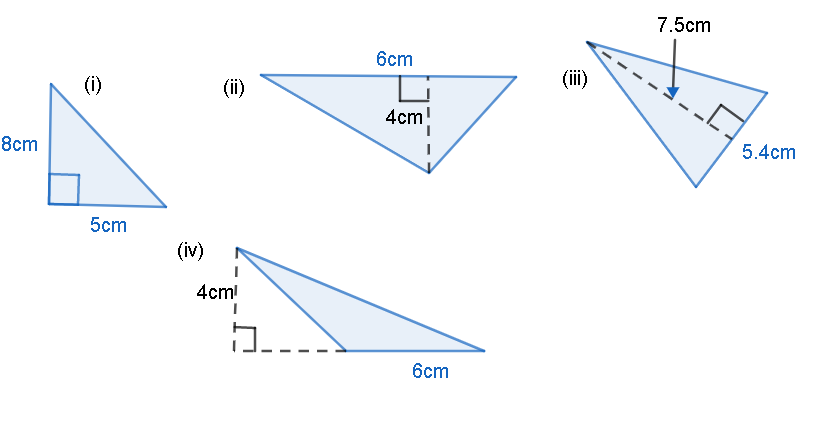
Find the area of each of the following triangles.
(a) $\left( i \right)20c{{m}^{2}},\left( ii \right)12c{{m}^{2}},\left( iii \right)20.25c{{m}^{2}},\left( iv \right)12c{{m}^{2}}$
(b) $\left( i \right)2c{{m}^{2}},\left( ii \right)12c{{m}^{2}},\left( iii \right)20.25c{{m}^{2}},\left( iv \right)12c{{m}^{2}}$
(c) $\left( i \right)20c{{m}^{2}},\left( ii \right)1c{{m}^{2}},\left( iii \right)20.25c{{m}^{2}},\left( iv \right)12c{{m}^{2}}$
(d) None of these.
Answer
 Verified
584.1k+ views
Hint: The area of a triangle is half of base multiplied by height. We have to use the formula $A=\dfrac{1}{2}\text{Base}\times \text{height}$ . The base is the side of a triangle which is considered to be the bottom, while the height of a triangle is the perpendicular line dropped onto its base from the vertex opposite to the base. We have to substitute the values in the formula for area for each of the triangles.
Complete step by step solution:
We have to find the area of the given triangles. Let us consider a triangle as shown below.
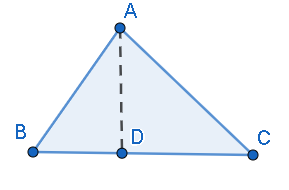
From the above figure, we can say that the base is BC and height is AD. We know that the area of a triangle is half of the base multiplied by height.
$\Rightarrow A=\dfrac{1}{2}\text{Base}\times \text{height}$
Now, let us find the area of each of the given triangles.
(i) Let us look into the given triangle.
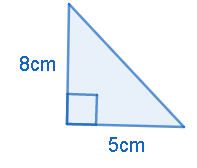
We can see that the base is 5cm and height is 8cm. Therefore, we can find the area as
$\begin{align}
& A=\dfrac{1}{2}\times 5\times 8 \\
& \Rightarrow A=\dfrac{40}{2} \\
& \Rightarrow A=20c{{m}^{2}} \\
\end{align}$
Now, let us find the area of the next triangle.
(ii) We can see from the figure below that the base is 6cm and height is 4cm.
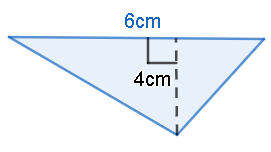
Therefore, we can find the area as
$\begin{align}
& A=\dfrac{1}{2}\times 6\times 4 \\
& \Rightarrow A=\dfrac{24}{2} \\
& \Rightarrow A=12c{{m}^{2}} \\
\end{align}$
(iii) From the figure below, we can see that the base is 5.4cm and the height is 7.5cm.
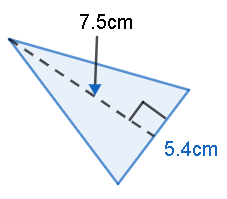
Therefore, we can find the area as
$\begin{align}
& A=\dfrac{1}{2}\times 5.4\times 7.5 \\
& \Rightarrow A=\dfrac{40.5}{2} \\
& \Rightarrow A=20.25c{{m}^{2}} \\
\end{align}$
Now, let us find the area of the last triangle.
(i) We can see from the figure below that the base is 6cm and height is 4cm.
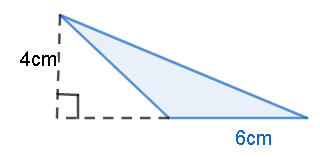
Therefore, we can find the area as
$\begin{align}
& A=\dfrac{1}{2}\times 6\times 4 \\
& \Rightarrow A=\dfrac{24}{2} \\
& \Rightarrow A=12c{{m}^{2}} \\
\end{align}$
So, the correct answer is “Option a”.
Note: Students must be thorough with the formula for the area of a triangle. The base is the side of a triangle which is considered to be the bottom, while the height of a triangle is the perpendicular line dropped onto its base from the vertex opposite to the base. Students must never miss to write the units along with the area.
Complete step by step solution:
We have to find the area of the given triangles. Let us consider a triangle as shown below.
From the above figure, we can say that the base is BC and height is AD. We know that the area of a triangle is half of the base multiplied by height.
$\Rightarrow A=\dfrac{1}{2}\text{Base}\times \text{height}$
Now, let us find the area of each of the given triangles.
(i) Let us look into the given triangle.
We can see that the base is 5cm and height is 8cm. Therefore, we can find the area as
$\begin{align}
& A=\dfrac{1}{2}\times 5\times 8 \\
& \Rightarrow A=\dfrac{40}{2} \\
& \Rightarrow A=20c{{m}^{2}} \\
\end{align}$
Now, let us find the area of the next triangle.
(ii) We can see from the figure below that the base is 6cm and height is 4cm.
Therefore, we can find the area as
$\begin{align}
& A=\dfrac{1}{2}\times 6\times 4 \\
& \Rightarrow A=\dfrac{24}{2} \\
& \Rightarrow A=12c{{m}^{2}} \\
\end{align}$
(iii) From the figure below, we can see that the base is 5.4cm and the height is 7.5cm.
Therefore, we can find the area as
$\begin{align}
& A=\dfrac{1}{2}\times 5.4\times 7.5 \\
& \Rightarrow A=\dfrac{40.5}{2} \\
& \Rightarrow A=20.25c{{m}^{2}} \\
\end{align}$
Now, let us find the area of the last triangle.
(i) We can see from the figure below that the base is 6cm and height is 4cm.
Therefore, we can find the area as
$\begin{align}
& A=\dfrac{1}{2}\times 6\times 4 \\
& \Rightarrow A=\dfrac{24}{2} \\
& \Rightarrow A=12c{{m}^{2}} \\
\end{align}$
So, the correct answer is “Option a”.
Note: Students must be thorough with the formula for the area of a triangle. The base is the side of a triangle which is considered to be the bottom, while the height of a triangle is the perpendicular line dropped onto its base from the vertex opposite to the base. Students must never miss to write the units along with the area.
Recently Updated Pages
Class 10 Question and Answer - Your Ultimate Solutions Guide

Master Class 12 Economics: Engaging Questions & Answers for Success
Master Class 12 Social Science: Engaging Questions & Answers for Success
Master Class 12 English: Engaging Questions & Answers for Success
Master Class 12 Maths: Engaging Questions & Answers for Success
Master Class 12 Physics: Engaging Questions & Answers for Success
Trending doubts
Explain the Treaty of Vienna of 1815 class 10 social science CBSE
The slogan Jai Hind was given by A Lal Bahadur Shastri class 10 social science CBSE
10 examples of evaporation in daily life with explanations
What is the full form of POSCO class 10 social science CBSE
Identify the feminine form of noun nephew a shenephew class 10 english CBSE
CSIR full form?