




Find the area of an isosceles triangle whose perimeter is 36 cm and base is 16 cm.
Answer
 Verified
630k+ views
Hint: Let the equal sides be a and the base be b. Then perimeter = a + a + b = 36 where b=16. From this, find a. Next find height, h. Height divides the triangle into two right angled triangles and bisects the base. Apply Pythagoras theorem on one of the right angled triangles to find h. Then use the area of a triangle = $\dfrac{1}{2}$$\times $ base $\times $ height to find the final answer.
Complete Step-by-step answer:
In this question, we need to find the area of an isosceles triangle whose perimeter is 36 cm and base is 16 cm.
Let the length of the equal sides of the isosceles triangle be a.
Let the length of the base of the isosceles triangle be b.
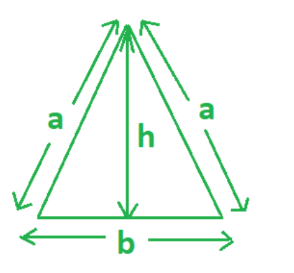
Perimeter of the triangle = Sum of all sides = a + a + b
We are given the question that the perimeter is 36 cm and the base is 16 cm.
This means that b = 16 cm and a + a + b = 36 cm.
Substituting b = 16 cm in a + a + b = 36 cm, we get the following:
a + a + 16 = 36
2a + 16 = 36
2a = 20
a = 10 cm
So, the length of the equal sides of the isosceles triangle is 10 cm.
Now, to find the area of the isosceles triangle, we need to find its height.
We know that the height of the triangle divides the triangle into two right angled triangles and bisects the base.
So, we will apply Pythagoras theorem on one of the right angled triangles to find the height of the isosceles triangle.
Let the height of the isosceles triangle be h.
Then, ${{h}^{2}}+{{\left( \dfrac{b}{2} \right)}^{2}}={{a}^{2}}$
Substitute b = 16 cm and a = 10 cm in this equation:
${{h}^{2}}+{{8}^{2}}={{10}^{2}}$
${{h}^{2}}+64=100$
${{h}^{2}}=36$
$h=6$ cm
So, the height of the isosceles triangle is 6 cm.
Now, area of a triangle = $\dfrac{1}{2}$$\times $ base $\times $ height
Area of isosceles triangle $=\dfrac{1}{2}\times b\times h$
Area of isosceles triangle $=\dfrac{1}{2}\times 16\times 6$
Area of isosceles triangle = 48 sq. cm.
Note: In this question, it is very important to remember the basic concepts of geometry and triangles. These are: an isosceles triangle has two sides equal, the height of the triangle divides the triangle into two right angled triangles and bisects the base, Pythagoras theorem, and area of a triangle = $\dfrac{1}{2}$$\times $ base $\times $ height.
Complete Step-by-step answer:
In this question, we need to find the area of an isosceles triangle whose perimeter is 36 cm and base is 16 cm.
Let the length of the equal sides of the isosceles triangle be a.
Let the length of the base of the isosceles triangle be b.
Perimeter of the triangle = Sum of all sides = a + a + b
We are given the question that the perimeter is 36 cm and the base is 16 cm.
This means that b = 16 cm and a + a + b = 36 cm.
Substituting b = 16 cm in a + a + b = 36 cm, we get the following:
a + a + 16 = 36
2a + 16 = 36
2a = 20
a = 10 cm
So, the length of the equal sides of the isosceles triangle is 10 cm.
Now, to find the area of the isosceles triangle, we need to find its height.
We know that the height of the triangle divides the triangle into two right angled triangles and bisects the base.
So, we will apply Pythagoras theorem on one of the right angled triangles to find the height of the isosceles triangle.
Let the height of the isosceles triangle be h.
Then, ${{h}^{2}}+{{\left( \dfrac{b}{2} \right)}^{2}}={{a}^{2}}$
Substitute b = 16 cm and a = 10 cm in this equation:
${{h}^{2}}+{{8}^{2}}={{10}^{2}}$
${{h}^{2}}+64=100$
${{h}^{2}}=36$
$h=6$ cm
So, the height of the isosceles triangle is 6 cm.
Now, area of a triangle = $\dfrac{1}{2}$$\times $ base $\times $ height
Area of isosceles triangle $=\dfrac{1}{2}\times b\times h$
Area of isosceles triangle $=\dfrac{1}{2}\times 16\times 6$
Area of isosceles triangle = 48 sq. cm.
Note: In this question, it is very important to remember the basic concepts of geometry and triangles. These are: an isosceles triangle has two sides equal, the height of the triangle divides the triangle into two right angled triangles and bisects the base, Pythagoras theorem, and area of a triangle = $\dfrac{1}{2}$$\times $ base $\times $ height.
Recently Updated Pages
Master Class 9 Social Science: Engaging Questions & Answers for Success

Master Class 9 Science: Engaging Questions & Answers for Success
Master Class 9 Maths: Engaging Questions & Answers for Success
Master Class 9 General Knowledge: Engaging Questions & Answers for Success
Class 9 Question and Answer - Your Ultimate Solutions Guide
Master Class 8 Social Science: Engaging Questions & Answers for Success
Trending doubts
What is the Full Form of ISI and RAW
Who is eligible for RTE class 9 social science CBSE
Bruno once got paralysis Why How was he cured class 9 english CBSE
Explain the importance of pH in everyday life class 9 chemistry CBSE
What comes after 10 crore in Indian system class 9 maths CBSE
What is the Full Form of ICSE, CBSE and SSC