




How do you find the area of a triangle whose vertices are \[A(2,4)\], \[B( - 2,0)\] and \[C(4, - 2)\].
Answer
 Verified
551.1k+ views
Hint: We use the concepts of geometry, triangle and matrices to solve this problem. A triangle is a polygon (a closed figure) of three sides. A matrix is a group of elements arranged in different numbers of rows and columns. It is represented as \[{A_{m \times n}}\] where \[m\] is the number of rows and \[n\] is the number of columns.
Complete step by step solution:
The triangle formed by points \[A(2,4)\], \[B( - 2,0)\] and \[C(4, - 2)\] is given below.
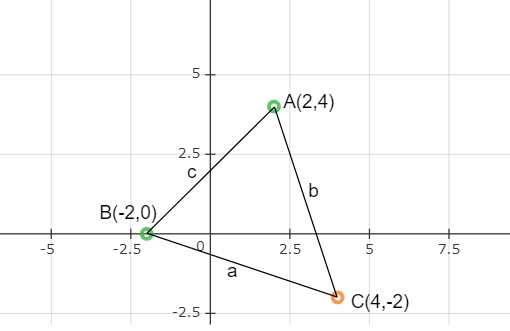
The side opposite to point ‘A’ is \[a\] units.
The side opposite to point ‘B’ is \[b\] units.
The side opposite to point ‘C’ is \[c\] units.
Area of a triangle with vertices \[\left( {{x_1},{y_1}} \right)\], \[\left( {{x_2},{y_2}} \right)\] and \[\left( {{x_3},{y_3}} \right)\] is given by half times the determinant of matrix ‘A’, where \[A = \left( {\begin{array}{*{20}{c}}
{{x_1}}&{{y_1}}&1 \\
{{x_2}}&{{y_2}}&1 \\
{{x_3}}&{{y_3}}&1
\end{array}} \right)\]
So, mathematically, \[Area = \dfrac{1}{2}|A|\] square units.
So, area of this triangle is
\[Area = \dfrac{1}{2}\left| {\begin{array}{*{20}{c}}
{{x_1}}&{{y_1}}&1 \\
{{x_2}}&{{y_2}}&1 \\
{{x_3}}&{{y_3}}&1
\end{array}} \right| = \left| {\begin{array}{*{20}{c}}
2&4&1 \\
{ - 2}&0&1 \\
4&{ - 2}&1
\end{array}} \right|\]
We all know that, determinant of a matrix \[\left( {\begin{array}{*{20}{c}}
{{a_{11}}}&{{a_{12}}}&{{a_{13}}} \\
{{a_{21}}}&{{a_{22}}}&{{a_{23}}} \\
{{a_{31}}}&{{a_{32}}}&{{a_{33}}}
\end{array}} \right)\] is equal to
\[\det = {a_{11}}({a_{22}}{a_{33}} - {a_{32}}{a_{23}}) - {a_{12}}({a_{21}}{a_{33}} - {a_{31}}{a_{23}}) + {a_{13}}({a_{21}}{a_{32}} - {a_{31}}{a_{22}})\]
So, we get,
\[Area = \dfrac{1}{2}.\left( {2((0)1 - ( - 2)1) - 4(( - 2)1 - (4)1) + 1(( - 2)( - 2) - (4).0)} \right)\]
\[ \Rightarrow Area = \dfrac{1}{2}.\left( {2(0 + 2) - 4( - 2 - 4) + 1(4 - 0)} \right)\]
On further simplification, we get finally,
\[ \Rightarrow Area = \dfrac{1}{2}.\left( {4 + 24 + 4} \right) = \dfrac{1}{2}\left( {32} \right) = 16\]
Therefore, we can conclude that, the area of a triangle with vertices \[A(2,4)\], \[B( - 2,0)\] and \[C(4, - 2)\] is equal to 16 square units.
Note:
We can also find the area of a triangle in another way. Let the lengths of sides of a triangle be \[a,b,c\].
Then area is given by \[area = \sqrt {s(s - a)(s - b)(s - c)} \], where \[s = \dfrac{{a + b + c}}{2}\].
Length of a line joining the points \[\left( {{x_1},{y_1}} \right)\] and \[\left( {{x_2},{y_2}} \right)\] is given by \[\sqrt {{{\left( {{x_2} - {x_1}} \right)}^2} + {{\left( {{y_2} - {y_1}} \right)}^2}} \].
Determinant of a matrix is defined as the sum of product of an element and its cofactor matrix in any row or a column.
Cofactor matrix is defined as \[{C_{ij}} = {( - 1)^{i + j}}|{M_{ij}}|\], where \[{M_{ij}}\] is a minor element.
A minor of an element is gained by removing the row and the column containing that element.
Complete step by step solution:
The triangle formed by points \[A(2,4)\], \[B( - 2,0)\] and \[C(4, - 2)\] is given below.
The side opposite to point ‘A’ is \[a\] units.
The side opposite to point ‘B’ is \[b\] units.
The side opposite to point ‘C’ is \[c\] units.
Area of a triangle with vertices \[\left( {{x_1},{y_1}} \right)\], \[\left( {{x_2},{y_2}} \right)\] and \[\left( {{x_3},{y_3}} \right)\] is given by half times the determinant of matrix ‘A’, where \[A = \left( {\begin{array}{*{20}{c}}
{{x_1}}&{{y_1}}&1 \\
{{x_2}}&{{y_2}}&1 \\
{{x_3}}&{{y_3}}&1
\end{array}} \right)\]
So, mathematically, \[Area = \dfrac{1}{2}|A|\] square units.
So, area of this triangle is
\[Area = \dfrac{1}{2}\left| {\begin{array}{*{20}{c}}
{{x_1}}&{{y_1}}&1 \\
{{x_2}}&{{y_2}}&1 \\
{{x_3}}&{{y_3}}&1
\end{array}} \right| = \left| {\begin{array}{*{20}{c}}
2&4&1 \\
{ - 2}&0&1 \\
4&{ - 2}&1
\end{array}} \right|\]
We all know that, determinant of a matrix \[\left( {\begin{array}{*{20}{c}}
{{a_{11}}}&{{a_{12}}}&{{a_{13}}} \\
{{a_{21}}}&{{a_{22}}}&{{a_{23}}} \\
{{a_{31}}}&{{a_{32}}}&{{a_{33}}}
\end{array}} \right)\] is equal to
\[\det = {a_{11}}({a_{22}}{a_{33}} - {a_{32}}{a_{23}}) - {a_{12}}({a_{21}}{a_{33}} - {a_{31}}{a_{23}}) + {a_{13}}({a_{21}}{a_{32}} - {a_{31}}{a_{22}})\]
So, we get,
\[Area = \dfrac{1}{2}.\left( {2((0)1 - ( - 2)1) - 4(( - 2)1 - (4)1) + 1(( - 2)( - 2) - (4).0)} \right)\]
\[ \Rightarrow Area = \dfrac{1}{2}.\left( {2(0 + 2) - 4( - 2 - 4) + 1(4 - 0)} \right)\]
On further simplification, we get finally,
\[ \Rightarrow Area = \dfrac{1}{2}.\left( {4 + 24 + 4} \right) = \dfrac{1}{2}\left( {32} \right) = 16\]
Therefore, we can conclude that, the area of a triangle with vertices \[A(2,4)\], \[B( - 2,0)\] and \[C(4, - 2)\] is equal to 16 square units.
Note:
We can also find the area of a triangle in another way. Let the lengths of sides of a triangle be \[a,b,c\].
Then area is given by \[area = \sqrt {s(s - a)(s - b)(s - c)} \], where \[s = \dfrac{{a + b + c}}{2}\].
Length of a line joining the points \[\left( {{x_1},{y_1}} \right)\] and \[\left( {{x_2},{y_2}} \right)\] is given by \[\sqrt {{{\left( {{x_2} - {x_1}} \right)}^2} + {{\left( {{y_2} - {y_1}} \right)}^2}} \].
Determinant of a matrix is defined as the sum of product of an element and its cofactor matrix in any row or a column.
Cofactor matrix is defined as \[{C_{ij}} = {( - 1)^{i + j}}|{M_{ij}}|\], where \[{M_{ij}}\] is a minor element.
A minor of an element is gained by removing the row and the column containing that element.
Recently Updated Pages
Master Class 12 Economics: Engaging Questions & Answers for Success

Master Class 12 Social Science: Engaging Questions & Answers for Success
Master Class 12 English: Engaging Questions & Answers for Success
Master Class 12 Maths: Engaging Questions & Answers for Success
Master Class 12 Physics: Engaging Questions & Answers for Success
Master Class 12 Biology: Engaging Questions & Answers for Success
Trending doubts
Draw a labelled sketch of the human eye class 12 physics CBSE
Which are the Top 10 Largest Countries of the World?
Draw ray diagrams each showing i myopic eye and ii class 12 physics CBSE
Which is the correct genotypic ratio of mendel dihybrid class 12 biology CBSE
Differentiate between homogeneous and heterogeneous class 12 chemistry CBSE
Give 10 examples of unisexual and bisexual flowers