




How do you find the area of a rhombus?
Answer
 Verified
543.6k+ views
Hint: A rhombus is a parallelogram with four congruent sides. Also, it does not have right angles, meaning no angle would be of ${{90}^{\circ }}$ . A parallelogram is a quadrilateral with two pairs of parallel sides. Moreover, the opposite sides of a parallelogram are of equal length. So, let’s see how we can solve this problem.
Complete step-by-step answer:
For finding the area of a rhombus we can find the length of each diagonal, then multiply them and divide the result with 2 to get the area.
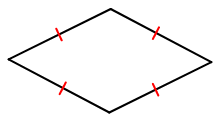
Let’s see an example.
The diagonals are lines that connect the opposite vertices. Let’s suppose that the length of diagonals are 4 cm and 6 cm.
So first we will multiply the length of diagonals, after which we will get $24c{{m}^{2}}$ . Now, we will divide this with 2, then we will get $\dfrac{24}{2}c{{m}^{2}}=12c{{m}^{2}}$ . Therefore, for the length of diagonal of the parallelogram of 4 cm and 6 cm, the area would be $12c{{m}^{2}}$ .
Note: For solving the above problem there is an alternative method. Let us see that as well. Suppose we know the length of base and height of parallelogram which is 10 cm and 7 cm respectively. On multiplying them we get $70c{{m}^{2}}$ . Therefore, $70c{{m}^{2}}$ is the area of the rhombus of base 10 cm and height 7 cm.
Complete step-by-step answer:
For finding the area of a rhombus we can find the length of each diagonal, then multiply them and divide the result with 2 to get the area.
Let’s see an example.
The diagonals are lines that connect the opposite vertices. Let’s suppose that the length of diagonals are 4 cm and 6 cm.
So first we will multiply the length of diagonals, after which we will get $24c{{m}^{2}}$ . Now, we will divide this with 2, then we will get $\dfrac{24}{2}c{{m}^{2}}=12c{{m}^{2}}$ . Therefore, for the length of diagonal of the parallelogram of 4 cm and 6 cm, the area would be $12c{{m}^{2}}$ .
Note: For solving the above problem there is an alternative method. Let us see that as well. Suppose we know the length of base and height of parallelogram which is 10 cm and 7 cm respectively. On multiplying them we get $70c{{m}^{2}}$ . Therefore, $70c{{m}^{2}}$ is the area of the rhombus of base 10 cm and height 7 cm.
Recently Updated Pages
Master Class 10 Computer Science: Engaging Questions & Answers for Success

Master Class 10 General Knowledge: Engaging Questions & Answers for Success
Master Class 10 English: Engaging Questions & Answers for Success
Master Class 10 Social Science: Engaging Questions & Answers for Success
Master Class 10 Maths: Engaging Questions & Answers for Success
Master Class 10 Science: Engaging Questions & Answers for Success
Trending doubts
What is the median of the first 10 natural numbers class 10 maths CBSE
Which women's tennis player has 24 Grand Slam singles titles?
Who is the Brand Ambassador of Incredible India?
Why is there a time difference of about 5 hours between class 10 social science CBSE
Write a letter to the principal requesting him to grant class 10 english CBSE
A moving boat is observed from the top of a 150 m high class 10 maths CBSE