




How do you find the area in the first quadrant bounded by $ y = {x^{ - 2}} $ and $ y = \dfrac{{17}}{4} - {x^2} $ ?
Answer
 Verified
551.4k+ views
Hint: The following type of question is solved first by plotting out the relevant curves on the graph in the coordinate plane. Then we find their intersection points of the two curves with each other by substituting the value of one function into the other function and then the definite integrating in the intervals in which the curve is the same to find the area of the curves. The area obtained will be in square units of the graph but we will generically write square units.
Complete step by step solution:
The following curves are first plotted on the graph,
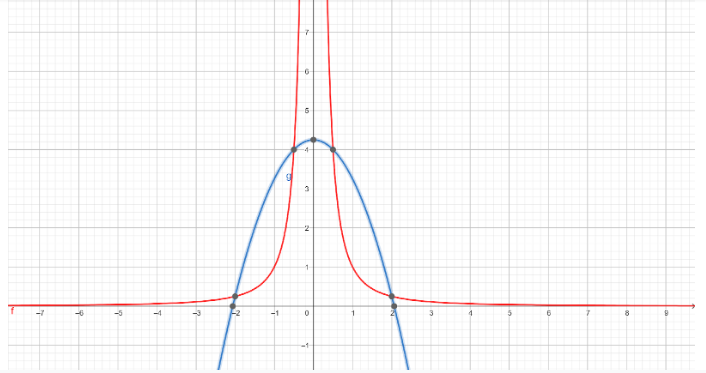
The graph in red is for $ y = {x^{ - 2}} $ while the graph in blue is of parabola $ y = \dfrac{{17}}{4} - {x^2} $
Then we will find the points of intersection of the parabola and the hyperbola:
We start by putting both the values of $ y $ equal we get:
$ {x^{ - 2}} = \dfrac{{17}}{4} - {x^2} $
Upon solving the above equation we reach,
$ 4{x^4} - 17{x^2} + 4 = 0 $
Since it has become a biquadratic equation we will put $ u = {x^2} $
Then we will get,
$ 4{u^2} - 17u + 4 = 0 $
$ \left( {4u - 1} \right)\left( {u - 4} \right) = 0 $
Upon solving for $ u $ we will get
$ u = \dfrac{1}{4}\;\:{\text{or}}\;\:4 $ and then we get value of $ x $ as
$ x = \pm \dfrac{1}{2}\;\:{\text{or}}\;\:x = \pm 2 $
Thus we see both from the graph and above solution that the curves cut each other 4 times.
Now to find the area in the first quadrant our two points of interest become $ 2 $ and $ \dfrac{1}{2} $ so upon integration we use these boundary conditions. The area will now be given by blue expression in the graph minus the the graph in red so we write our expression as:
$ A = \mathop \int \nolimits_{\dfrac{1}{2}}^2 \dfrac{{17}}{4} - {x^2} - \left( {{x^{ - 2}}} \right)dx $
Which upon solving becomes,
$ A = \left[ {\dfrac{{17}}{4}\left( x \right) - \dfrac{1}{3}{x^3} + {x^{ - 1}}} \right]_{\dfrac{1}{2}}^2 $
This will then be evaluated by putting the boundary conditions,
$ A = \dfrac{{17}}{4}\left( 2 \right) - \dfrac{1}{3}{\left( 2 \right)^3} + {2^{ - 1}} - \left( {\dfrac{{17}}{4}\left( {\dfrac{1}{2}} \right) - \dfrac{1}{3}{{\left( {\dfrac{1}{2}} \right)}^3} + {{\left( {\dfrac{1}{2}} \right)}^{ - 1}}} \right) $
$ A = 7 - \dfrac{8}{3} - \dfrac{{50}}{{24}} $
Thus after solving above expression we get our area as,
$ A = \dfrac{{54}}{{24}} = \dfrac{9}{4}{\text{square units}} $
So, the correct answer is “ $ A = \dfrac{{54}}{{24}} = \dfrac{9}{4}{\text{square units}} $ ”.
Note: It is very important to find the point of intersection in the given types of questions otherwise we will not get the boundary conditions that will tell upto which limits we have to integrate. Also note here we have neglected negative values of $ x $ since we had to find the area in the first quadrant.
Complete step by step solution:
The following curves are first plotted on the graph,
The graph in red is for $ y = {x^{ - 2}} $ while the graph in blue is of parabola $ y = \dfrac{{17}}{4} - {x^2} $
Then we will find the points of intersection of the parabola and the hyperbola:
We start by putting both the values of $ y $ equal we get:
$ {x^{ - 2}} = \dfrac{{17}}{4} - {x^2} $
Upon solving the above equation we reach,
$ 4{x^4} - 17{x^2} + 4 = 0 $
Since it has become a biquadratic equation we will put $ u = {x^2} $
Then we will get,
$ 4{u^2} - 17u + 4 = 0 $
$ \left( {4u - 1} \right)\left( {u - 4} \right) = 0 $
Upon solving for $ u $ we will get
$ u = \dfrac{1}{4}\;\:{\text{or}}\;\:4 $ and then we get value of $ x $ as
$ x = \pm \dfrac{1}{2}\;\:{\text{or}}\;\:x = \pm 2 $
Thus we see both from the graph and above solution that the curves cut each other 4 times.
Now to find the area in the first quadrant our two points of interest become $ 2 $ and $ \dfrac{1}{2} $ so upon integration we use these boundary conditions. The area will now be given by blue expression in the graph minus the the graph in red so we write our expression as:
$ A = \mathop \int \nolimits_{\dfrac{1}{2}}^2 \dfrac{{17}}{4} - {x^2} - \left( {{x^{ - 2}}} \right)dx $
Which upon solving becomes,
$ A = \left[ {\dfrac{{17}}{4}\left( x \right) - \dfrac{1}{3}{x^3} + {x^{ - 1}}} \right]_{\dfrac{1}{2}}^2 $
This will then be evaluated by putting the boundary conditions,
$ A = \dfrac{{17}}{4}\left( 2 \right) - \dfrac{1}{3}{\left( 2 \right)^3} + {2^{ - 1}} - \left( {\dfrac{{17}}{4}\left( {\dfrac{1}{2}} \right) - \dfrac{1}{3}{{\left( {\dfrac{1}{2}} \right)}^3} + {{\left( {\dfrac{1}{2}} \right)}^{ - 1}}} \right) $
$ A = 7 - \dfrac{8}{3} - \dfrac{{50}}{{24}} $
Thus after solving above expression we get our area as,
$ A = \dfrac{{54}}{{24}} = \dfrac{9}{4}{\text{square units}} $
So, the correct answer is “ $ A = \dfrac{{54}}{{24}} = \dfrac{9}{4}{\text{square units}} $ ”.
Note: It is very important to find the point of intersection in the given types of questions otherwise we will not get the boundary conditions that will tell upto which limits we have to integrate. Also note here we have neglected negative values of $ x $ since we had to find the area in the first quadrant.
Recently Updated Pages
Three beakers labelled as A B and C each containing 25 mL of water were taken A small amount of NaOH anhydrous CuSO4 and NaCl were added to the beakers A B and C respectively It was observed that there was an increase in the temperature of the solutions contained in beakers A and B whereas in case of beaker C the temperature of the solution falls Which one of the following statements isarecorrect i In beakers A and B exothermic process has occurred ii In beakers A and B endothermic process has occurred iii In beaker C exothermic process has occurred iv In beaker C endothermic process has occurred

Master Class 11 Social Science: Engaging Questions & Answers for Success
Master Class 11 Physics: Engaging Questions & Answers for Success
Master Class 11 Maths: Engaging Questions & Answers for Success
Master Class 11 Economics: Engaging Questions & Answers for Success
Master Class 11 Computer Science: Engaging Questions & Answers for Success
Three beakers labelled as A B and C each containing 25 mL of water were taken A small amount of NaOH anhydrous CuSO4 and NaCl were added to the beakers A B and C respectively It was observed that there was an increase in the temperature of the solutions contained in beakers A and B whereas in case of beaker C the temperature of the solution falls Which one of the following statements isarecorrect i In beakers A and B exothermic process has occurred ii In beakers A and B endothermic process has occurred iii In beaker C exothermic process has occurred iv In beaker C endothermic process has occurred
Master Class 11 Social Science: Engaging Questions & Answers for Success
Master Class 11 Physics: Engaging Questions & Answers for Success
Trending doubts
There are 720 permutations of the digits 1 2 3 4 5 class 11 maths CBSE
State and prove Bernoullis theorem class 11 physics CBSE
1 Quintal is equal to a 110 kg b 10 kg c 100kg d 1000 class 11 physics CBSE
Discuss the various forms of bacteria class 11 biology CBSE
Explain zero factorial class 11 maths CBSE
What is 1s 2s 2p 3s 3p class 11 chemistry CBSE