




Find the area enclosed by each of the given figures:
Answer
 Verified
647.7k+ views
Hint: To specify a figure most fundamental quantities are perimeter, area and volume. Perimeter can be defined as the total length of the boundary of a geometrical figure. Area can be defined as the space occupied by a flat shape or the surface of an object. Area of a combination of two figures is the individual area of each figure. So, using this definition we can easily solve our problem.
Complete step-by-step answer:
According to our question, we are given three figures whose areas are to be evaluated. Some of the useful formulas for calculating area of geometrical figures are:
Area of a square of side a $={{a}^{2}}$
Area of a triangle having base length b and height h $=\dfrac{1}{2}\times b\times h$
Area of a trapezium of height h and parallel sides a and b $=\dfrac{h}{2}\left( a+b \right)$
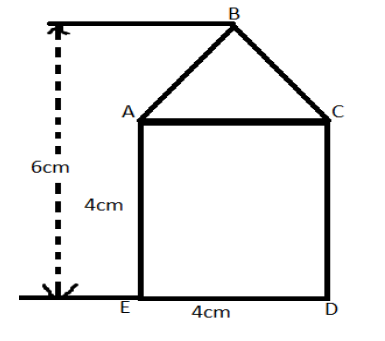
For figure 1, area of the polygon is equal to sum of the area of square of side 4 cm and triangle having base 4 cm and height 2 cm:
$\begin{align}
& =4\times 4+\dfrac{1}{2}\times 4\times 2 \\
& =16+4 \\
& =20c{{m}^{2}} \\
\end{align}$
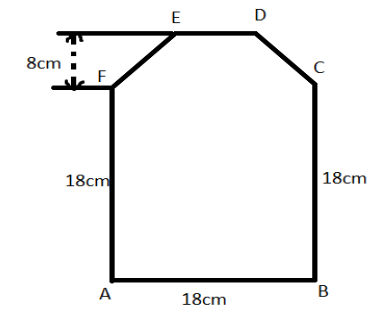
For figure 2, area of the polygon is equal to sum of area of square of side 18 cm and trapezium of height 8 cm and parallel sides 18 cm and 8 cm:
$\begin{align}
& =18\times 18+\dfrac{8}{2}\left( 8+18 \right) \\
& =324+4(26) \\
& =324+104 \\
& =428c{{m}^{2}} \\
\end{align}$
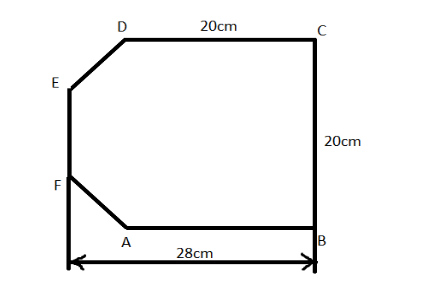
For figure 3, area of the polygon is equal to sum of area of square of side 20 cm and trapezium of height 8 cm and parallel sides 20 cm and 8 cm:
$\begin{align}
& =20\times 20+\dfrac{8}{2}\times \left( 8+20 \right) \\
& =400+4\times 28 \\
& =400+112 \\
& =512c{{m}^{2}} \\
\end{align}$
Area of figure (i) is 20 square cm.
Area of figure (ii) is 428 square cm.
Area of figure (iii) is 512 square cm.
Note: The key concept for solving this problem is the segregation of the whole area into two parts. By separating the area into desired shapes, we easily evaluated the area of the whole polygon. This concept is very useful in solving complex problems.
Complete step-by-step answer:
According to our question, we are given three figures whose areas are to be evaluated. Some of the useful formulas for calculating area of geometrical figures are:
Area of a square of side a $={{a}^{2}}$
Area of a triangle having base length b and height h $=\dfrac{1}{2}\times b\times h$
Area of a trapezium of height h and parallel sides a and b $=\dfrac{h}{2}\left( a+b \right)$
For figure 1, area of the polygon is equal to sum of the area of square of side 4 cm and triangle having base 4 cm and height 2 cm:
$\begin{align}
& =4\times 4+\dfrac{1}{2}\times 4\times 2 \\
& =16+4 \\
& =20c{{m}^{2}} \\
\end{align}$
For figure 2, area of the polygon is equal to sum of area of square of side 18 cm and trapezium of height 8 cm and parallel sides 18 cm and 8 cm:
$\begin{align}
& =18\times 18+\dfrac{8}{2}\left( 8+18 \right) \\
& =324+4(26) \\
& =324+104 \\
& =428c{{m}^{2}} \\
\end{align}$
For figure 3, area of the polygon is equal to sum of area of square of side 20 cm and trapezium of height 8 cm and parallel sides 20 cm and 8 cm:
$\begin{align}
& =20\times 20+\dfrac{8}{2}\times \left( 8+20 \right) \\
& =400+4\times 28 \\
& =400+112 \\
& =512c{{m}^{2}} \\
\end{align}$
Area of figure (i) is 20 square cm.
Area of figure (ii) is 428 square cm.
Area of figure (iii) is 512 square cm.
Note: The key concept for solving this problem is the segregation of the whole area into two parts. By separating the area into desired shapes, we easily evaluated the area of the whole polygon. This concept is very useful in solving complex problems.
Recently Updated Pages
Master Class 8 English: Engaging Questions & Answers for Success

Master Class 8 Science: Engaging Questions & Answers for Success
Master Class 8 Maths: Engaging Questions & Answers for Success
Class 8 Question and Answer - Your Ultimate Solutions Guide
Master Class 8 Social Science: Engaging Questions & Answers for Success
Master Class 12 Economics: Engaging Questions & Answers for Success
Trending doubts
What is BLO What is the full form of BLO class 8 social science CBSE
Which Indian state shares the longest international class 8 social science CBSE
Citizens of India can vote at the age of A 18 years class 8 social science CBSE
Right to vote is a AFundamental Right BFundamental class 8 social science CBSE
Full form of STD, ISD and PCO
What is the area formula of an obtuse triangle class 8 maths CBSE