




How do you find the area between \[f(x)={{x}^{2}}+2x+1\] and \[g(x)=3x+3\]?
Answer
 Verified
563.1k+ views
Hint: From the given question we have been asked to find the area between two functions. For solving this question we will find the point of intersection of two functions. After finding it we will find the area of both functions and subtract the area of curve or function which is above among the both in the graph. So, we proceed with the solution as follows.
Complete step by step solution:
The point of intersection of these two functions are as follows.
We will equate both the functions and find the abscissa of the intersection point.
\[\Rightarrow {{x}^{2}}+2x+1=3x+3\]
\[\Rightarrow {{x}^{2}}+2x+1-3x-3=0\]
\[\Rightarrow {{x}^{2}}-x-2=0\]
Here we will add and subtract x on the left hand side of the equation.
\[\Rightarrow {{x}^{2}}-2x+x-2=0\]
\[\Rightarrow x\left( x-2 \right)+1\left( x-2 \right)=0\]
\[\Rightarrow \left( x-2 \right)\left( x+1 \right)=0\]
\[\Rightarrow x=2,-1\]
So, we will substitute this x points in one of the function and find the y points.
So, we get the equation as follows.
\[\Rightarrow y=3x+3\]
When we substitute x as \[2\] we get,
\[\Rightarrow y=3(2)+3\]
\[\Rightarrow y=9\]
When we substitute x as \[-1\] we get,
\[\Rightarrow y=3(-1)+3\]
\[\Rightarrow y=0\]
So, the points of intersection are \[(-1,0),(2,9)\].
The graph will be as follows.
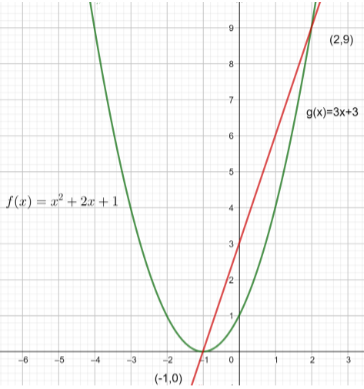
So, we have to find the area under the curve of \[g(x)\], then subtract the area under the curve \[f(x)\] because \[g(x)\] is above the function \[f(x)\] in the interval \[[-1,2]\].
We use integration for finding the area.
\[\Rightarrow \int\limits_{-1}^{2}{g(x)dx-\int\limits_{-1}^{2}{f(x)dx}}\]
\[\Rightarrow \int\limits_{-1}^{2}{(3x+3)dx-\int\limits_{-1}^{2}{({{x}^{2}}+2x+1)dx}}\]
Here we used the integration formulae which is \[\Rightarrow \int{{{x}^{n}}dx}=\dfrac{{{x}^{n+1}}}{n+1}\].
\[\Rightarrow \left[ \dfrac{3}{2}{{x}^{2}}+3x \right]_{-1}^{2}-\left[ \dfrac{1}{3}{{x}^{3}}+{{x}^{2}}+x \right]_{-1}^{2}\]
Now we remove the boundary by substituting them as follows.
\[\begin{align}
& \Rightarrow \left[ \left( \dfrac{3}{2}\times {{2}^{2}}+3\times 2 \right)-\left( \dfrac{3}{2}\times {{(-1)}^{2}}+3\times (-1) \right) \right]- \\
& \text{ }\left[ \left( \dfrac{1}{3}{{(2)}^{3}}+{{(2)}^{2}}+2 \right)-\left( \dfrac{1}{3}{{(-1)}^{3}}+{{(-1)}^{2}}+-1 \right) \right] \\
\end{align}\]
\[\Rightarrow \left[ \left( 6+6 \right)-\left( \dfrac{3}{2}-3 \right) \right]-\left[ \left( \dfrac{8}{3}+6 \right)-\left( \dfrac{-1}{3} \right) \right]\]
\[\Rightarrow 13.5-9\]
\[\Rightarrow 4.5\] square units
Note: Students must be very careful in doing the calculations. Students should know the concept of integration, areas and functions. Students should know the basic integration formulae like,
\[\Rightarrow \int{{{x}^{n}}dx}=\dfrac{{{x}^{n+1}}}{n+1}\]
Complete step by step solution:
The point of intersection of these two functions are as follows.
We will equate both the functions and find the abscissa of the intersection point.
\[\Rightarrow {{x}^{2}}+2x+1=3x+3\]
\[\Rightarrow {{x}^{2}}+2x+1-3x-3=0\]
\[\Rightarrow {{x}^{2}}-x-2=0\]
Here we will add and subtract x on the left hand side of the equation.
\[\Rightarrow {{x}^{2}}-2x+x-2=0\]
\[\Rightarrow x\left( x-2 \right)+1\left( x-2 \right)=0\]
\[\Rightarrow \left( x-2 \right)\left( x+1 \right)=0\]
\[\Rightarrow x=2,-1\]
So, we will substitute this x points in one of the function and find the y points.
So, we get the equation as follows.
\[\Rightarrow y=3x+3\]
When we substitute x as \[2\] we get,
\[\Rightarrow y=3(2)+3\]
\[\Rightarrow y=9\]
When we substitute x as \[-1\] we get,
\[\Rightarrow y=3(-1)+3\]
\[\Rightarrow y=0\]
So, the points of intersection are \[(-1,0),(2,9)\].
The graph will be as follows.
So, we have to find the area under the curve of \[g(x)\], then subtract the area under the curve \[f(x)\] because \[g(x)\] is above the function \[f(x)\] in the interval \[[-1,2]\].
We use integration for finding the area.
\[\Rightarrow \int\limits_{-1}^{2}{g(x)dx-\int\limits_{-1}^{2}{f(x)dx}}\]
\[\Rightarrow \int\limits_{-1}^{2}{(3x+3)dx-\int\limits_{-1}^{2}{({{x}^{2}}+2x+1)dx}}\]
Here we used the integration formulae which is \[\Rightarrow \int{{{x}^{n}}dx}=\dfrac{{{x}^{n+1}}}{n+1}\].
\[\Rightarrow \left[ \dfrac{3}{2}{{x}^{2}}+3x \right]_{-1}^{2}-\left[ \dfrac{1}{3}{{x}^{3}}+{{x}^{2}}+x \right]_{-1}^{2}\]
Now we remove the boundary by substituting them as follows.
\[\begin{align}
& \Rightarrow \left[ \left( \dfrac{3}{2}\times {{2}^{2}}+3\times 2 \right)-\left( \dfrac{3}{2}\times {{(-1)}^{2}}+3\times (-1) \right) \right]- \\
& \text{ }\left[ \left( \dfrac{1}{3}{{(2)}^{3}}+{{(2)}^{2}}+2 \right)-\left( \dfrac{1}{3}{{(-1)}^{3}}+{{(-1)}^{2}}+-1 \right) \right] \\
\end{align}\]
\[\Rightarrow \left[ \left( 6+6 \right)-\left( \dfrac{3}{2}-3 \right) \right]-\left[ \left( \dfrac{8}{3}+6 \right)-\left( \dfrac{-1}{3} \right) \right]\]
\[\Rightarrow 13.5-9\]
\[\Rightarrow 4.5\] square units
Note: Students must be very careful in doing the calculations. Students should know the concept of integration, areas and functions. Students should know the basic integration formulae like,
\[\Rightarrow \int{{{x}^{n}}dx}=\dfrac{{{x}^{n+1}}}{n+1}\]
Recently Updated Pages
Master Class 12 Business Studies: Engaging Questions & Answers for Success

Master Class 12 Biology: Engaging Questions & Answers for Success
Master Class 12 Chemistry: Engaging Questions & Answers for Success
Class 12 Question and Answer - Your Ultimate Solutions Guide
Master Class 11 Social Science: Engaging Questions & Answers for Success
Master Class 11 English: Engaging Questions & Answers for Success
Trending doubts
Which is more stable and why class 12 chemistry CBSE
What are the major means of transport Explain each class 12 social science CBSE
Sulphuric acid is known as the king of acids State class 12 chemistry CBSE
The value of constant k in coulombs law is beginalign class 12 physics CBSE
Why should a magnesium ribbon be cleaned before burning class 12 chemistry CBSE
Suicide bags of cells are aEndoplasmic reticulum bLysosome class 12 biology CBSE