



Find the area and perimeter of a square with diagonal 24 cm. (Take $\sqrt{2}=1.41$ )
Answer
 Verified
636.6k+ views
Hint: First, here we have to assume the value of all sides of the square as x. Then the formula of the diagonal of the square should be known which is equal to $\sqrt{2}\times \left( side \right)=\sqrt{2}x$. Then by using this formula value of single side is obtained and then using Pythagoras theorem to find area $A{{C}^{2}}=A{{B}^{2}}+B{{C}^{2}}$ and then to find perimeter use $4\times \left( side \right)$ .
Complete step-by-step answer:
Now, we are given with only diagonal $d=24cm$ . Assuming sides as ‘x’ so, diagram will be
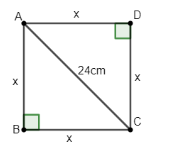
Now, we also know that if the diagonal is there then the angle made by the triangle will be the right angle triangle. So, for triangle ABC we can use Pythagoras theorem i.e.,
$\Rightarrow A{{C}^{2}}=A{{B}^{2}}+B{{C}^{2}}$ ………………………….(i)
Substituting values in above equation, we get
$\Rightarrow {{\left( 24 \right)}^{2}}={{x}^{2}}+{{x}^{2}}$
$\Rightarrow 576=2{{x}^{2}}$
$\Rightarrow {{x}^{2}}=\dfrac{576}{2}=288c{{m}^{2}}$ ………………………(ii)
Now, we know that area of square $=\left( side \right)\times \left( side \right)$
$={{x}^{2}}$
So, from equation (ii) we get the value of area as 288 $c{{m}^{2}}$ .
Now, for finding the perimeter of the square which is $=4\times \left( side \right)$ we need to find the value of the single side. We can also find a side by finding a square root of area of 288 $c{{m}^{2}}$ . But we will use the formula to find diagonal which is given as
$\Rightarrow \sqrt{2}\times \left( side \right)=\sqrt{2}x=24$
$\Rightarrow x=\dfrac{24}{\sqrt{2}}$ cm …………………………….……….(iii)
Thus, the value of the single side is $\dfrac{24}{\sqrt{2}}$ cm.
Therefore, perimeter of square $=4\left( side \right)$
$=4\left( x \right)=4\left( \dfrac{24}{\sqrt{2}} \right)$
$=\dfrac{96}{\sqrt{2}}\Rightarrow \dfrac{96\sqrt{2}}{\sqrt{2}\times \sqrt{2}}=48\sqrt{2}$ cm
To remove the fraction part, we just multiply $\sqrt{2}$ in numerator and denominator.
$=48\times 1.41$ (given to use $\sqrt{2}=1.41$ )
$=67.68cm$
Hence, the area of the square is 288 $c{{m}^{2}}$ and the perimeter is 67.68 cm.
Note: Another approach to solve this problem is, first finding the area of triangle ABC and ADC separately and then adding both values which will be in terms of x. So, then we will again have to use Pythagoras Theorem and do the same procedure. Thus, it will become lengthier and time consuming. Although, perimeter of square is $48\sqrt{2}$cm we can also leave it as $\dfrac{96}{\sqrt{2}}cm$ which is also absolutely correct if not given to use $\sqrt{2}=1.41$ . So, both answers are the same. Also, remember the formula of diagonal then only the value of side will be found.
Complete step-by-step answer:
Now, we are given with only diagonal $d=24cm$ . Assuming sides as ‘x’ so, diagram will be
Now, we also know that if the diagonal is there then the angle made by the triangle will be the right angle triangle. So, for triangle ABC we can use Pythagoras theorem i.e.,
$\Rightarrow A{{C}^{2}}=A{{B}^{2}}+B{{C}^{2}}$ ………………………….(i)
Substituting values in above equation, we get
$\Rightarrow {{\left( 24 \right)}^{2}}={{x}^{2}}+{{x}^{2}}$
$\Rightarrow 576=2{{x}^{2}}$
$\Rightarrow {{x}^{2}}=\dfrac{576}{2}=288c{{m}^{2}}$ ………………………(ii)
Now, we know that area of square $=\left( side \right)\times \left( side \right)$
$={{x}^{2}}$
So, from equation (ii) we get the value of area as 288 $c{{m}^{2}}$ .
Now, for finding the perimeter of the square which is $=4\times \left( side \right)$ we need to find the value of the single side. We can also find a side by finding a square root of area of 288 $c{{m}^{2}}$ . But we will use the formula to find diagonal which is given as
$\Rightarrow \sqrt{2}\times \left( side \right)=\sqrt{2}x=24$
$\Rightarrow x=\dfrac{24}{\sqrt{2}}$ cm …………………………….……….(iii)
Thus, the value of the single side is $\dfrac{24}{\sqrt{2}}$ cm.
Therefore, perimeter of square $=4\left( side \right)$
$=4\left( x \right)=4\left( \dfrac{24}{\sqrt{2}} \right)$
$=\dfrac{96}{\sqrt{2}}\Rightarrow \dfrac{96\sqrt{2}}{\sqrt{2}\times \sqrt{2}}=48\sqrt{2}$ cm
To remove the fraction part, we just multiply $\sqrt{2}$ in numerator and denominator.
$=48\times 1.41$ (given to use $\sqrt{2}=1.41$ )
$=67.68cm$
Hence, the area of the square is 288 $c{{m}^{2}}$ and the perimeter is 67.68 cm.
Note: Another approach to solve this problem is, first finding the area of triangle ABC and ADC separately and then adding both values which will be in terms of x. So, then we will again have to use Pythagoras Theorem and do the same procedure. Thus, it will become lengthier and time consuming. Although, perimeter of square is $48\sqrt{2}$cm we can also leave it as $\dfrac{96}{\sqrt{2}}cm$ which is also absolutely correct if not given to use $\sqrt{2}=1.41$ . So, both answers are the same. Also, remember the formula of diagonal then only the value of side will be found.
Recently Updated Pages
Master Class 12 Economics: Engaging Questions & Answers for Success

Master Class 12 English: Engaging Questions & Answers for Success
Master Class 12 Social Science: Engaging Questions & Answers for Success
Master Class 12 Maths: Engaging Questions & Answers for Success
Master Class 12 Physics: Engaging Questions & Answers for Success
Master Class 9 General Knowledge: Engaging Questions & Answers for Success
Trending doubts
What is the Full Form of ICSE / ISC ?
What is the Full Form of ICSE, CBSE and SSC
Differentiate between the Western and the Eastern class 9 social science CBSE
What comes after 10 crore in Indian system class 9 maths CBSE
Write the 6 fundamental rights of India and explain in detail
Differentiate between nationstate and modern state class 9 social science CBSE