




How do you find the amplitude and period of $y = \dfrac{1}{2}\sin \theta ?$
Answer
 Verified
541.8k+ views
Hint: Amplitude is the highest value of a function in its one complete cycle or one complete period.
Period is the smallest length that repeats itself in a repeating or periodic function. And since, all the trigonometric functions are periodic, hence $\sin $function is also a periodic function.
Complete step by step answer:
As we already know that the amplitude of function means the highest possible value of that function. So do you know what’s the highest value of a $\sin $ function?
Let us find out the highest value of a $\sin $function with the help of its graph.
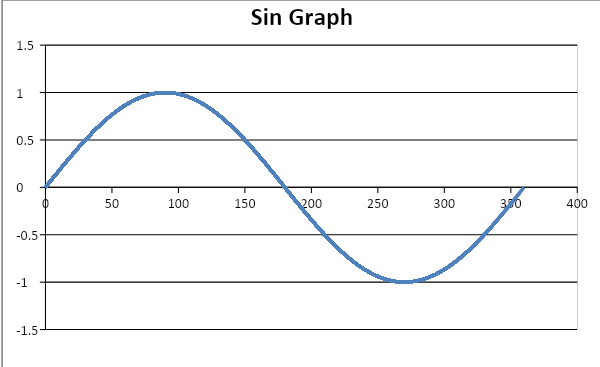
Now, from the graph we know the highest value of a $\sin $ function is $1$, therefore required amplitude will be the highest value of $y$ in the equation
$y = \dfrac{1}{2}\sin \theta $
Here in the equation $\dfrac{1}{2}$ is constant, so the only variable which can affect the value of $y$ is $\sin \theta $
And from the graph, we know the highest value of $\sin \theta $, which is equal to $1$
So, substituting the highest value of $\sin \theta $ which is $1$ in the above equation we get,
$
\Rightarrow y = \dfrac{1}{2}\sin \theta \\
\Rightarrow y = \dfrac{1}{2} \times 1 \\
\Rightarrow y = \dfrac{1}{2} \\
$
Therefore the amplitude of the function $y = \dfrac{1}{2}\sin \theta $ is $\dfrac{1}{2}$
Now, coming to the period as from the above graph we get to know that the period of $\sin $function is $2\pi $ or ${360^ \circ }$ (in degrees)
But we have to find the period of $\dfrac{1}{2}\sin \theta $,
Here, we can see that $\dfrac{1}{2}$ is multiplied to the outcomes or $y - $ values of the function.
Therefore it will not affect the period until and unless the angle part which is $\theta $ being multiplied or divided by it.
Therefore, the required period is $2\pi $ and amplitude is $\dfrac{1}{2}$
Note: When tackling this type of more questions then here is the general formula to find amplitude and period of a sine function. If $\sin $function is written as $a\sin b\theta $, then the amplitude and period is given by Amplitude $ = a$ and period $ = \dfrac{{2\pi }}{b}$
Period is the smallest length that repeats itself in a repeating or periodic function. And since, all the trigonometric functions are periodic, hence $\sin $function is also a periodic function.
Complete step by step answer:
As we already know that the amplitude of function means the highest possible value of that function. So do you know what’s the highest value of a $\sin $ function?
Let us find out the highest value of a $\sin $function with the help of its graph.
Now, from the graph we know the highest value of a $\sin $ function is $1$, therefore required amplitude will be the highest value of $y$ in the equation
$y = \dfrac{1}{2}\sin \theta $
Here in the equation $\dfrac{1}{2}$ is constant, so the only variable which can affect the value of $y$ is $\sin \theta $
And from the graph, we know the highest value of $\sin \theta $, which is equal to $1$
So, substituting the highest value of $\sin \theta $ which is $1$ in the above equation we get,
$
\Rightarrow y = \dfrac{1}{2}\sin \theta \\
\Rightarrow y = \dfrac{1}{2} \times 1 \\
\Rightarrow y = \dfrac{1}{2} \\
$
Therefore the amplitude of the function $y = \dfrac{1}{2}\sin \theta $ is $\dfrac{1}{2}$
Now, coming to the period as from the above graph we get to know that the period of $\sin $function is $2\pi $ or ${360^ \circ }$ (in degrees)
But we have to find the period of $\dfrac{1}{2}\sin \theta $,
Here, we can see that $\dfrac{1}{2}$ is multiplied to the outcomes or $y - $ values of the function.
Therefore it will not affect the period until and unless the angle part which is $\theta $ being multiplied or divided by it.
Therefore, the required period is $2\pi $ and amplitude is $\dfrac{1}{2}$
Note: When tackling this type of more questions then here is the general formula to find amplitude and period of a sine function. If $\sin $function is written as $a\sin b\theta $, then the amplitude and period is given by Amplitude $ = a$ and period $ = \dfrac{{2\pi }}{b}$
Recently Updated Pages
Master Class 11 English: Engaging Questions & Answers for Success

Master Class 11 Maths: Engaging Questions & Answers for Success
Master Class 11 Biology: Engaging Questions & Answers for Success
Master Class 11 Social Science: Engaging Questions & Answers for Success
Master Class 11 Physics: Engaging Questions & Answers for Success
Master Class 11 Accountancy: Engaging Questions & Answers for Success
Trending doubts
One Metric ton is equal to kg A 10000 B 1000 C 100 class 11 physics CBSE
Discuss the various forms of bacteria class 11 biology CBSE
Draw a diagram of a plant cell and label at least eight class 11 biology CBSE
State the laws of reflection of light
Explain zero factorial class 11 maths CBSE
10 examples of friction in our daily life