




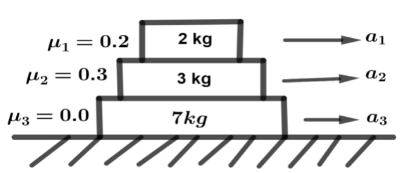
Find the accelerations ${a_1},{a_2},{a_3}$ of the three blocks shown in figure. If a horizontal force of $10N$ is applied on (i) $2kg$ block (ii) $7kg$ block ( Take $g = 10\,m{s^{ - 2}}$). (i.e. find ${a_1},{a_2},{a_3}$ in all three cases).
Answer
 Verified
516k+ views
Hint: From the given data there three accelerations ${a_1},{a_2},{a_3}$ in blocks for these accelerations there is some weight on it and some force is acting upon it. For these accelerations there are three cases, now we are going to solve those three cases and here given some value, $g = 10\,m{s^{ - 2}}$. With all those given data we are going to calculate those three accelerations.
Complete step by step answer:
We are going to calculate acceleration in three cases. If any object to move there must be some force that type of force is friction force. By using friction force and applied force only we are going to calculate those three cases. Here given applied force is
$F = 10\,N \\
\Rightarrow g = 10\,m{s^{ - 2}} \\ $
Case 1: For $2kg$ block
$10 - {f_1} = 2{a_1}$
Using frictional force formula, $f = \mu N$
$10 - {\mu _1}\left( {2g} \right) = 2{a_1}$
Already given ${\mu _1}$ value in diagram, by substituting this value we get,
$10 - 0.2 \times 20 = 2{a_1} \\
\Rightarrow 10 - 4 = 2{a_1} \\
\Rightarrow 2{a_1} = 6 \\
\therefore {a_1} = 3\,m{s^{ - 2}} $
Case: For $3kg$ block,
Using same formula,
${f_1} - {f_2} = 3{a_2} \\
\Rightarrow {\mu _1}\left( {2g} \right) - {\mu _2}\left( {5g} \right) = 3{a_2} \\
\Rightarrow 0.2 \times 20 - 0.3 \times 50 = 3{a_2} \\
\Rightarrow 3{a_2} = - 14 \\
\therefore {a_2} = - \dfrac{{14}}{3} $
Here we get ${a_2}$ value in negative which is not possible for acting force on it.
When $3kg$ and $7kg$ blocks move together, we have
${F_1} = 7a \\
\therefore a = \dfrac{4}{7}\,m{s^{ - 2}} \\ $
Where accelerations ${a_2} = {a_3} = \dfrac{4}{7}\,m{s^{ - 2}}$ are the same.
Now we are going to calculate case (2) in maximum force,
${f_{2\max }} = {\mu _2}\left( {5g} \right) = 0.3 \times 50 = 15N \\
\Rightarrow {f_{1\max }} = {\mu _1}\left( {2g} \right) = 0.2 \times 20 = 4N \\ $
Here the pseudo force is acting on the force which is less than ${f_{1\max }}$
Now by applying all three forces together, we get
${a_1} = {a_2} = {a_3} = a$
This means,
$F - {m_1}a = \left( {7 + 3 + 2} \right)a \\
\Rightarrow 10 - 2a = 12a \\
\Rightarrow 14a = 10 \\
\therefore a = \dfrac{5}{7}\,m{s^{ - 2}} $
Case3: when all the blocks move together,
${a_1} = {a_2} = {a_3} = a$ by bringing all blocks, we get
$\Rightarrow F - {m_1}a - {m_2}a = \left( {7 + 3 + 2} \right)a \\
\Rightarrow 10 - 2a - 3a = 12a \\
\Rightarrow 17a = 10 \\
\therefore a = \dfrac{{10}}{{17}}\,m{s^{ - 2}}$
In all three cases we have proved the accelerations.
Note: From the given data we have proved it in three cases, in case (1) we have proved the acceleration ${a_1}$ and acceleration ${a_2}$ which is not possible. In the second case we have taken the maximum values of force in two types that means ${f_{1\max }}$ and ${f_{2\max }}$. In the third case we have brought all the blocks together and calculated the acceleration in the joint. Thus we have proven all the three accelerations.
Complete step by step answer:
We are going to calculate acceleration in three cases. If any object to move there must be some force that type of force is friction force. By using friction force and applied force only we are going to calculate those three cases. Here given applied force is
$F = 10\,N \\
\Rightarrow g = 10\,m{s^{ - 2}} \\ $
Case 1: For $2kg$ block
$10 - {f_1} = 2{a_1}$
Using frictional force formula, $f = \mu N$
$10 - {\mu _1}\left( {2g} \right) = 2{a_1}$
Already given ${\mu _1}$ value in diagram, by substituting this value we get,
$10 - 0.2 \times 20 = 2{a_1} \\
\Rightarrow 10 - 4 = 2{a_1} \\
\Rightarrow 2{a_1} = 6 \\
\therefore {a_1} = 3\,m{s^{ - 2}} $
Case: For $3kg$ block,
Using same formula,
${f_1} - {f_2} = 3{a_2} \\
\Rightarrow {\mu _1}\left( {2g} \right) - {\mu _2}\left( {5g} \right) = 3{a_2} \\
\Rightarrow 0.2 \times 20 - 0.3 \times 50 = 3{a_2} \\
\Rightarrow 3{a_2} = - 14 \\
\therefore {a_2} = - \dfrac{{14}}{3} $
Here we get ${a_2}$ value in negative which is not possible for acting force on it.
When $3kg$ and $7kg$ blocks move together, we have
${F_1} = 7a \\
\therefore a = \dfrac{4}{7}\,m{s^{ - 2}} \\ $
Where accelerations ${a_2} = {a_3} = \dfrac{4}{7}\,m{s^{ - 2}}$ are the same.
Now we are going to calculate case (2) in maximum force,
${f_{2\max }} = {\mu _2}\left( {5g} \right) = 0.3 \times 50 = 15N \\
\Rightarrow {f_{1\max }} = {\mu _1}\left( {2g} \right) = 0.2 \times 20 = 4N \\ $
Here the pseudo force is acting on the force which is less than ${f_{1\max }}$
Now by applying all three forces together, we get
${a_1} = {a_2} = {a_3} = a$
This means,
$F - {m_1}a = \left( {7 + 3 + 2} \right)a \\
\Rightarrow 10 - 2a = 12a \\
\Rightarrow 14a = 10 \\
\therefore a = \dfrac{5}{7}\,m{s^{ - 2}} $
Case3: when all the blocks move together,
${a_1} = {a_2} = {a_3} = a$ by bringing all blocks, we get
$\Rightarrow F - {m_1}a - {m_2}a = \left( {7 + 3 + 2} \right)a \\
\Rightarrow 10 - 2a - 3a = 12a \\
\Rightarrow 17a = 10 \\
\therefore a = \dfrac{{10}}{{17}}\,m{s^{ - 2}}$
In all three cases we have proved the accelerations.
Note: From the given data we have proved it in three cases, in case (1) we have proved the acceleration ${a_1}$ and acceleration ${a_2}$ which is not possible. In the second case we have taken the maximum values of force in two types that means ${f_{1\max }}$ and ${f_{2\max }}$. In the third case we have brought all the blocks together and calculated the acceleration in the joint. Thus we have proven all the three accelerations.
Recently Updated Pages
Master Class 11 Computer Science: Engaging Questions & Answers for Success

Master Class 11 Business Studies: Engaging Questions & Answers for Success
Master Class 11 Economics: Engaging Questions & Answers for Success
Master Class 11 English: Engaging Questions & Answers for Success
Master Class 11 Maths: Engaging Questions & Answers for Success
Master Class 11 Biology: Engaging Questions & Answers for Success
Trending doubts
One Metric ton is equal to kg A 10000 B 1000 C 100 class 11 physics CBSE
There are 720 permutations of the digits 1 2 3 4 5 class 11 maths CBSE
Discuss the various forms of bacteria class 11 biology CBSE
Draw a diagram of a plant cell and label at least eight class 11 biology CBSE
State the laws of reflection of light
Explain zero factorial class 11 maths CBSE