




How do you find six trigonometric functions for ${{60}^{\circ }}$ ?
Answer
 Verified
560.7k+ views
Hint: We have been asked to find all six trigonometric functions, which are sine, cosine, tangent, cosecant, secant and cotangent for ${{60}^{\circ }}$. Now, we will start by computing functions $\sin {{60}^{\circ }},\cos {{60}^{\circ }}\text{ and }\tan {{60}^{\circ }}$ and then using reciprocal identity, we will compute the other three functions as well. We must know that ${{60}^{\circ }}$ is a standard angle and the value is known. For example, we know that $\sin {{60}^{\circ }}=\dfrac{\sqrt{3}}{2}$ . Similarly, we can recollect the rest and obtain the final answers.
Complete step by step answer:
Let us begin with the solution by understanding the trigonometric functions. We have six trigonometric functions namely – sine, cosine, tangent, cosecant, secant and cotangent. These can be abbreviated as sin, cos, tan, cosec, sec and cot respectively.
For obtaining the functions, we can draw a right-angled triangle and label the sides as perpendicular, hypotenuse and base.
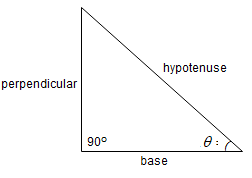
Now, we can write the trigonomeric functions as
$\begin{align}
& \sin \theta =\dfrac{perpendicular}{hypotenuse} \\
& \cos \theta =\dfrac{base}{hypotenuse} \\
& \tan \theta =\dfrac{perpendicular}{base} \\
\end{align}$
We have the reciprocal identity as per which functions sine and cosecant, cosine and secant and tangent and cotangent are reciprocals of each other. Mathematically, we can write as
$\begin{align}
& \sin \theta =\dfrac{1}{\operatorname{cosec}\theta } \\
& \cos \theta =\dfrac{1}{\sec \theta } \\
& \tan \theta =\dfrac{1}{\cot \theta } \\
\end{align}$
We have a table available using which we can find the value of these functions at standard angles - ${{0}^{\circ }},{{30}^{\circ }},{{45}^{\circ }},{{60}^{\circ }},{{90}^{\circ }}$ .
Now that we have an idea of the functions, let us go ahead and obtain the values from the above table.
So, for the angle ${{60}^{\circ }}$, we have the trigonometric functions as
$\begin{align}
& \sin {{60}^{\circ }}=\dfrac{\sqrt{3}}{2} \\
& \cos {{60}^{\circ }}=\dfrac{1}{2} \\
& \tan {{60}^{\circ }}=\sqrt{3} \\
\end{align}$
Using reciprocal identity, we get
\[\begin{align}
& \operatorname{cosec}{{60}^{\circ }}=\dfrac{1}{\sin {{60}^{\circ }}}=\dfrac{2}{\sqrt{3}} \\
& \sec {{60}^{\circ }}=\dfrac{1}{\cos {{60}^{\circ }}}=2 \\
& \cot {{60}^{\circ }}=\dfrac{1}{\tan {{60}^{\circ }}}=\dfrac{1}{\sqrt{3}} \\
\end{align}\]
Note: We have to memorise the values of three functions sine, cosine and tangent for all standard angles. To recollect the values, we have to first draw the skeleton table with functions and angles. Then we can start filling in values. So we will start with $\sin {{0}^{\circ }}$ as 0 and $\sin {{90}^{\circ }}$ as 1. Then, we will fill $\sin {{45}^{\circ }}=\dfrac{1}{\sqrt{2}}$ . We need to note that values of sin increase as angle increases, so $\sin {{30}^{\circ }}$ would be $\dfrac{1}{2}$ and $\sin {{60}^{\circ }}$ would be $\dfrac{\sqrt{3}}{2}$ . The values for sin and cos are opposite for all angles except ${{45}^{\circ }}$ and so we can fill up cos as well. For tan, we have to apply the formula $\tan \theta =\dfrac{\sin \theta }{\cos \theta }$ .
Complete step by step answer:
Let us begin with the solution by understanding the trigonometric functions. We have six trigonometric functions namely – sine, cosine, tangent, cosecant, secant and cotangent. These can be abbreviated as sin, cos, tan, cosec, sec and cot respectively.
For obtaining the functions, we can draw a right-angled triangle and label the sides as perpendicular, hypotenuse and base.
Now, we can write the trigonomeric functions as
$\begin{align}
& \sin \theta =\dfrac{perpendicular}{hypotenuse} \\
& \cos \theta =\dfrac{base}{hypotenuse} \\
& \tan \theta =\dfrac{perpendicular}{base} \\
\end{align}$
We have the reciprocal identity as per which functions sine and cosecant, cosine and secant and tangent and cotangent are reciprocals of each other. Mathematically, we can write as
$\begin{align}
& \sin \theta =\dfrac{1}{\operatorname{cosec}\theta } \\
& \cos \theta =\dfrac{1}{\sec \theta } \\
& \tan \theta =\dfrac{1}{\cot \theta } \\
\end{align}$
We have a table available using which we can find the value of these functions at standard angles - ${{0}^{\circ }},{{30}^{\circ }},{{45}^{\circ }},{{60}^{\circ }},{{90}^{\circ }}$ .
| ${{0}^{\circ }}$ | ${{30}^{\circ }}$ | \[{{45}^{\circ }}\] | ${{60}^{\circ }}$ | ${{90}^{\circ }}$ | |
| sin | 0 | $\dfrac{1}{2}$ | $\dfrac{1}{\sqrt{2}}$ | $\dfrac{\sqrt{3}}{2}$ | 1 |
| cos | 1 | $\dfrac{\sqrt{3}}{2}$ | $\dfrac{1}{\sqrt{2}}$ | $\dfrac{1}{2}$ | 0 |
| tan | 0 | $\dfrac{1}{\sqrt{3}}$ | 1 | $\sqrt{3}$ | Not defined |
Now that we have an idea of the functions, let us go ahead and obtain the values from the above table.
So, for the angle ${{60}^{\circ }}$, we have the trigonometric functions as
$\begin{align}
& \sin {{60}^{\circ }}=\dfrac{\sqrt{3}}{2} \\
& \cos {{60}^{\circ }}=\dfrac{1}{2} \\
& \tan {{60}^{\circ }}=\sqrt{3} \\
\end{align}$
Using reciprocal identity, we get
\[\begin{align}
& \operatorname{cosec}{{60}^{\circ }}=\dfrac{1}{\sin {{60}^{\circ }}}=\dfrac{2}{\sqrt{3}} \\
& \sec {{60}^{\circ }}=\dfrac{1}{\cos {{60}^{\circ }}}=2 \\
& \cot {{60}^{\circ }}=\dfrac{1}{\tan {{60}^{\circ }}}=\dfrac{1}{\sqrt{3}} \\
\end{align}\]
Note: We have to memorise the values of three functions sine, cosine and tangent for all standard angles. To recollect the values, we have to first draw the skeleton table with functions and angles. Then we can start filling in values. So we will start with $\sin {{0}^{\circ }}$ as 0 and $\sin {{90}^{\circ }}$ as 1. Then, we will fill $\sin {{45}^{\circ }}=\dfrac{1}{\sqrt{2}}$ . We need to note that values of sin increase as angle increases, so $\sin {{30}^{\circ }}$ would be $\dfrac{1}{2}$ and $\sin {{60}^{\circ }}$ would be $\dfrac{\sqrt{3}}{2}$ . The values for sin and cos are opposite for all angles except ${{45}^{\circ }}$ and so we can fill up cos as well. For tan, we have to apply the formula $\tan \theta =\dfrac{\sin \theta }{\cos \theta }$ .
Recently Updated Pages
Master Class 10 Computer Science: Engaging Questions & Answers for Success

Master Class 10 General Knowledge: Engaging Questions & Answers for Success
Master Class 10 English: Engaging Questions & Answers for Success
Master Class 10 Social Science: Engaging Questions & Answers for Success
Master Class 10 Maths: Engaging Questions & Answers for Success
Master Class 10 Science: Engaging Questions & Answers for Success
Trending doubts
Explain the Treaty of Vienna of 1815 class 10 social science CBSE
What is the median of the first 10 natural numbers class 10 maths CBSE
Who Won 36 Oscar Awards? Record Holder Revealed
What is the name of Japan Parliament?
Why is it 530 pm in india when it is 1200 afternoon class 10 social science CBSE
Select the word that is correctly spelled a Twelveth class 10 english CBSE