




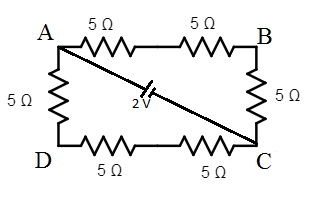
Find potential difference between A and B
A. $\dfrac{2}{3}$ V
B. $\dfrac{8}{9}$ V
C. $\dfrac{4}{3}$ V
Answer
 Verified
589.8k+ views
Hint: We need to find the total current that the connected battery drives in the circuit. For this, first determine the total equivalent resistance of the circuit. The current gets divided into two branches so the potential difference will be the product of concerned resistances and the current in the branch.
Formula used:
Equivalent resistance in series combination:
$R = R_1 + R_2$ .
Equivalent resistance in parallel combination:
$\dfrac{1}{R} = \dfrac{1}{R_1} \dfrac{1}{R_2}$ .
Complete step by step answer:
The given circuit has two branches, which are exactly the same. The given circuit can also be redrawn as shown below.
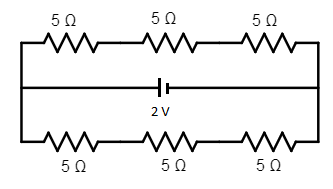
Now in any one branch, there are three 5 $\Omega$ resistances in series which gives a total of 15 $\Omega$ for one branch.
The two branches ADC and ABC are in parallel combination which will give an equivalent resistance for the entire circuit as:
$\dfrac{1}{R} = \dfrac{1}{15} + \dfrac{1}{15}$
$\implies R = \dfrac{15 \times 15}{15 + 15} = \dfrac{15}{2} \Omega$.
Therefore, the equivalent resistance of the entire circuit is $\dfrac{15}{2} \Omega$. The current drawn by this circuit from a battery of 2V can be written as:
$I = \dfrac{2 V}{(15/2) \Omega} = \dfrac{4}{15} A$.
This current gets divided into two equal branches so that the current in one branch is given by:
$I' = \dfrac{2}{15} A$.
To find out the potential difference across AB, we simply multiply the resistance(s) with current. As there are two $5 \Omega$ resistances between A and B giving an equivalent of $10 \Omega$, the potential difference is written as:
$V = \dfrac{2}{15} \times 10 = \dfrac{4}{3} V$.
Therefore, the correct answer is option (C).
Note:
For this question, one must remember that current gets divided when there is a parallel network involved and it remains the same for a series network. In a parallel network potential difference always remains the same.
Formula used:
Equivalent resistance in series combination:
$R = R_1 + R_2$ .
Equivalent resistance in parallel combination:
$\dfrac{1}{R} = \dfrac{1}{R_1} \dfrac{1}{R_2}$ .
Complete step by step answer:
The given circuit has two branches, which are exactly the same. The given circuit can also be redrawn as shown below.
Now in any one branch, there are three 5 $\Omega$ resistances in series which gives a total of 15 $\Omega$ for one branch.
The two branches ADC and ABC are in parallel combination which will give an equivalent resistance for the entire circuit as:
$\dfrac{1}{R} = \dfrac{1}{15} + \dfrac{1}{15}$
$\implies R = \dfrac{15 \times 15}{15 + 15} = \dfrac{15}{2} \Omega$.
Therefore, the equivalent resistance of the entire circuit is $\dfrac{15}{2} \Omega$. The current drawn by this circuit from a battery of 2V can be written as:
$I = \dfrac{2 V}{(15/2) \Omega} = \dfrac{4}{15} A$.
This current gets divided into two equal branches so that the current in one branch is given by:
$I' = \dfrac{2}{15} A$.
To find out the potential difference across AB, we simply multiply the resistance(s) with current. As there are two $5 \Omega$ resistances between A and B giving an equivalent of $10 \Omega$, the potential difference is written as:
$V = \dfrac{2}{15} \times 10 = \dfrac{4}{3} V$.
Therefore, the correct answer is option (C).
Note:
For this question, one must remember that current gets divided when there is a parallel network involved and it remains the same for a series network. In a parallel network potential difference always remains the same.
Recently Updated Pages
Basicity of sulphurous acid and sulphuric acid are

Master Class 12 English: Engaging Questions & Answers for Success
Master Class 12 Social Science: Engaging Questions & Answers for Success
Master Class 12 Maths: Engaging Questions & Answers for Success
Master Class 12 Economics: Engaging Questions & Answers for Success
Master Class 12 Physics: Engaging Questions & Answers for Success
Trending doubts
Which are the Top 10 Largest Countries of the World?
Draw a labelled sketch of the human eye class 12 physics CBSE
Draw ray diagrams each showing i myopic eye and ii class 12 physics CBSE
Give 10 examples of unisexual and bisexual flowers
Coming together federation is practiced in A India class 12 social science CBSE
Write the formula to find the shortest distance between class 12 maths CBSE