




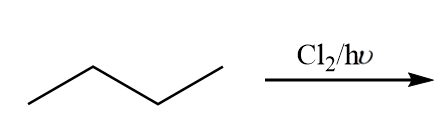
Find out the number of monochlorinated products (including stereoisomers) which are possible in the given reaction.
(A) $2$
(B) $3$
(C) $4$
(D) $5$
Answer
 Verified
591.3k+ views
Hint :The two or more compounds which have the same molecular formula but differ in the arrangement of atoms in the space are known as stereoisomers. The most necessary condition for a compound to show stereoisomerism is that the compound should have at least one chiral carbon i.e., at least one carbon atom which is connected to four different groups.
Complete Step By Step Answer:
The reactant given in the question is n-butane and the attack of chlorine is possible at two positions in the carbon chain. The reactions possible are as follows:
Reaction-1: The attack of chlorine atom at first carbon:
When chlorine attacks the first carbon atom of n-butane in the presence of light, then the formation of 1-chlorobutane takes place along with the removal of $HCl$. The reaction proceeds as follows:

Reaction-2: The attack of chlorine atom at second carbon:
When chlorine attacks the second carbon atom of n-butane in the presence of light, then the formation of 2-chlorobutane takes place along with the removal of $HCl$. The reaction proceeds as follows:
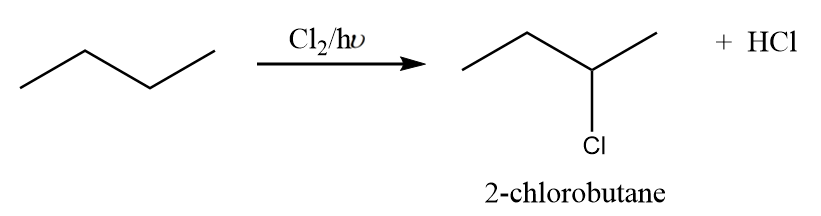
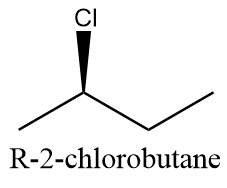
But the compound formed in the reaction i.e., 2-chlorobutane consist of a chiral carbon and thus, it will exist in its two absolute configurations which are as follows:
R-configuration: when chlorine atoms attack above the plane. The compound will be as follows:
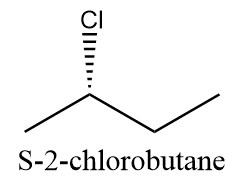
S-configuration: when chlorine atoms attack the chain from below the plane. The compound will be as follows:
Hence, three monochlorinated products (including stereoisomers) are possible for the given reaction.
So, option (B) is the correct answer.
Note :
It is important to note that n-butane is the symmetrical alkene, so the attack of chlorine on third and fourth carbon will form products identical to that of the first and second atom. Therefore, the attack on carbon third and fourth is not taken into consideration for the given reaction.
Complete Step By Step Answer:
The reactant given in the question is n-butane and the attack of chlorine is possible at two positions in the carbon chain. The reactions possible are as follows:
Reaction-1: The attack of chlorine atom at first carbon:
When chlorine attacks the first carbon atom of n-butane in the presence of light, then the formation of 1-chlorobutane takes place along with the removal of $HCl$. The reaction proceeds as follows:
Reaction-2: The attack of chlorine atom at second carbon:
When chlorine attacks the second carbon atom of n-butane in the presence of light, then the formation of 2-chlorobutane takes place along with the removal of $HCl$. The reaction proceeds as follows:
But the compound formed in the reaction i.e., 2-chlorobutane consist of a chiral carbon and thus, it will exist in its two absolute configurations which are as follows:
R-configuration: when chlorine atoms attack above the plane. The compound will be as follows:
S-configuration: when chlorine atoms attack the chain from below the plane. The compound will be as follows:
Hence, three monochlorinated products (including stereoisomers) are possible for the given reaction.
So, option (B) is the correct answer.
Note :
It is important to note that n-butane is the symmetrical alkene, so the attack of chlorine on third and fourth carbon will form products identical to that of the first and second atom. Therefore, the attack on carbon third and fourth is not taken into consideration for the given reaction.
Recently Updated Pages
Which will be the least stable resonating structure class 11 chemistry CBSE

How many 5 digit telephone numbers can be construc-class-11-maths-CBSE
How do you find the angle of the resultant vector class 11 physics CBSE
Draw labelled diagram of the following i Gram seed class 11 biology CBSE
1 Quintal is equal to a 110 kg b 10 kg c 100kg d 1000 class 11 physics CBSE
What is the need and importance of classification class 11 biology CBSE
Trending doubts
Find the value of the expression given below sin 30circ class 11 maths CBSE
One Metric ton is equal to kg A 10000 B 1000 C 100 class 11 physics CBSE
10 examples of friction in our daily life
Draw a diagram of a plant cell and label at least eight class 11 biology CBSE
Difference between physical and chemical change class 11 chemistry CBSE
Proton was discovered by A Thomson B Rutherford C Chadwick class 11 chemistry CBSE